
Nestable crate for containers
a container and crate technology, applied in the field of nestable crate, can solve the problems of lack of features in many low-depth nestable crates, lack of surface area or vertical sidewall construction, and insufficient surface area of many low-depth crates, etc., and achieve the effect of more efficient storag
- Summary
- Abstract
- Description
- Claims
- Application Information
AI Technical Summary
Benefits of technology
Problems solved by technology
Method used
Image

Examples
first embodiment
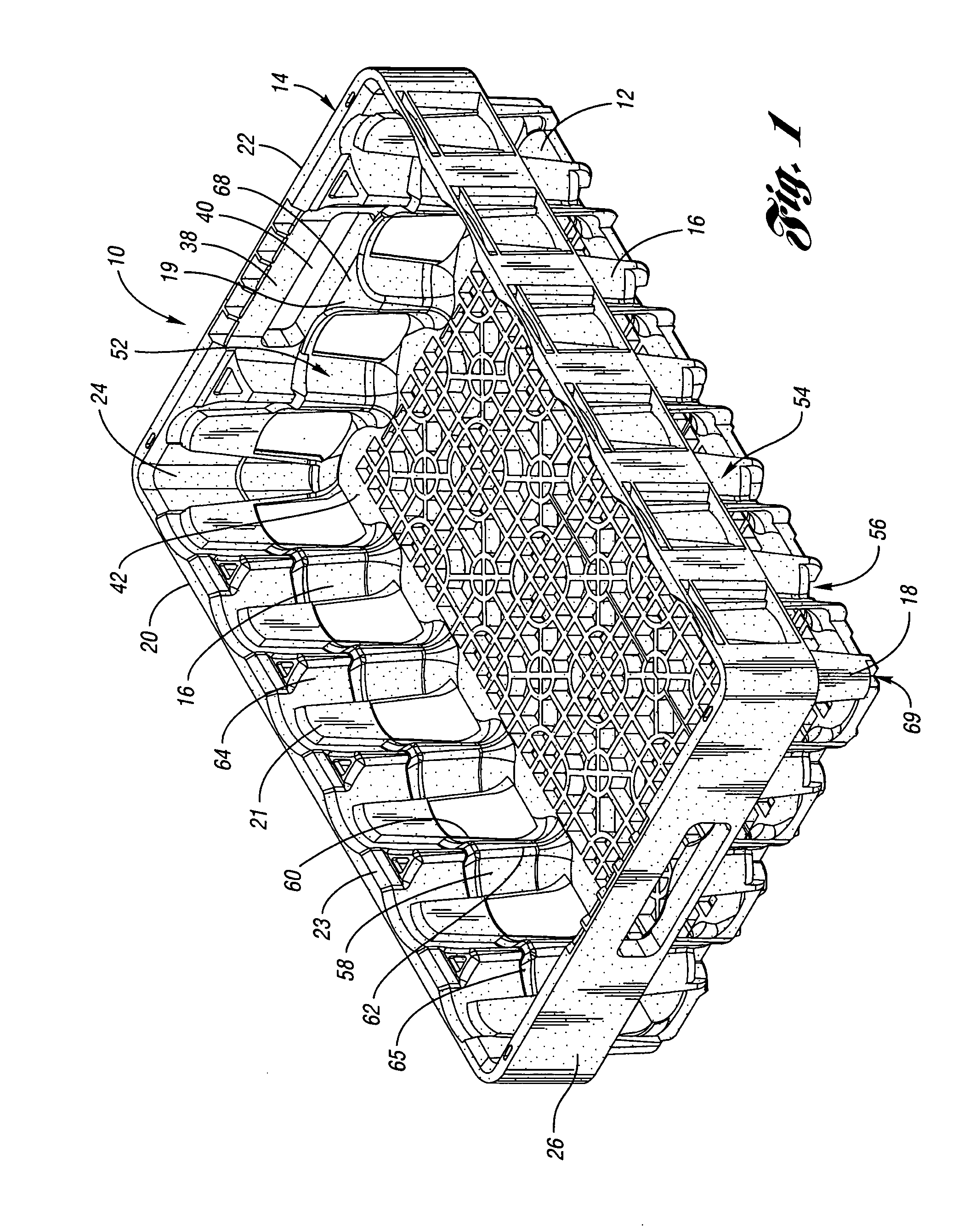
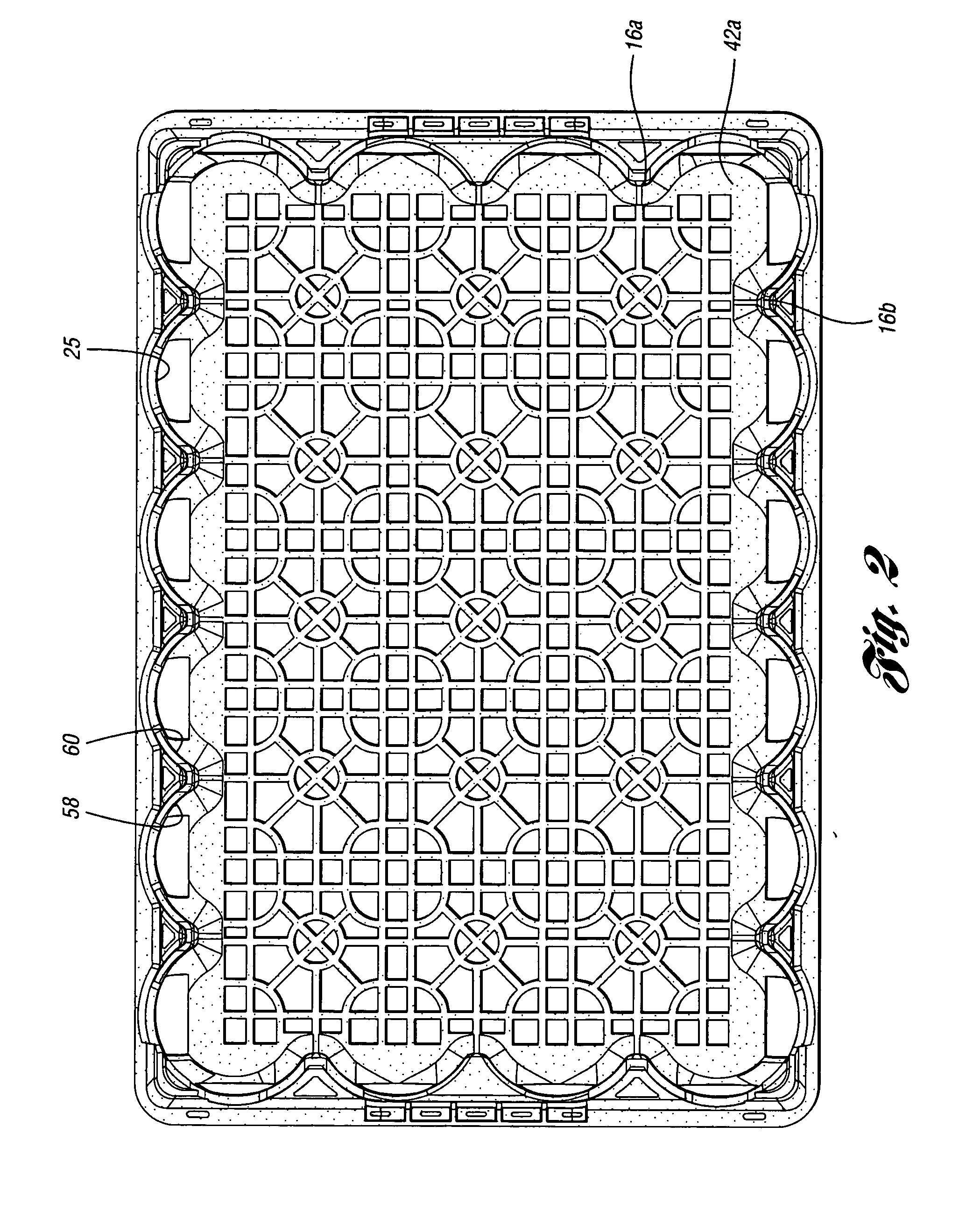
[0040] In accordance with the present invention, provided in FIGS. 1-7 is a nestable bottle crate 10 which is suitable for holding containers 5 (shown as bottles in FIGS. 19-20) therein. Crate 10 is preferably formed from a plastic material, such as high density polyethylene (HDPE), by an injection molding or other suitable plastic molding process. Crate 10 is also preferably formed as a unitary member with all components integrally connected. Containers 5 may be used for beverages and have a generally cylindrical shape. Referring to FIG. 1, crate 10 includes a floor member 12, and also includes a wall structure that has a top band 14 (or upper wall member) and a plurality of columns 16 (or lower wall member) extending around the periphery of the floor member 12 for connecting floor member 12 to top band 14. Columns 16 are arranged along the sides of crate 10. Crate 10 also includes corner column members 18 at each of the corners of crate 10. The wall structure includes sidewalls 20...
second embodiment
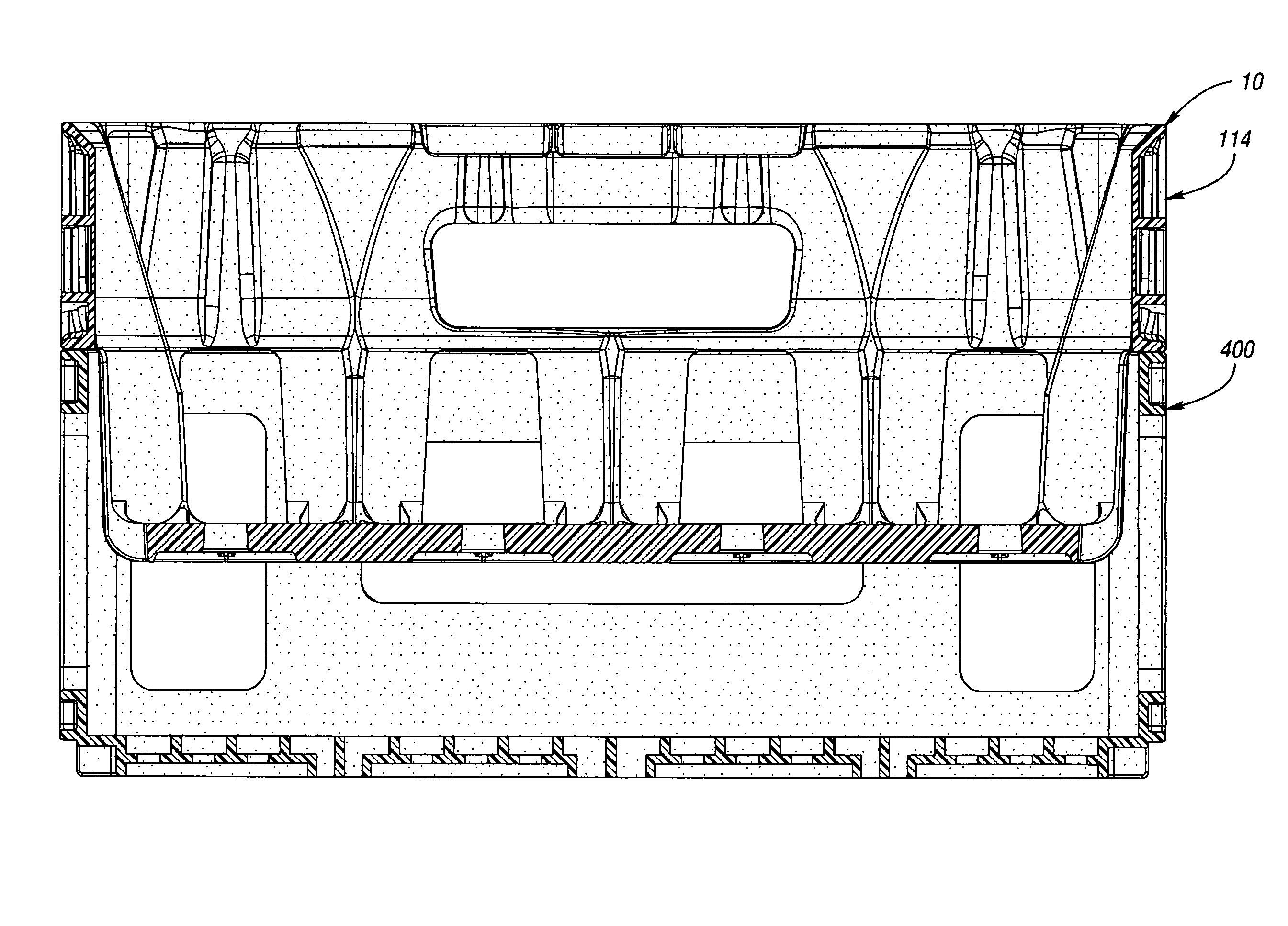
[0052] As previously noted, typical half-depth crates may only stack (not nest) with similar half-depth crates due to their construction, while low-depth crates typically are nested within similar low-depth crates. Thus, crates according to this invention provide for dual application in that it may nest within similar container 210′ (FIG. 19), and it also nests within a half-depth crate 400 of different construction (FIGS. 8a-8b), as illustrated by second embodiment of crate 110. Accordingly, crates according to the present invention provide efficient bottle containment having an optimally sized footprint similar to a non-nestable half-depth crate, while allowing for nestability both with similar crates and with non-nestable half-depth cases having a similar footprint. As shown in FIG. 8b, the outer surface of top band 114 is vertically disposed and co-planar with the outer surface of half-depth crate 400.
[0053]FIGS. 9-20 illustrate a third embodiment of a crate 210 according to the...
PUM
 Login to View More
 Abstract
Description
Claims
Application Information
 Login to View More