
Wet cleaning method to eliminate copper corrosion
- Summary
- Abstract
- Description
- Claims
- Application Information
AI Technical Summary
Benefits of technology
Problems solved by technology
Method used
Image

Examples
Embodiment Construction
[0012] The present invention provides a semiconductor substrate cleaning method that prevents copper corrosion. The cleaning method includes a DI (deionized) water cleaning operation in which the semiconductor substrate, alternatively referred to as a “wafer”, is rotated at a speed of no greater than 350 rpm. As will be discussed, the cleaning method of the present invention may include multiple distinct cleaning operations or steps.
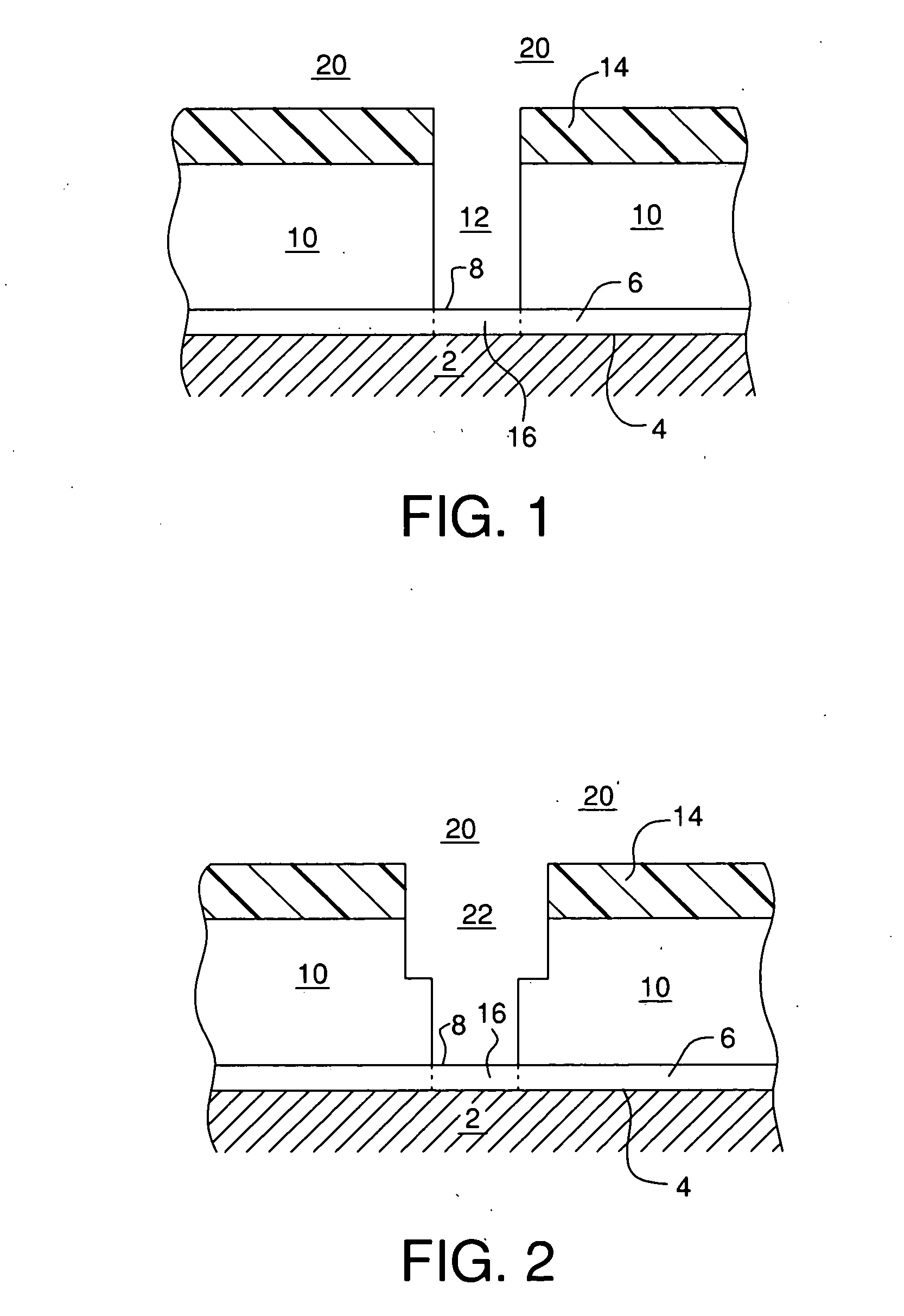
[0013] The wafer cleaning method of the present invention may be used at various stages during the formation of semiconductor devices on the wafer. A particularly advantageous application of the present invention is a cleaning operation used to clean a wafer with a copper-containing conductive material formed thereon and a film directly interposed between the copper containing conductive material and the environment. Such a structure may be produced after an etching operation. FIGS. 1 and 2 are each cross-sectional views of exemplary conventional struct...
PUM
| Property | Measurement | Unit |
|---|---|---|
| Diameter | aaaaa | aaaaa |
| Diameter | aaaaa | aaaaa |
| Angular velocity | aaaaa | aaaaa |
Abstract
Description
Claims
Application Information
 Login to View More