
Common LAN architecture and flow control relay
a technology of flow control relay and common lan, which is applied in the direction of data switching network, multiplex communication, digital transmission, etc., can solve the problems of mismatching data bandwidth between lan and wan, development cost, and failure to work for flow control implementations that work for one lan/wan technology combination,
- Summary
- Abstract
- Description
- Claims
- Application Information
AI Technical Summary
Benefits of technology
Problems solved by technology
Method used
Image

Examples
Embodiment Construction
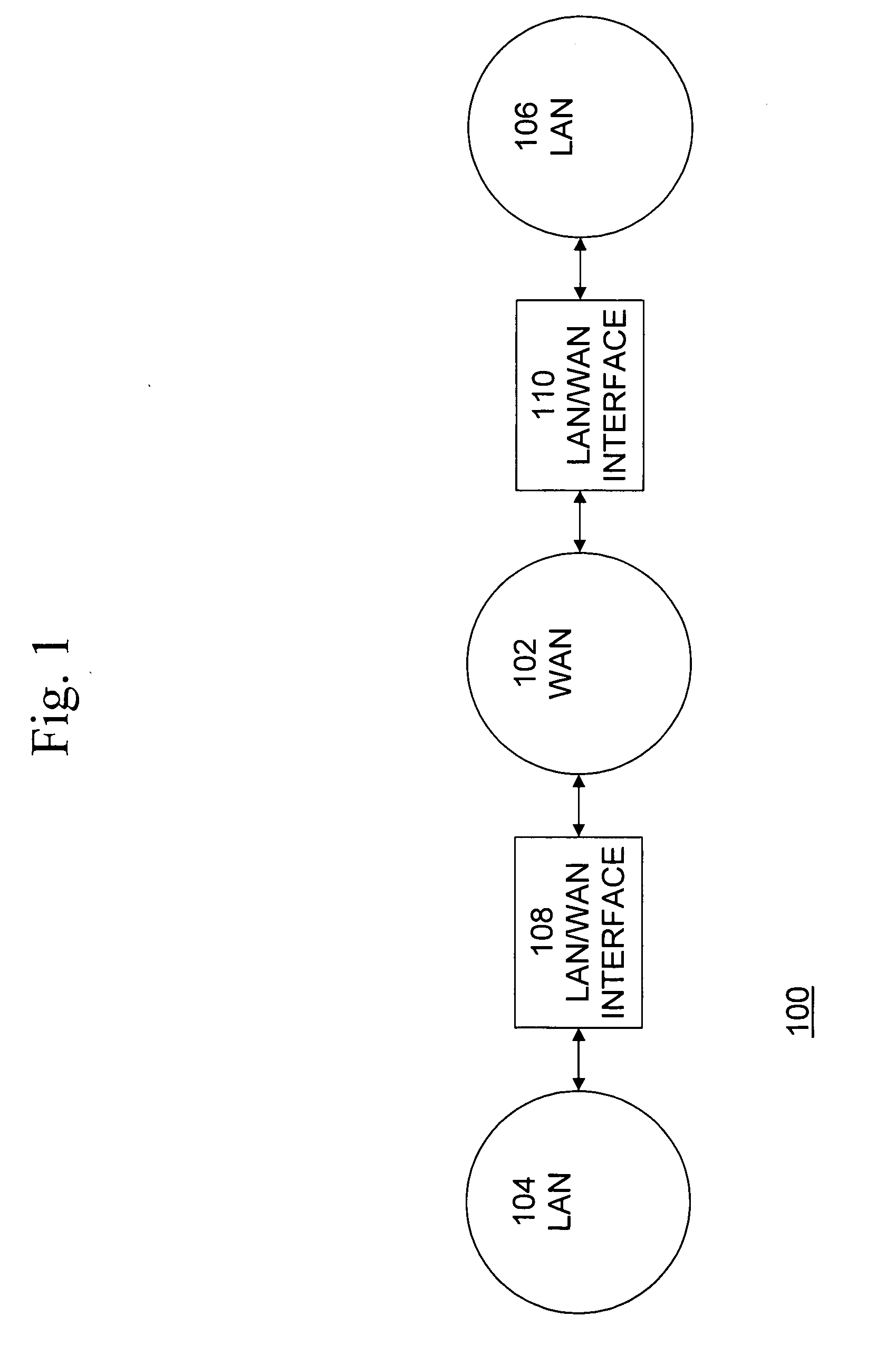
[0012] An exemplary block diagram of a system 100 in which the present invention may be implemented is shown in FIG. 1. System 100 includes a Wide Area Network 102 (WAN), one or more Local Area Networks 104 and 106 (LAN), and one or more LAN / WAN interfaces 108 and 110. A LAN, such as LANs 104 and 106, is a computer network that spans a relatively small area. Most LANs connect workstations and personal computers. Each node (individual computer) in a LAN has its own CPU with which it executes programs, but it also is able to access data and devices anywhere on the LAN. This means that many users can share expensive devices, such as laser printers, as well as data. Users can also use the LAN to communicate with each other, by sending e-mail or engaging in chat sessions.
[0013] There are many different types of LANs, Ethernets being the most common for Personal Computers (PCs). Most Apple Macintosh networks are based on Apple's AppleTalk network system, which is built into Macintosh com...
PUM
 Login to View More
 Abstract
Description
Claims
Application Information
 Login to View More