Unlock instant, AI-driven research and patent intelligence for your innovation.

Device for directing mortar droppings/debris, protecting a drainage weep device and draining water from a single wythe wall, the single wythe wall provided with the device, and method of draining water from the single wythe wall

a technology for directing mortar droppings and debris, which is applied in the direction of construction, building components, foundation engineering, etc., can solve the problems of mortar droppings, moisture/water problems, and failure to achieve 100% success ra

Active Publication Date: 2005-07-21
ARGILA ANTHONY
View PDF19 Cites 4 Cited by
  • Summary
  • Abstract
  • Description
  • Claims
  • Application Information

AI Technical Summary

Benefits of technology

[0018] Accordingly, it is an object to the present invention to provide a device for directing mortar droppings / or debris, protecting weep drainage device associated therewith, and draining water from an inner hollow cell of a single wythe wall, which eliminates the disadvantages of the prior art.

Problems solved by technology

These cells are where the moisture / water problems occur.
The location of the droppings, which fall within the hollow block cells, is where the problem occurs.
Even with flashings and weep designs, the mortar droppings occur and clog any passage of water weeping back out of the wall.
It has been attempted to stop moisture penetration through single wythe walls with such materials as integral water repellent admixtures and surface applied coatings, which however have not been 100% successful.
However, since these flat trays are flat or substantially flat, they can accumulate a complete layer from side to side of mortar droppings thereon, cutting off water drainage from weep holes, thus allowing water to accumulate within the cells of the wall and to cause major damage to the block walls by seeping through the inner face shell of the single wythe wall and into the building.
However, BLOCKNET® has the same disadvantages as the other products on the market today.
Disadvantages with this product include the fact that the metal flashing, with a mesh element adhered to it, must be set at the bottom base of wall, prior to any mortar being spread.
The first step potentially presents the major down fall.
Mortar droppings will inevitably occur, and just the procedure of spreading mortar over the flashing, may clog the weep drainage device.
However, this product also sits at the base of the wall with little or no protection from falling mortar droppings and debris from above.
But just as other devices fail because a lack of adequate protection from the mortar droppings caused by the spreading of mortar, this can fail also under mortar accumulation.
But, the necessity for the flashing, at the base, causes a major weakness in the wall, because the mortar doesn't bond to the flashing separating the block courses.

Method used

the structure of the environmentally friendly knitted fabric provided by the present invention; figure 2 Flow chart of the yarn wrapping machine for environmentally friendly knitted fabrics and storage devices; image 3 Is the parameter map of the yarn covering machine
View more

Image

Smart Image Click on the blue labels to locate them in the text.
Viewing Examples
Smart Image
  • Device for directing mortar droppings/debris, protecting a drainage weep device and draining water from a single wythe wall, the single wythe wall provided with the device, and method of draining water from the single wythe wall
  • Device for directing mortar droppings/debris, protecting a drainage weep device and draining water from a single wythe wall, the single wythe wall provided with the device, and method of draining water from the single wythe wall
  • Device for directing mortar droppings/debris, protecting a drainage weep device and draining water from a single wythe wall, the single wythe wall provided with the device, and method of draining water from the single wythe wall

Examples

Experimental program
Comparison scheme
Effect test

Embodiment Construction

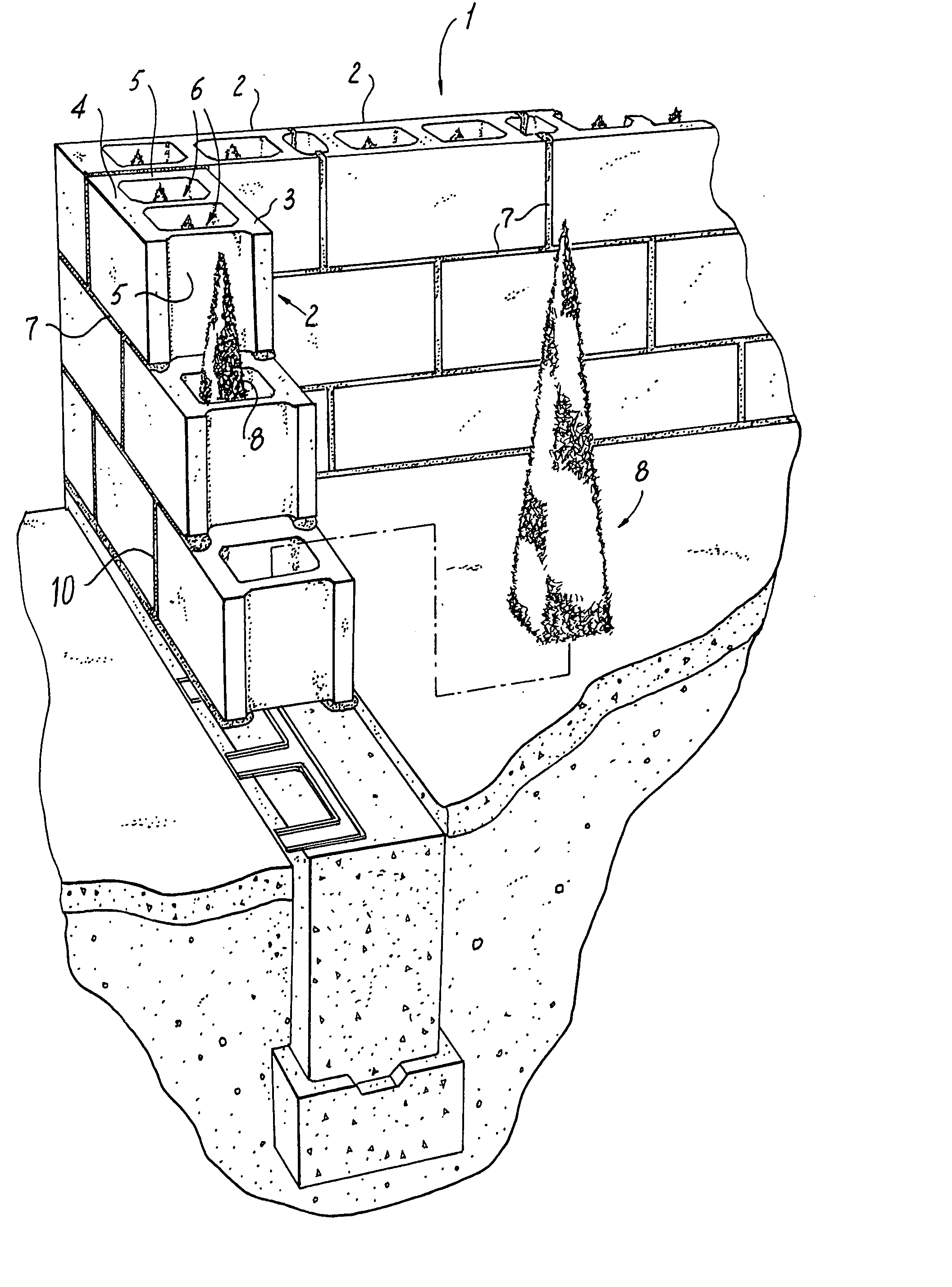
[0045]FIG. 1 is a perspective cutaway view showing a single wythe masonry wall which is identified as a whole with reference numeral 1. The single wythe wall 1 is composed of a plurality of structural masonry elements 2 each formed as an integral structural element or block having an inner face shell 3, an outer face shell 4 and three cross webs 5 forming two inner hollow recesses known in the masonry trade as cells 6, which are separated from one another by the middle cross webs 5.

[0046] The masonry blocks 2 are laid one on top of another with a mortar joint 7 separating the blocks from one another. The mortar joint 7 which separates the blocks is spread on sides of the webs 5 and on the inner and outer face shells 3, 4 when each block is laid. Mortar is placed with a trowel and spillage occurs when the mortar is spread. This spillage is known as mortar droppings. These droppings fall both inside and outside of the hollow block cells. The droppings which fall inside the hollow inn...

the structure of the environmentally friendly knitted fabric provided by the present invention; figure 2 Flow chart of the yarn wrapping machine for environmentally friendly knitted fabrics and storage devices; image 3 Is the parameter map of the yarn covering machine
Login to View More

PUM

No PUM Login to View More

Abstract

A device for protecting weep channels of masonry blocks of a single wythe wall, each block forming at least one inner hollow cell. A plurality of upwardly extending water-permeable bodies is provided for the hollow cells, each of the bodies having a plurality of passages such as to permit water to pass through the passages to prevent passing of mortar and other debris through the passages and to protect the drainage weep hole channels thereof. Preferably each of the bodies has a transverse dimension which decreases upwardly from a lower transverse cross section to cover a draining channel and to direct falling mortar and other debris in the inner hollow cells of each masonry block of the single wythe wall, onto a surface of each of the upwardly extending water-permeable bodies but at the same time to prevent falling of the mortar and other debris in the hollow cells, into a draining channel, whereby water in each of the inner hollow cells can flow through a respective one of the bodies into the drainage weep hole channel and outside.

Description

RELATED APPLICATIONS [0001] This application is based upon provisional patent application No. 60 / 537,734 dated Jan. 20, 2004, and claims benefit under 35 U.S. Code section 119(e).FIELD OF THE INVENTION [0002] The present invention relates to a device for directing mortar droppings / debris from an inner cell / cavity of a single wythe wall and draining water therefrom, to a single wythe wall provided, with the device, and to a method of draining water from a single wythe wall and preventing mortar dropping debris from clogging drainage weep holes therein. BACKGROUND OF THE INVENTION [0003] Although they come in a variety of shapes and sizes, concrete masonry units are generally similar in design. Blocks are generally hollow units made of cement with hollow cores called cells. The outside surfaces of the block units are called face shells, and they are connected by cross webs. Each block generally consists of 2 face shells (inner and outer), 3 cross webs (one at each end and one in the m...

Claims

the structure of the environmentally friendly knitted fabric provided by the present invention; figure 2 Flow chart of the yarn wrapping machine for environmentally friendly knitted fabrics and storage devices; image 3 Is the parameter map of the yarn covering machine
Login to View More

Application Information

Patent Timeline
no application Login to View More
IPC IPC(8): E04B1/70E04B5/04
CPCE04B1/70E04B1/7038E04B1/703
Inventor ARGILA, ANTHONY
Owner ARGILA ANTHONY