Ski boot

a technology for ski boots and boots, applied in the field of ski boots, can solve the problems of ski boots continuing to soften, general pain in the front of the foot, and leather becoming too soft, and achieve the effects of enhancing the comfort of the boot, good lateral support, and avoiding the proximity of stiff materials

a technology for ski boots and boots, applied in the field of ski boots, can solve the problems of ski boots continuing to soften, general pain in the front of the foot, and leather becoming too soft, and achieve the effects of enhancing the comfort of the boot, good lateral support, and avoiding the proximity of stiff materials

US20050178028A1Inactive Publication Date: 2005-08-18LIGHT J THOMAS

Image

Smart Image Click on the blue labels to locate them in the text.
Viewing Examples
Smart Image
  • Ski boot
  • Ski boot
  • Ski boot

Examples

Experimental program
Comparison scheme
Effect test

Embodiment Construction

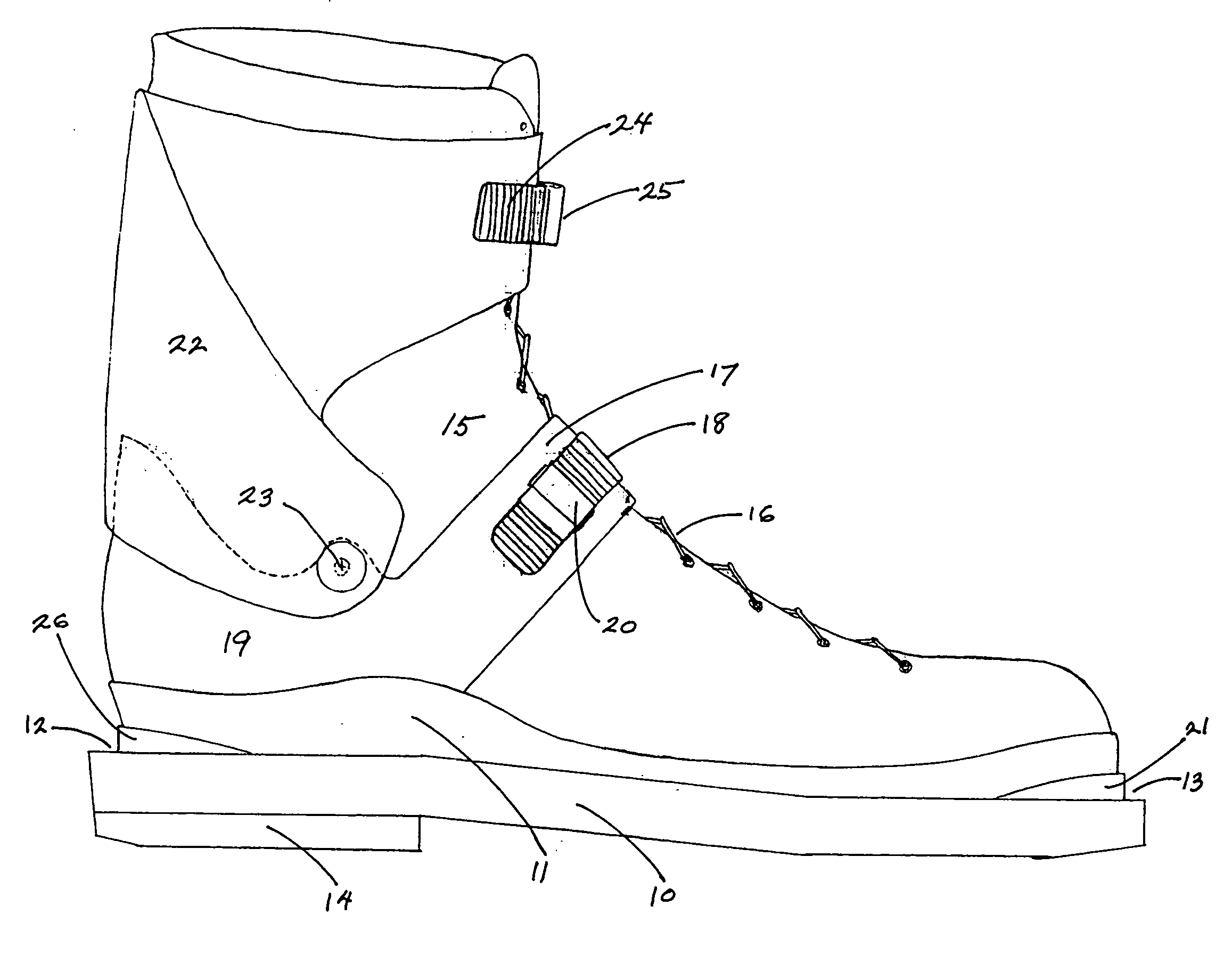
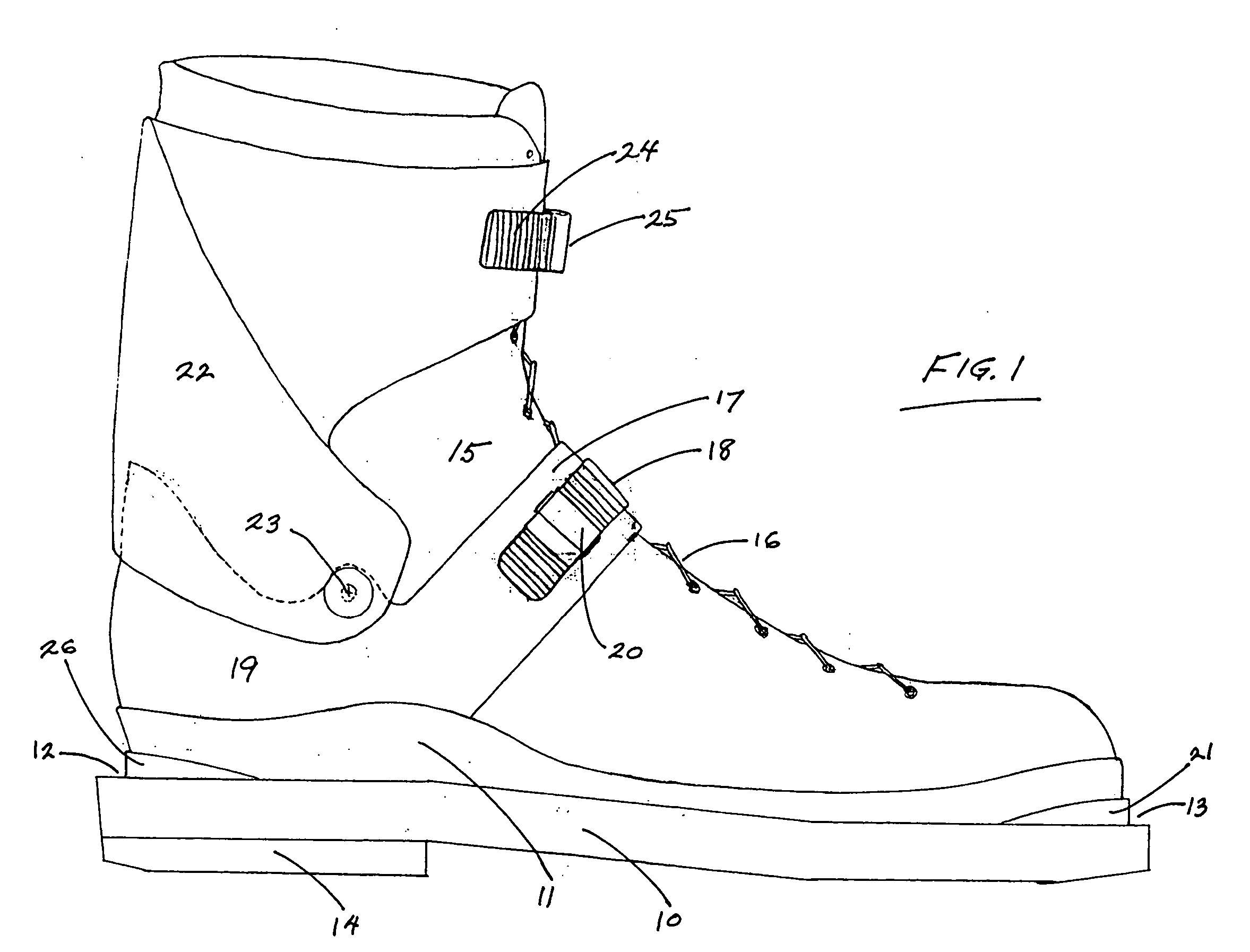
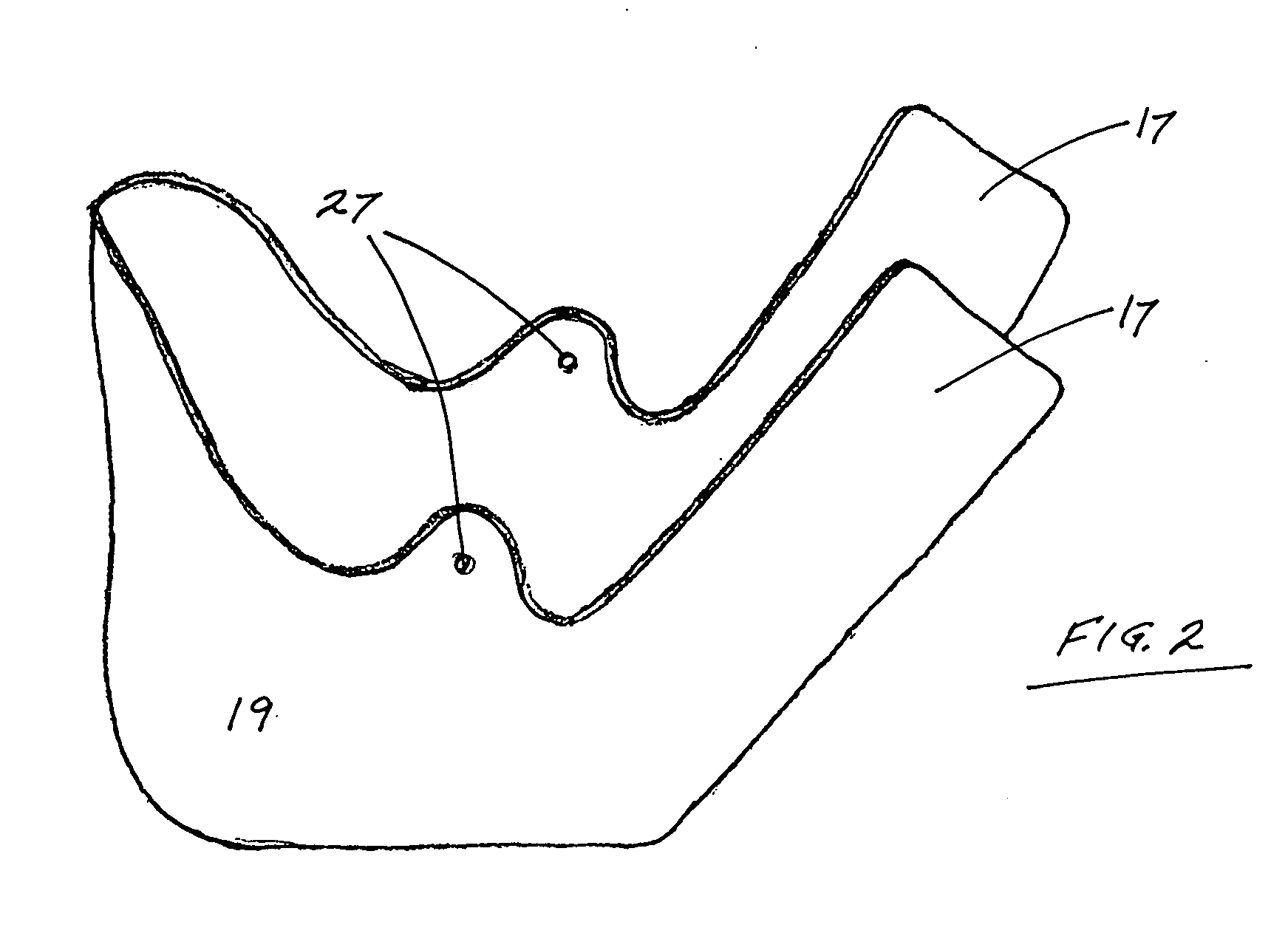
[0028] One embodiment of an alpine ski boot according to the present invention is shown in FIG. 1. Referring to FIG. 1, the ski boot has a shell-less and substantially flexible upper portion 15. The upper portion may be comprised of any appropriate flexible material, including for example leather, canvas, fabrics, flexible elastomers or plastics, or combinations of these materials. If desired, the upper portion may include layers or linings comprised of flexible materials such as fabrics of natural or synthetic fibers, canvas, rubber, neoprene, vinyl or flexible plastics. Referring also to FIG. 2, a semi-rigid plastic support piece 19 surrounds externally, on three sides, the back of the upper portion 15 in the heel region, excluding the anklebone areas. The support piece is preferably molded of a moderately flexible elastomer such as polypropylene or nylon. The support piece has a pivot point 27 on each of two sides at opposite locations below the anklebone areas and has two semi-r...

the structure of the environmentally friendly knitted fabric provided by the present invention; figure 2 Flow chart of the yarn wrapping machine for environmentally friendly knitted fabrics and storage devices; image 3 Is the parameter map of the yarn covering machine
Login to View More

PUM

PropertyMeasurementUnit
flexibleaaaaaaaaaa
interface areaaaaaaaaaaa
thickaaaaaaaaaa
Login to View More

Abstract

An alpine ski boot is provided that consists of a rigid sole and a shell-less substantially flexible upper portion that is attached to the sole. The upper portion is partially reinforced around the lower heel area by a semi-rigid plastic support piece that surrounds, on three sides, the lower heel region, excluding the anklebone areas. The support piece has a pivot point on each of two sides at opposite locations below the anklebone areas and two semi-rigid mid-foot region securing ears. The boot is secured to the wearer's foot by laces or buckles. The boot is further secured to the wearer's foot by closure of the semi-rigid mid-foot securing ears by closure means such as a lever actuated ribbed nylon strap attached to an adjustable buckle. The sole is comprised of rigid plastic and the heel and toe portions of the sole may be manufactured to conform to the requirements of ISO 5355 for ski boots. The ski boot has a cuff pivotally attached to the support piece at the two pivot points, wherein the cuff surrounds the upper portion of the ski boot at a location above the region of the anklebones and has a closure means such as a lever actuated ribbed nylon strap connecting to an adjustable buckle. The cuff follows the movement of the lower leg and provides lateral support to the ankle while introducing minimal or no restriction to the fore and aft flexion of the ankle.

Description

FIELD OF THE INVENTION [0001] This invention relates to ski boots and in particular to ski boots that may be used with downhill, or alpine skis, that are equipped with safety-release bindings. The invention also relates to ski boots that are more readily compatible with certain alpine skiing techniques that date to the era before the invention of plastic ski boots and that are difficult or impossible to perform with plastic ski boots. BACKGROUND [0002] Before the advent of the plastic ski boot in the mid-1960's, all alpine skiers used boots constructed of leather. To provide support, the leather in the lower part of the boot was several layers thick and generally quite stiff. New leather boots required a period of break-in to soften the leather and to improve the comfort of the boots. Once broken-in, leather boots were generally quite comfortable. [0003] In addition to serving as the attachment means between the feet and the skis, the leather boots fulfilled two very important funct...

Claims

the structure of the environmentally friendly knitted fabric provided by the present invention; figure 2 Flow chart of the yarn wrapping machine for environmentally friendly knitted fabrics and storage devices; image 3 Is the parameter map of the yarn covering machine
Login to View More

Application Information

Patent Timeline
18 Aug 2005
Publication
US20050178028A1
IPC
A43B5/04; A43B7/20
CPC
A43B5/04; A43B5/0482; A43B23/17; A43B5/0488; A43B7/1495; A43B7/20
Inventors
LIGHT, J. THOMAS