
Image formation assisting device, image formation assisting method, and image formation assisting system
a technology of image data and ctp method, applied in the direction of visual presentation using printers, digital output to print units, instruments, etc., can solve the problem that the image data of the ctp method cannot be used in conjunction with the image data for on-demand printing
- Summary
- Abstract
- Description
- Claims
- Application Information
AI Technical Summary
Benefits of technology
Problems solved by technology
Method used
Image

Examples
embodiment 1
[0039] One example of the an embodiment of the present invention will be described in detail with reference to the drawings.
[Image Forming System]
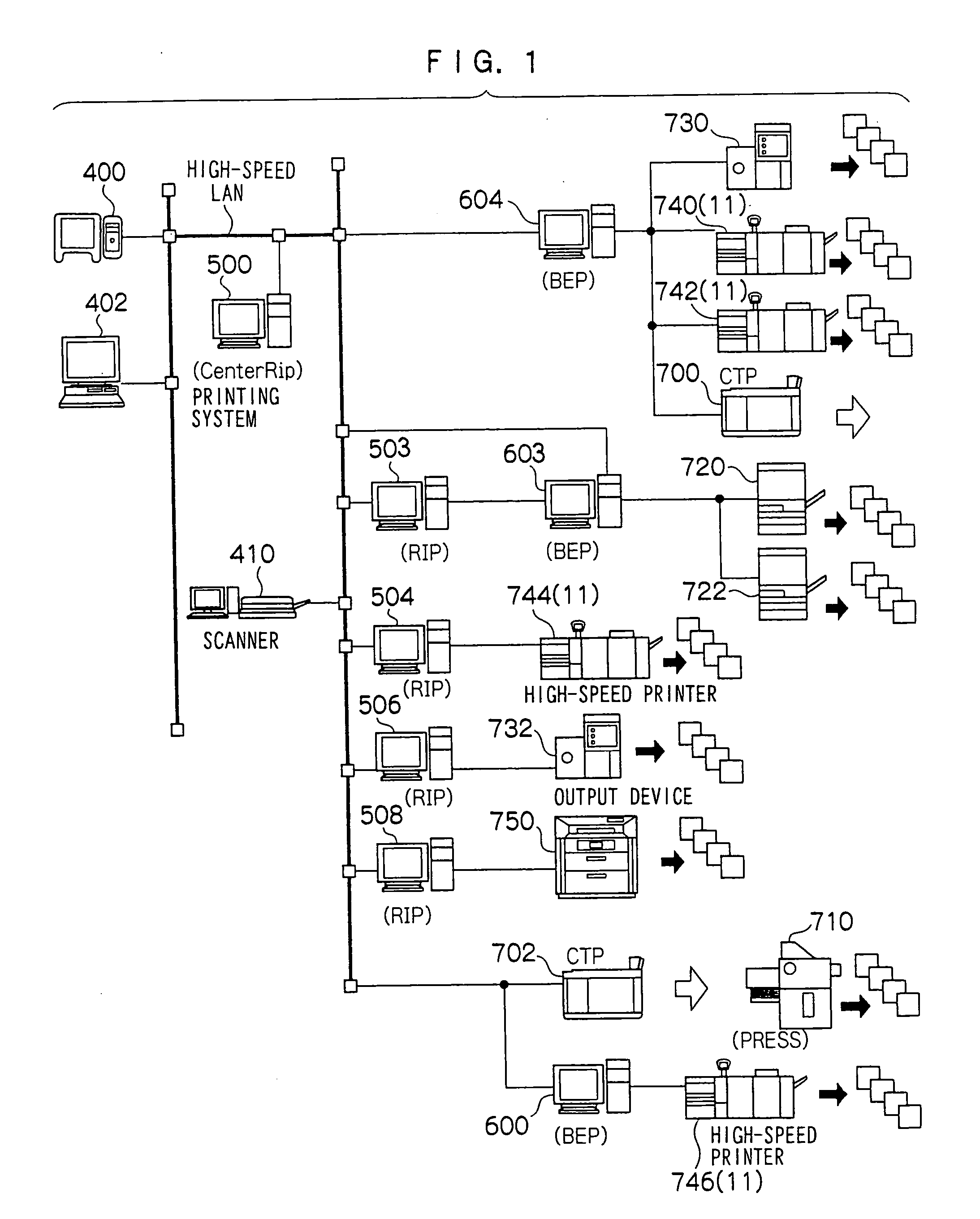
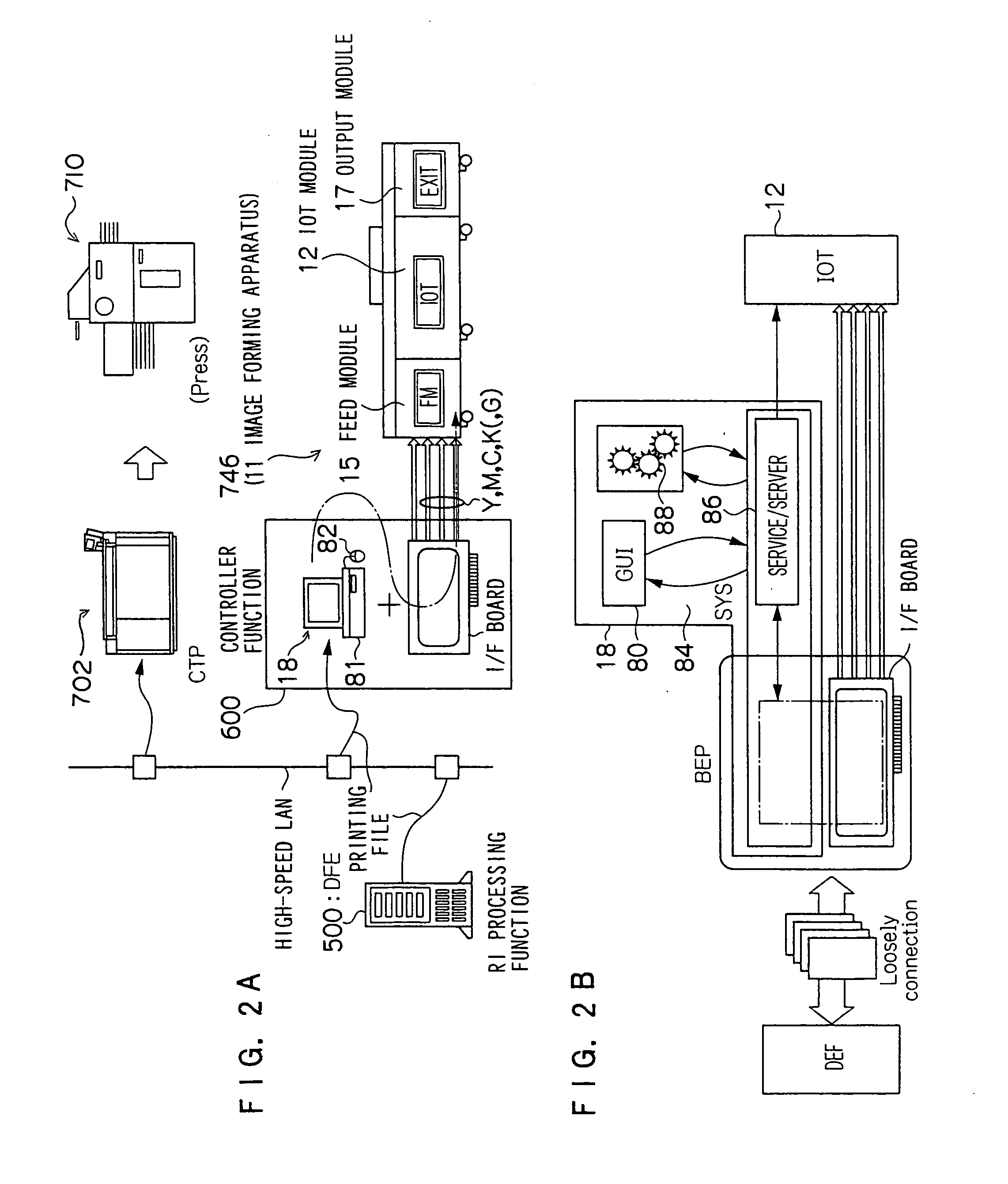
[0040]FIG. 1 is an illustration to show the general configuration of an image forming system in accordance as a result embodiment. The image forming system has a high-speed LAN (Local Area Network) using a general-purpose communications protocol and client terminals 400 and 402 for inputting electronic data (printing data) described in, for example, a page description language (PDL) are connected to the high-speed LAN. The client terminals 400 and 402 are computers capable of executing various kinds of application programs under different operating systems (OS). A scanner 410, which reads an image on an original document and outputs the data of the image, is also connected to the high-speed LAN. Further, DFE processors 500, 503, 504, 506, and 508, BEPs (back end processor) 600, 603, and 604 as an image formation assisting device of the i...
embodiment 2
[0102] Another example of the embodiment of the invention will be described in detail with reference to the drawings.
[0103] Since the image forming system and the configuration example are the same as those in the embodiment 1, their descriptions will be omitted, and the same elements are denoted by the same reference symbols.
[0104] The embodiment 1 does not present any problem in the case of printing an image only on the top of the paper, but when an image is also printed on the bottom of the paper, the image to be printed on the bottom of the paper is outputted from another plate. Hence, in this embodiment, further, the BEP 600 ascertains the allocated layout of each plate, position information, instruction of the printing side (top (front) and / or bottom (back)) of the paper to be provided to the engine side, and the page sequence of the engine side, and sorts the respective electronically edited images from the image data of a large size also in consideration of the printing si...
embodiment 3
[0125] Hereafter, still another example of an embodiment of the invention will be described in detail with reference to the drawings.
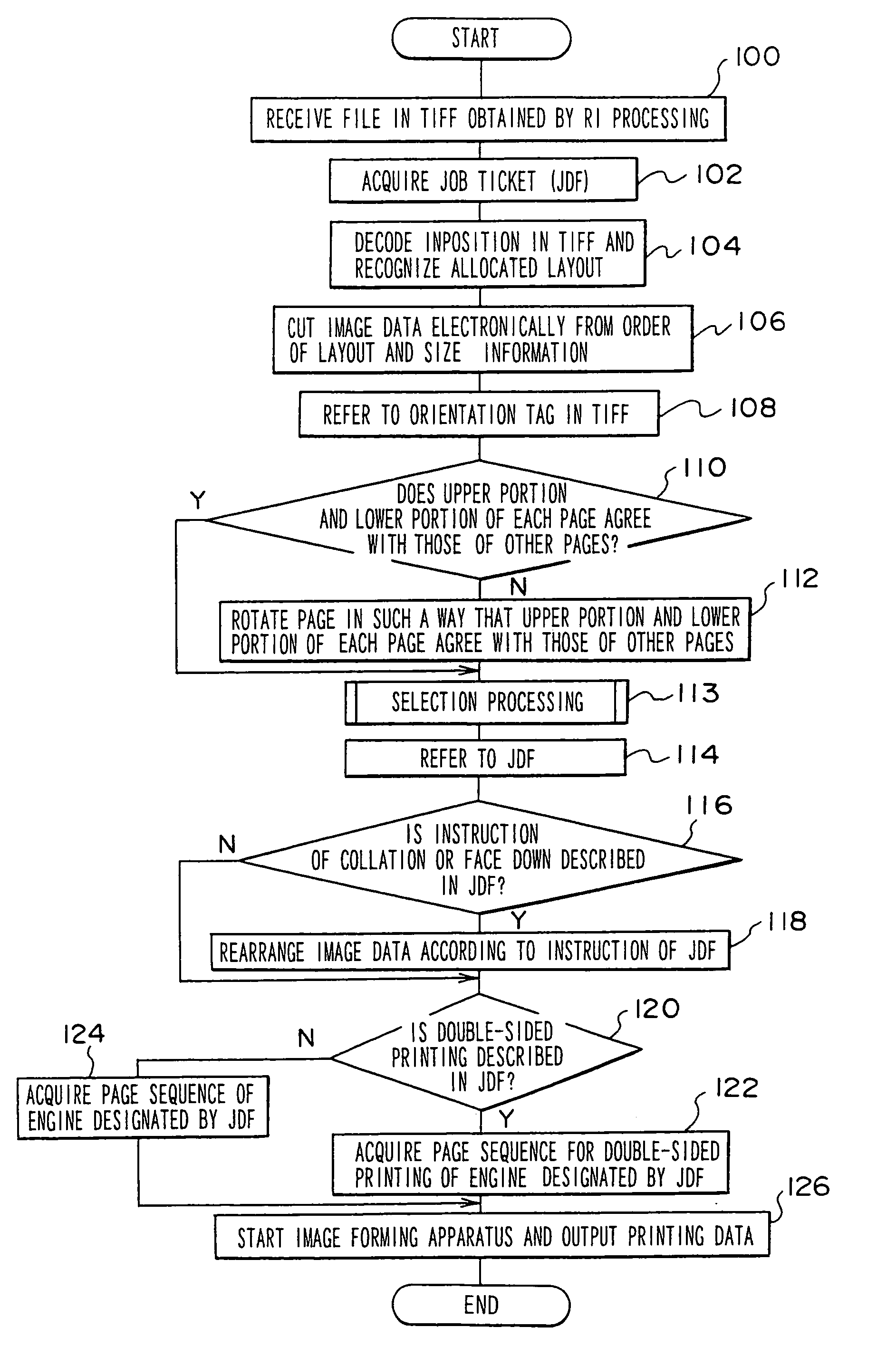
[0126] When compared with the embodiment 2, this embodiment is different in that whether the image is printed by the CTP device 702 or by the POD (image forming apparatus 11) can be selected according to the kind of image and the like of each electronically edited page. The other elements are the same as those in the embodiment 2, and hence descriptions thereof will be omitted. Further, the same elements are denoted by the same reference symbols. FIG. 10 is a flow chart showing one example of the processing performed at this time by the BEP. When compared with the flow chart shown in FIG. 7 in the embodiment 2, this flow chart is different in that a selection processing step 113 is added.
[0127] When the image data of a large size for the CTP method is produced by the RIP section 510 and is outputted to the BEP 600, in the BEP 600, first, at step 100,...
PUM
 Login to View More
 Abstract
Description
Claims
Application Information
 Login to View More