Unlock instant, AI-driven research and patent intelligence for your innovation.

Audio feedback processing system

a feedback processing and audio technology, applied in the field of feedback in audio systems, can solve the problems of limited sampling resolution of the sampled frequency spectrum representation, inability to accurately estimate inability to provide samples accurate estimates of the actual frequency of the feedback signal, so as to reduce the effect of audio signal quality and eliminate or reduce the feedback signal

Active Publication Date: 2006-03-16
HARMAN INT IND INC
View PDF18 Cites 8 Cited by
  • Summary
  • Abstract
  • Description
  • Claims
  • Application Information

AI Technical Summary

Benefits of technology

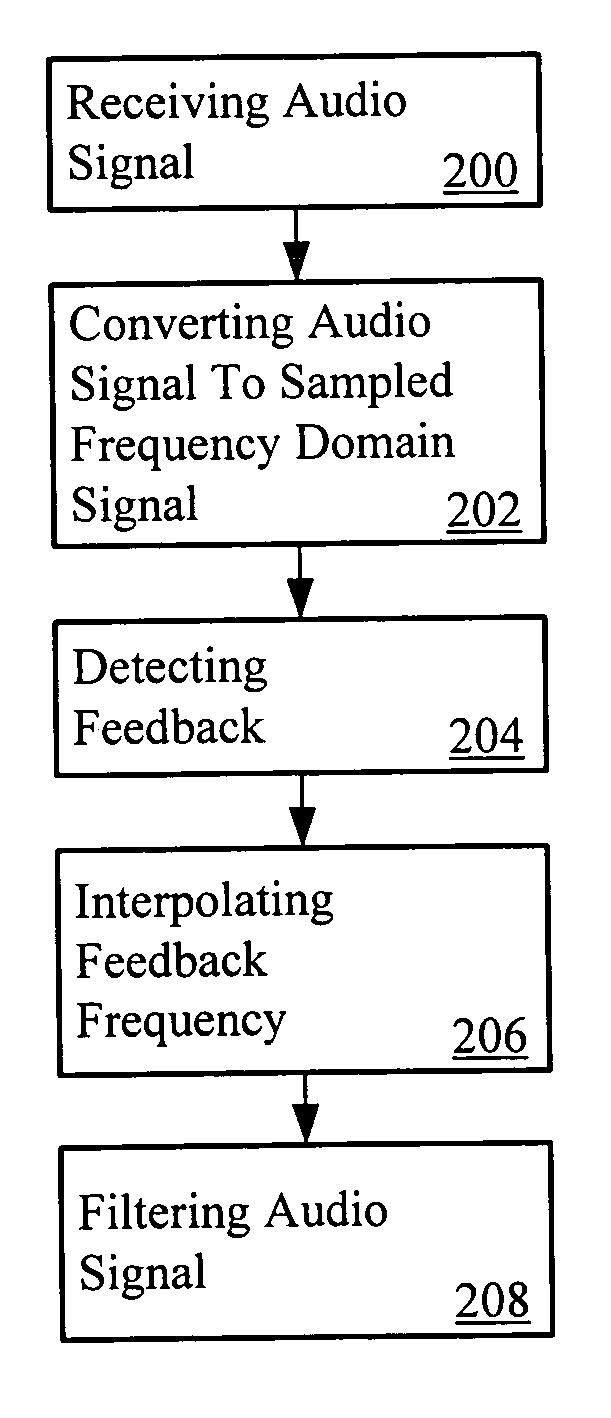
[0009] This invention provides an audio system that identifies the frequency of a feedback signal using interpolative feedback identification. The interpolative feedback identification may be accomplished using frequency interpolation on a sampled frequency spectrum signal corresponding to a feedback signal. The feedback interpolation allows the frequency of the feedback signal to be identified, especially where the frequency of the feedback lies between samples of the frequency spectrum signal. The interpolation may include using samples of the sampled frequency spectrum signal to generate a unique quadratic (or higher order polynomial), which resembles the original main lobe of the feedback signal represented by the frequency spectrum signal. The polynomial may be constructed from the samples using polynomial interpolation, rational function interpolation, cubic spline interpolation, and the like. The peak of the polynomial and thus a representation / estimation of the actual frequency of the feedback signal may be determined, for example, by setting a derivative of the generated polynomial equation to zero. A narrowly tailored filter, such as a notch filter, may be placed at the determined frequency of the feedback to eliminate or reduce the feedback signal. The filter also reduces the effect on the audio signal quality provided by the audio system.
[0010] The audio system may adaptively filter multiple feedback signals using a single filter such as a notch filter. The adaptive filtering may include identifying frequencies of feedback in the audio signal, and determining which frequencies of feedback signals lie within a frequency window comprising adjoining samples of the sampled frequency spectrum. A filter, such as a notch filter is configured to filter out the frequencies identified as within a frequency range covered by the frequency window, thereby freeing-up notch filters for filtering other feedback signals, or for reducing memory and processing requirements for the microprocessor of the audio system. The frequency range covered by the frequency window may comprise any number of adjoining samples, and may be predetermined and / or configurable. Further, the frequency range covered by the frequency window may vary depending on the frequency band being examined, and / or the resolution of the sampled frequency spectrum.

Problems solved by technology

However, when the microphone receives a portion of the audio provided at the speaker as an input, an unstable, closed-loop system is created, resulting in audio feedback.
However, because of computational and memory limitations of the microprocessor, the sampling resolution of the sampled frequency spectrum representation is limited.
Thus, the selected frequency sample does not provide an accurate estimate of an actual frequency of the feedback signal.
However, the use of a wider bandwidth and / or greater cut-depth notch filter can degrade the audio quality of the sound at the speaker.
The computational and memory limitations of the microprocessor limits the number of notch filters that may be used to eliminate audio feedback signals.
Where the number of feedback signals exceeds the number of notch filters available, some of the feedback signals cannot be eliminated by the system.
The failure to eliminate at least some of the feedback signals may require a system gain to be reduced, resulting in degraded system performance.
The filter also reduces the effect on the audio signal quality provided by the audio system.

Method used

the structure of the environmentally friendly knitted fabric provided by the present invention; figure 2 Flow chart of the yarn wrapping machine for environmentally friendly knitted fabrics and storage devices; image 3 Is the parameter map of the yarn covering machine
View more

Image

Smart Image Click on the blue labels to locate them in the text.
Viewing Examples
Smart Image
  • Audio feedback processing system
  • Audio feedback processing system
  • Audio feedback processing system

Examples

Experimental program
Comparison scheme
Effect test

Embodiment Construction

[0030]FIG. 1 is a block diagram of an audio system 100 having feedback identification and feedback reduction or elimination techniques. The audio system uses interpolative feedback identification and may adaptively filter multiple feedback signals using one notch filter. The interpolative feedback identification provides for a single estimate of the feedback frequency achieved from more than one sample of a discrete frequency spectrum representation of a feedback signal. The interpolative feedback identification may include utilizing frequency interpolation by generating a second degree or higher polynomial using one or more samples of the discrete frequency spectrum representation. An accurate representation of the actual frequency of the feedback signal may be determined, for example, by setting a derivative of the polynomial to zero. A filter, such as a notch filter, may be placed in response to the interpolative feedback identification to reduce or eliminate the feedback signal ...

the structure of the environmentally friendly knitted fabric provided by the present invention; figure 2 Flow chart of the yarn wrapping machine for environmentally friendly knitted fabrics and storage devices; image 3 Is the parameter map of the yarn covering machine
Login to View More

PUM

No PUM Login to View More

Abstract

A signal processing system improves signal quality by accurately locating and eliminating a feedback signal in an input signal, such as an audio signal. The signal processing system interpolates between frequency sample points to obtain a more accurate identification of a feedback signal frequency. A less intrusive filter reduces or eliminates the identified frequency signal frequency without excessive adverse effects on adjacent frequencies in the input signal.

Description

PRIORITY CLAIM [0001] This application is a Continuation application of, and claims the benefit of priority from, U.S. patent application Ser. No. 10 / 387,915 filed Mar. 13, 2003 and titled Audio Feedback Processing System, which is incorporated by reference. This application also claims the benefit of priority from U.S. Provisional Pat. App. Ser. No. 60 / 363,994, filed Mar. 13, 2002 and titled Employing Narrow Bandwidth Notch Filters In Feedback Elimination, which is also incorporated herein by reference.BACKGROUND OF THE INVENTION [0002] 1. Technical Field [0003] This invention relates to feedback in audio systems. More particularly, this invention relates to identifying a feedback frequency in a signal and adaptively filtering the feedback frequency from the signal. [0004] 2. Related Art [0005] An audio system typically includes an input transducer (microphone), an amplifier, a microprocessor and an audio output (loudspeaker). The input transducer receives sound into the system, th...

Claims

the structure of the environmentally friendly knitted fabric provided by the present invention; figure 2 Flow chart of the yarn wrapping machine for environmentally friendly knitted fabrics and storage devices; image 3 Is the parameter map of the yarn covering machine
Login to View More

Application Information

Patent Timeline
no application Login to View More
IPC IPC(8): H04R3/00G10L21/02H04R3/02
CPCH04R3/02G10L2021/02082G10L19/02H04B15/00H04R5/04H04B15/02
Inventor KREIFELDT, RICHARD A.REED, CURTIS R.HAMMOND, AARON M.
Owner HARMAN INT IND INC
Features
  • R&D
  • Intellectual Property
  • Life Sciences
  • Materials
  • Tech Scout
Why Patsnap Eureka
  • Unparalleled Data Quality
  • Higher Quality Content
  • 60% Fewer Hallucinations
Social media
Patsnap Eureka Blog
Learn More