[0004] The apparatus and method of the present invention may reduce or eliminate certain problems and disadvantages associated with previous dental devices.
[0006] Particular embodiments of the present invention may provide one or more technical advantages. According to the present invention, an apparatus and method are provided for removing enamel from one or more of a person's teeth. The removal of enamel from one or both of two adjacent teeth may create space, or additional space, between the adjacent teeth. Thus, an IER procedure may be performed to prevent or treat the overcrowding of teeth associated with malocclusion and avoid the need for one or more
tooth extractions. Additionally or alternatively, an IER procedure may be used to recontour or otherwise alter the size and shape of one or more of the person's teeth to provide a more aesthetically pleasing result.
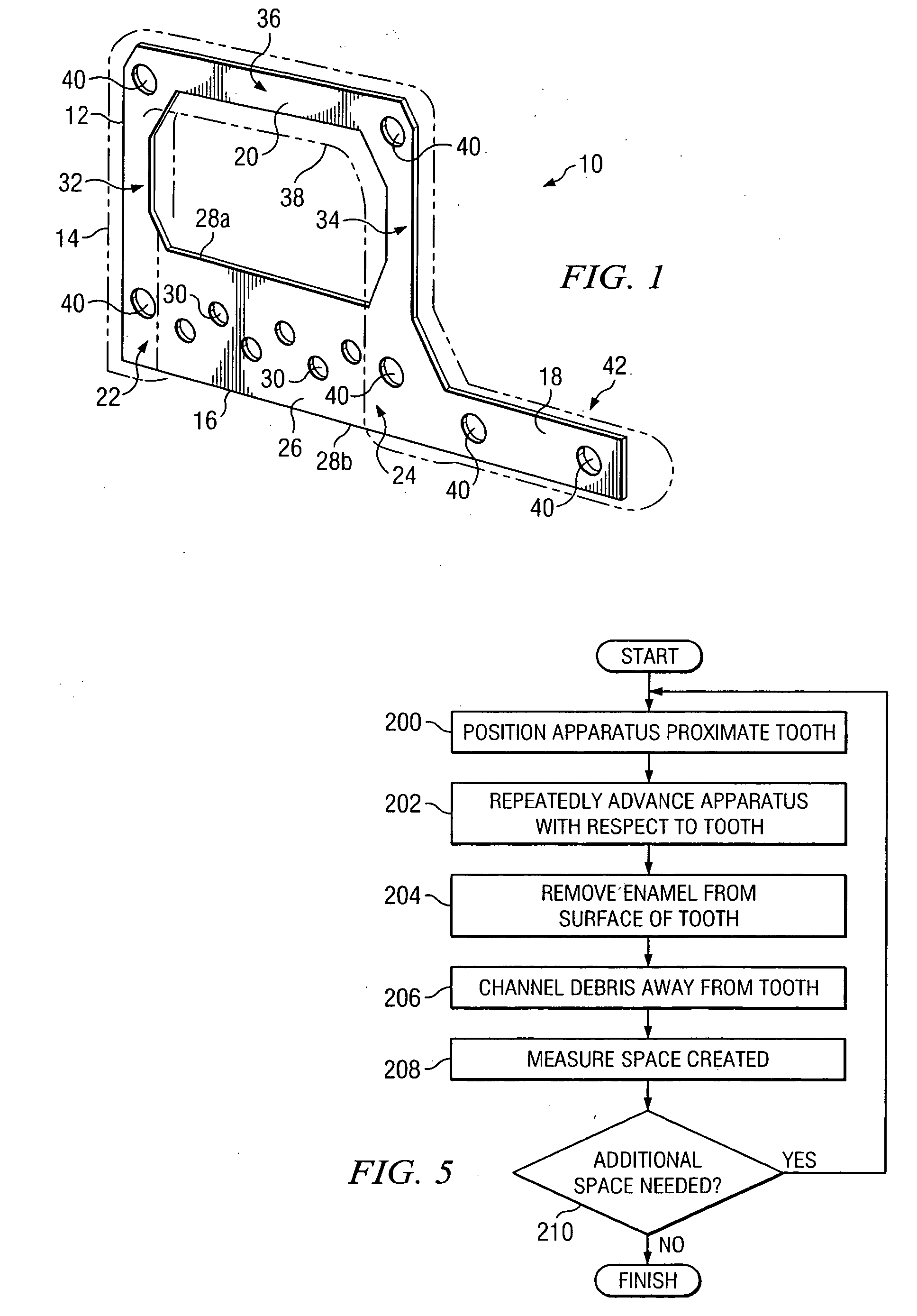
[0007] In certain embodiments, the apparatus includes a one-piece integrally-formed frame, preferably
metal, that provides strength and rigidity and is unlikely to break or otherwise fail during use. In certain embodiments, portions of the frame, including at least the
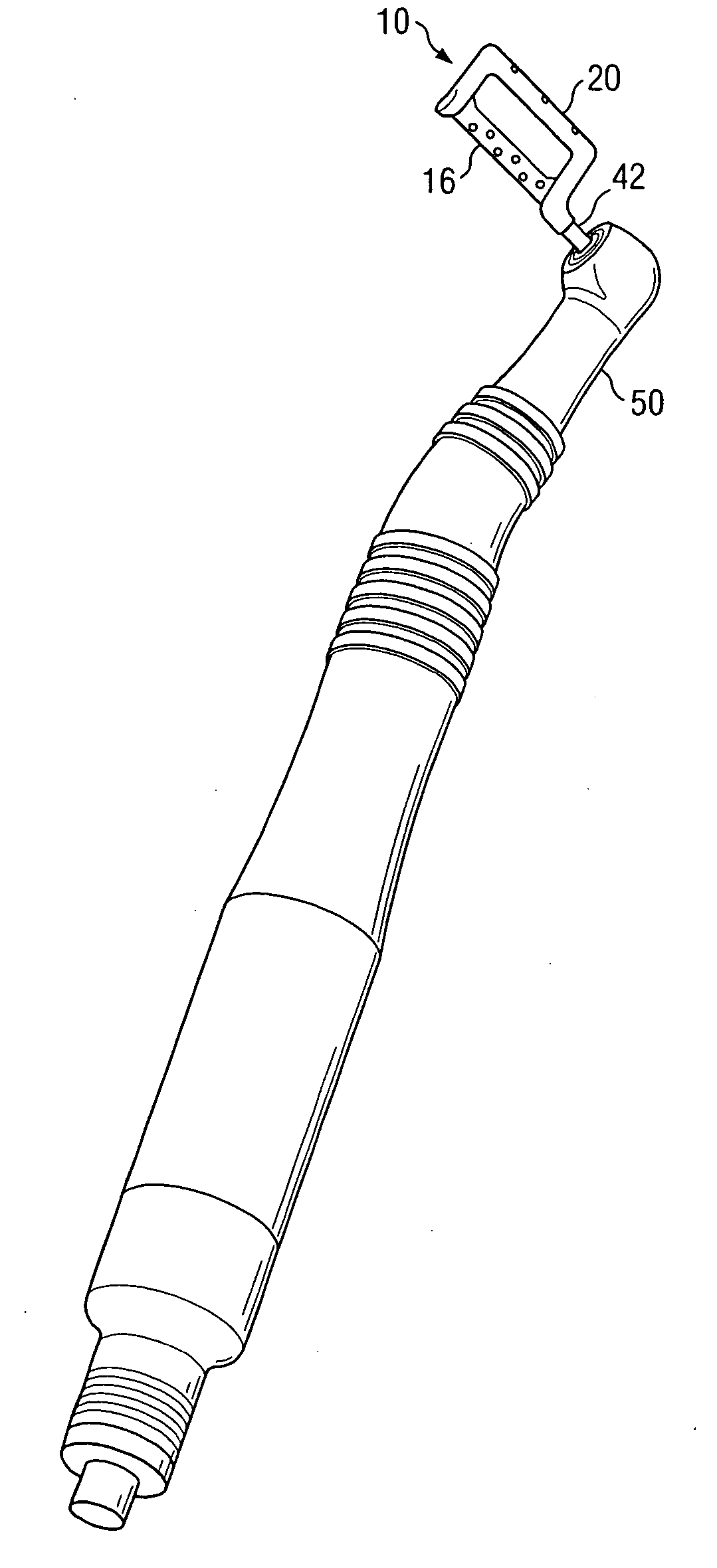
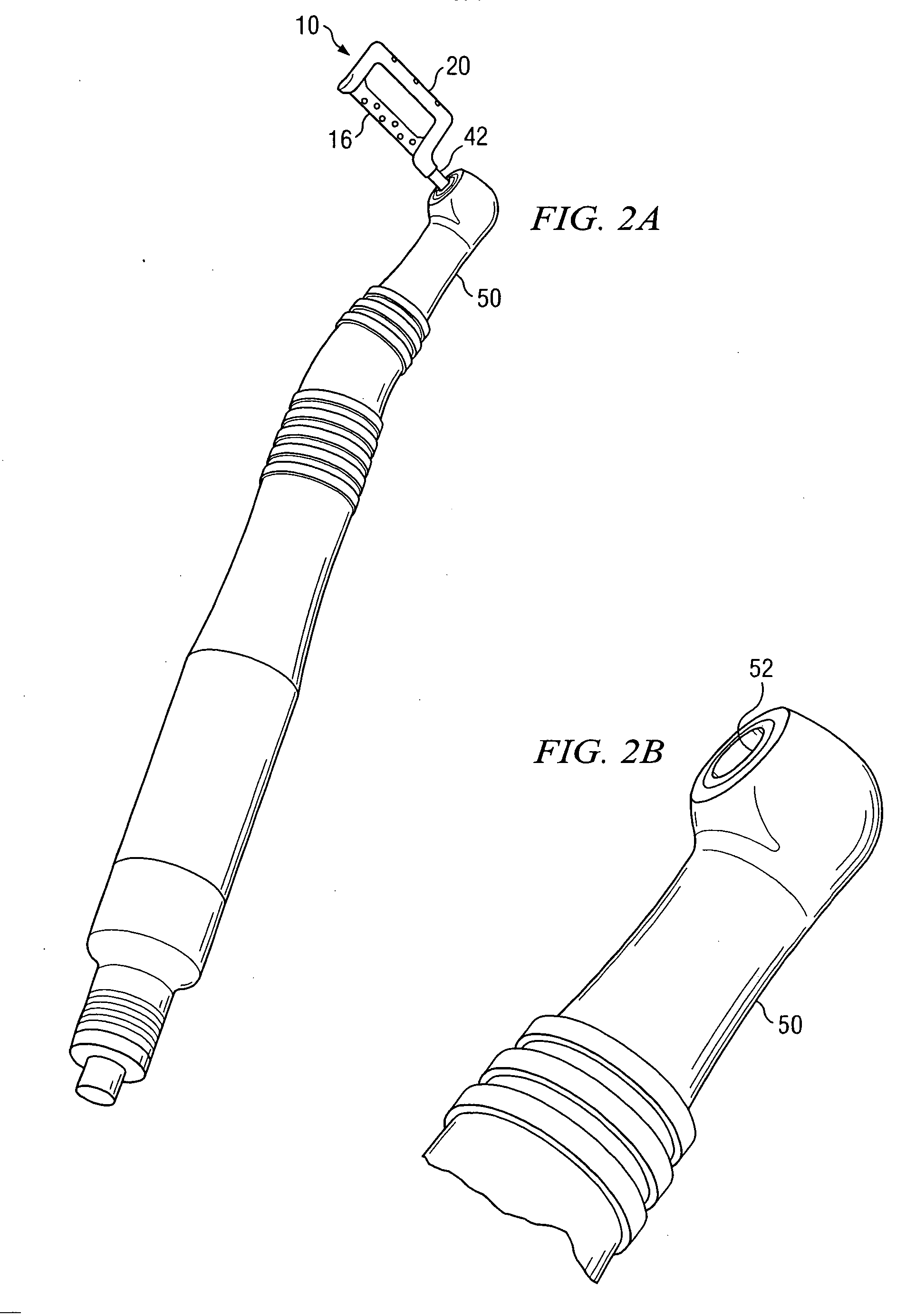
handle portion, are enveloped or otherwise covered by a body, which may be made of plastic and may also be integrally-formed. In certain embodiments, the resulting handle may be manually gripped by an orthodontist or other clinical professional when using the apparatus to remove enamel from a person's tooth. In certain embodiments, the apparatus is lightweight and may be easily positioned and manipulated by the clinical professional. In certain embodiments, a driver mechanism may be used in cooperation with the frame to drive reciprocal motion of the abrasive surface of the blade portion of the frame against the enamel of a person's tooth. In certain embodiments, one or more apertures formed through the blade portion of the frame channel debris away from the interproximal contact area as an IER procedure is being performed. As a result, bits of removed enamel,
saliva, blood and any liquids, chemicals, or pastes used in the IER procedure and present at the interproximal contact area may be channeled away from the tooth through the one or more apertures and the area kept cleaner and visibly unobstructed during the procedure, reducing or eliminating the need to interrupt the procedure to clean the interproximal contact area. In certain embodiments, the apparatus may be inexpensively
mass manufactured such that it is economically practical to dispose of the apparatus after a
single use, eliminating the need for cleaning and sterilization between uses. In certain embodiments, the handle may have a substantially circular cross-section with a substantially continuous circumference. The handle may also be substantially
solid. As a result, the handle may be substantially non-deformable such that cross-sectional dimensions of the handle remain substantially constant when the handle is force-fitted into or otherwise coupled to a corresponding opening of a driver mechanism.


 Login to View More
  Login to View More