
Endless metal belt and its maufacturing method and continuously variable transmission
a technology of metal belts and end plates, applied in the direction of gearing elements, hoisting equipments, gearing, etc., can solve the problem that the arrangement of elements alone does not necessarily have an adequate noise reduction effect, and achieve the effect of reducing noise and vibration
- Summary
- Abstract
- Description
- Claims
- Application Information
AI Technical Summary
Benefits of technology
Problems solved by technology
Method used
Image

Examples
first embodiment
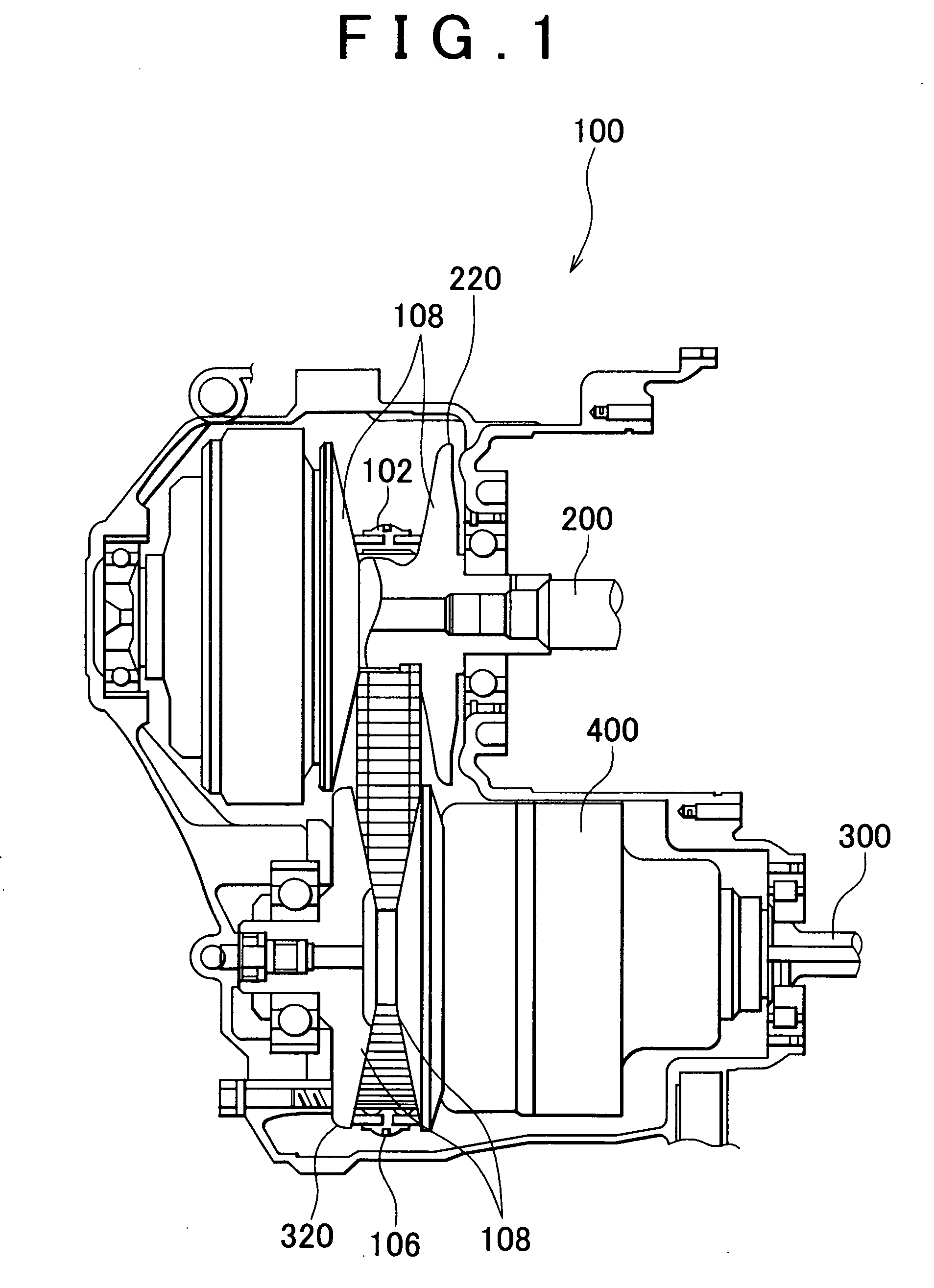
[0029]FIG. 1 is a cross-sectional view of a belt-type continuously variable transmission according to a first embodiment of the invention. A belt-type continuously variable transmission 100 according to the first embodiment of the invention will be described with reference to FIG. 1. In the belt-type continuously variable transmission 100, an endless metal belt 106 is wound around an input pulley 220 attached to an input shaft 200 and an output pulley 320 attached to an output shaft 300. Also provided in the belt-type continuously variable transmission 100 is an assist portion 400 that provides additional clamping force to the output pulley 320 to counter rotation fluctuations received by the output shaft 300 from a drive wheel.
[0030] The input pulley 220 and the output pulley 320 are respectively provided with a pair of sheaves 108 whose groove widths may be continuously varied. Varying the groove widths using a hydraulic pressure circuit that is controlled depending on the vehicl...
second embodiment
[0048] In a second embodiment, another method is used to minimize noise. FIG. 10 is a block diagram showing a manufacturing method for the endless metal belt according to the second embodiment. In the second embodiment, various random numbers are generated, and actual samples are made based upon these random numbers. By measuring the sample noise, random numbers capable of minimizing noise were found.
[0049] Referring to FIG. 10, first in step 801 an n amount of random numbers are generated from a 1st random number up to an nth random number. Physical random numbers and pseudo-random numbers can be used for this random number generating method. Furthermore, methods based upon a linear congruence method or a maximum length sequence may also be employed as methods for generating pseudo-random numbers. Also, the random numbers are random numbers using an arrangement of zeros and ones.
[0050] Next in step 802, samples 1 to n are made respectively corresponding to the random numbers. The...
PUM
 Login to View More
 Abstract
Description
Claims
Application Information
 Login to View More