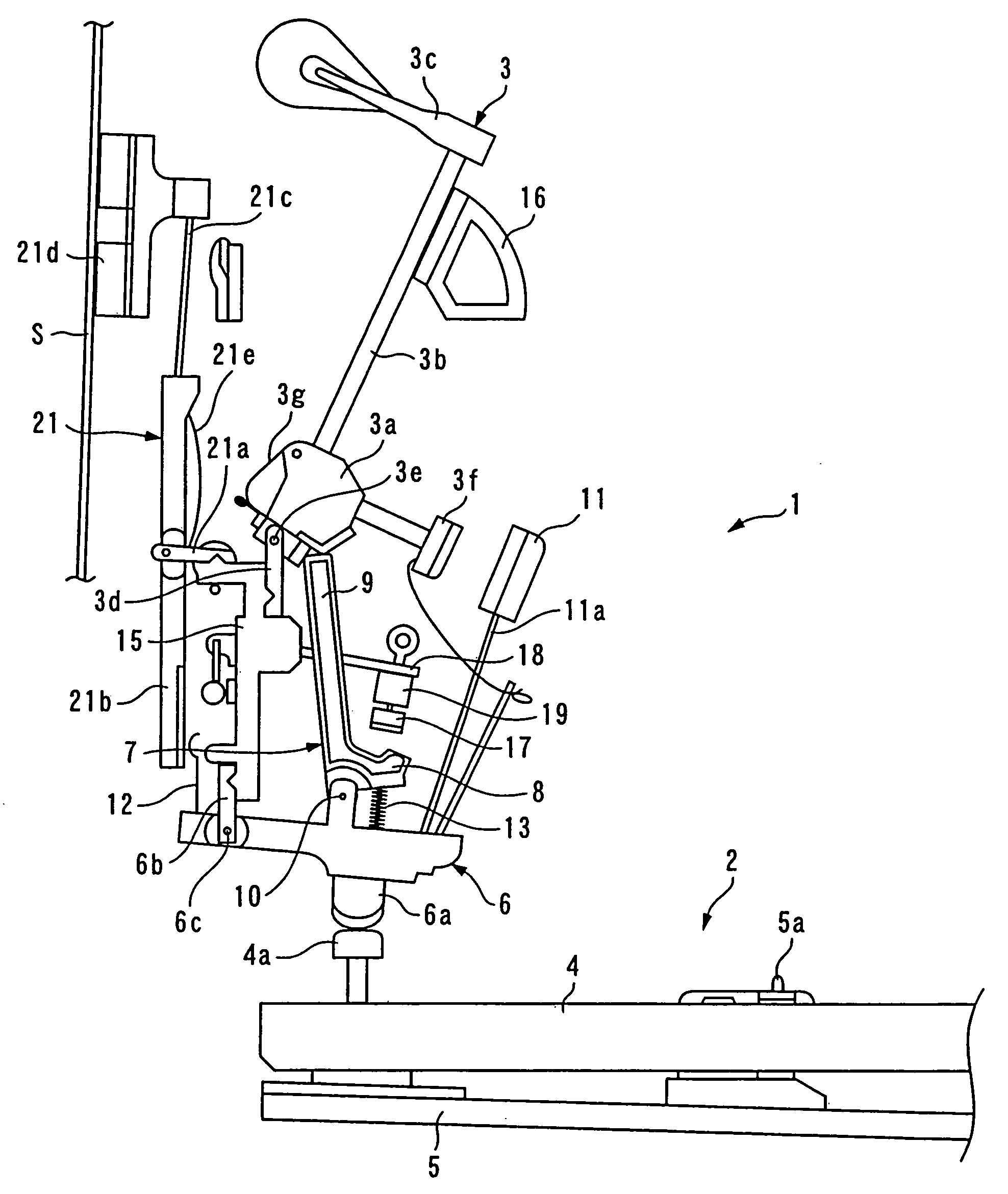
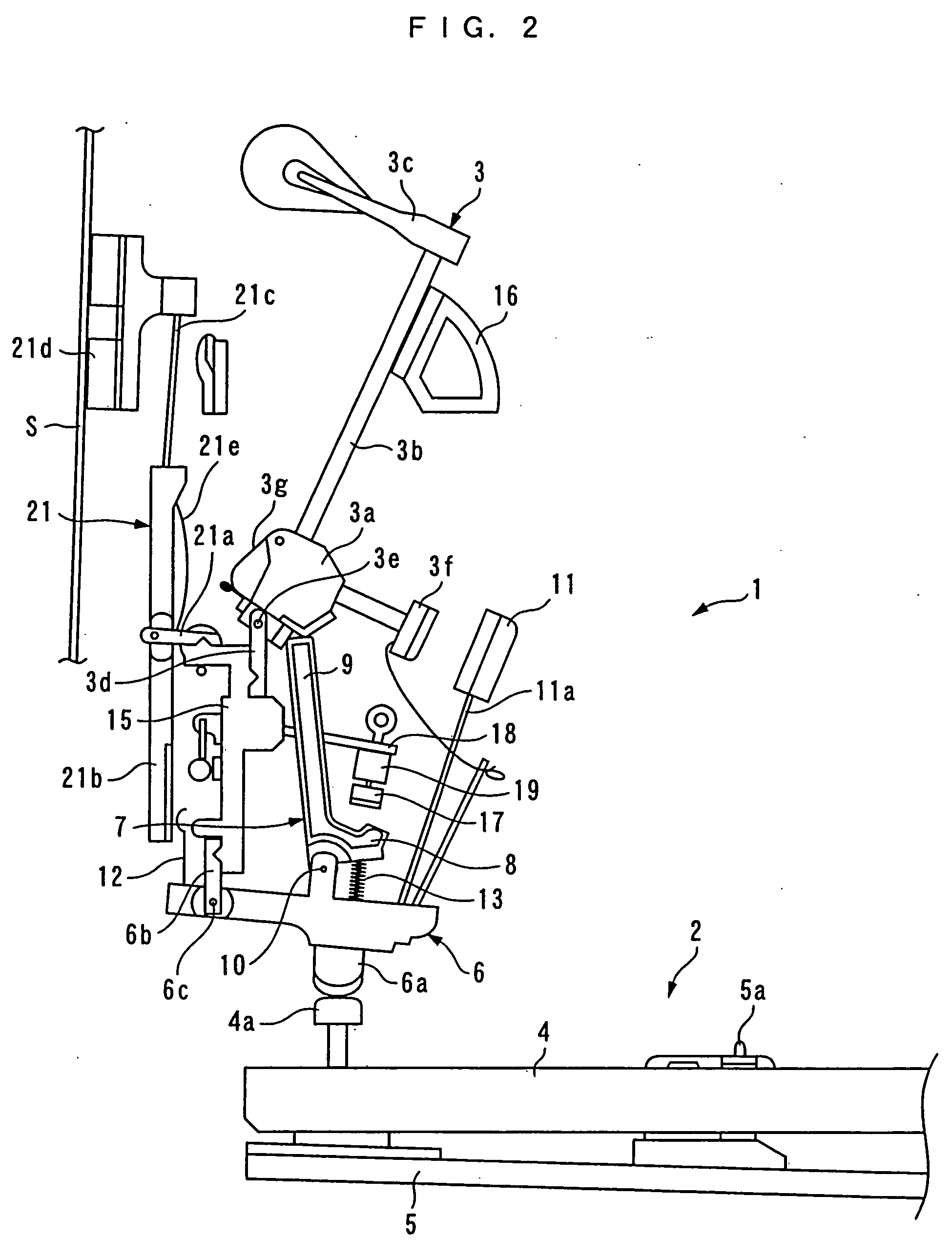
[0012] As described above, after coming into contact with the regulating button, the jack pivotally moves relative to the wippen, while its regulating button contact protrusion is sliding along the jack contact surface, with the counter-force acting from the regulating button. The counter-force of the regulating button in this event is transmitted to the key through the jack and wippen, resulting in a corresponding increase in tough weight. In this sequence of operations, since both the regulating button contact surface and jack contact surface are both flat in the present invention, the regulating button contact surface comes into planar contact with the jack contact surface, to increase the contact area of both, as compared with the aforementioned conventional regulating button contact surface which is curved, resulting in a larger
frictional resistance between the regulating button contact protrusion and the regulating button. This makes the regulating button contact protrusion difficult to slide along the jack contact surface to cause consequent difficulties in the pivotal movement of the jack. Thus, the counter-force of the regulating button, transmitted through the jack and wippen, is further increasing until the jack comes off. This results in a larger touch weight immediately before let-off, i.e., a larger let-off load, and a larger amount of change in the touch weight before and after the let-off, thereby making it possible to clarify the timing of the let-off. In response to the thus clarified timing of the let-off, the player can finely adjust a string striking speed of the hammer to realize high playing performance excellent in expressive power. Also, the foregoing advantageous effects can be provided in a simple structure only including the flat jack contact surface and flat regulating button contact surface.
[0013] Preferably, in the action for a piano described above, the regulating button contact surface is angled such that the regulating button contact surface comes into planar contact with the jack contact surface.
[0014] According to this preferred embodiment of the action for a piano, the regulating button contact surface comes into tightly planar contact with the jack contact surface without fail. This causes the generation of a large
frictional resistance between the regulating button contact protrusion and the regulating button, which makes the jack difficult to pivotally move, and increases the let-off load, thus making it possible to ensure the advantageous effects mentioned above.
[0015] Preferably, the action for a piano described above further comprises a sheeted damping material on at least one of the jack contact surface or the regulating button contact surface, wherein the regulating button contact surface is angled such that when the regulating button contact surface comes into contact with the jack contact surface through the damping material, the regulating button contact surface comes into contact with an end of the jack contact surface close to the jack fulcrum, and the regulating button contact surface extends obliquely in close proximity to the jack contact surface.
[0016] According to this preferred embodiment of the action for a piano, during a pivotal movement of the wippen associated with a depression on the key, the regulating button contact surface of the regulating button contact protrusion comes into contact with the jack contact surface through the sheeted damping material, causing the jack to pivotally move relative to the wippen. Also, when this contact is made, the regulating button contact surface comes into contact with the end of the jack close to the jack fulcrum, and extends obliquely in close proximity to the jack contact surface, i.e., comes into contact with the jack contact surface at a slight angle formed thereto. In this event, as the intervening sheeted damping material is compressed, a combination of the end of the regulating button contact surface close to the jack fulcrum and its vicinity is in contact with planar contact with the jack contact surface through the damping material, thereby ensuring a larger
frictional resistance. Further, such a planar contact causes the center of the planar contact, i.e., a point acted by the counter-force from the regulating point, to be near the jack fulcrum, resulting in a larger counter-force of the regulating button required for the pivotal movement of the jack. Thus, according to the present invention, the let-off load is increased by a larger frictional resistance ensured by the planar contact, and the counter-force of the regulating button acting on a position closer to the jack fulcrum, thus ensuring the advantageous effects of the action described above.
[0017] Preferably, in the action for a piano described above, the jack includes a hammer push-up rod extending upward from the jack fulcrum, and configured to engage with the hammer, and the hammer push-up rod includes a prominence formed along an edge of a top surface thereof opposite to the regulating button contact protrusion.


 Login to View More
  Login to View More