Ventilator with rescuer and victim guidance

a technology of ventilator and victim, applied in the field of ventilator, can solve the problems of prior art devices also suffering from the lack of feedback loop, complicated breathing function, and difficulty in breathing assistan

US20060249151A1Inactive Publication Date: 2006-11-09CPAIR
17 Cites 47 Cited by

Patent Information

Authority / Receiving Office
US · United States
Patent Type
Applications(United States)
Current Assignee / Owner
Publication Date
2006-11-09
Estimated Expiration
Not applicable · inactive patent

Smart Images

  • Figure 1
    Figure 1
  • Figure 2
    Figure 2
  • Figure 3
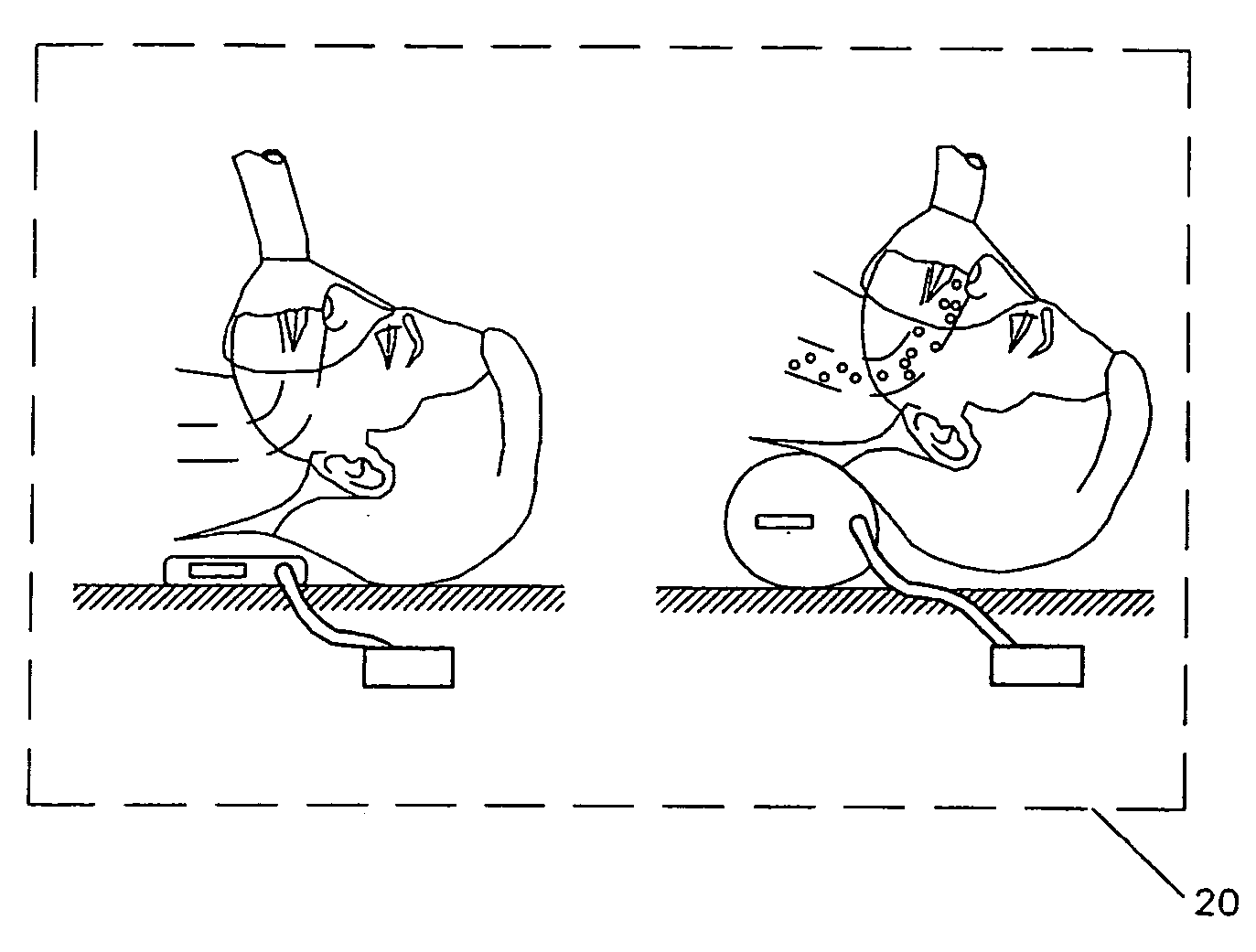
    Figure 3
Patent Text Reader

Abstract

A breathing assistance device is provides guidance to the rescuer, guidance to the victim, and modifies treatment parameters automatically based upon feedback loops relating to patient needs. Guidance can include pictograms showing cartoons of lung expansion, airway patency, breathing rate, and depth of breathing. A microprocessor preferably produces the pictorial guidance as a function of at least one of estimated end tidal CO2, estimated fractional inspired oxygen, estimated fractional expired oxygen, estimated airway resistance, and estimated lung compliance. The microprocessor can also execute a software code that executes a feedback loop that attempts to normalize values of a parameter over time, by controlling at least one pressure in a neck pillow, mask pressure, breathing rate, breathing volume, inspiration time, and expiration time. Contemplated parameters can include estimated end tidal CO2, estimated fractional inspired oxygen, estimated fractional expired oxygen, estimated airway resistance, and estimated lung compliance.
Need to check novelty before this filing date? Find Prior Art

Description

[0001] This application claims priority to U.S. provisional application Ser. No. 60 / 677473 filed May 3, 2005.FIELD OF THE INVENTION

[0002] The field of the invention is emergency rescue equipment. BACKGROUND

[0003] Breathing is a complicated function, and providing assistance to a victim who is experiencing breathing difficulties is thought to require skilled intervention. A significant problem is that a great many situations require breathing assistance take place outside of a hospital or other health care facility in which sufficiently trained personal and equipment are available.

[0004] U.S. Pat. No. 6,289,890 to Bliss et al. (September 2001) addresses the skilled personnel problem by providing a portable rescue breathing assistance device that is said to provide semi-automated functionality. Devices contemplated in that patent provide verbal instructions to a rescuer, which nevertheless require some degree of training and expertise. For example, the rescuer must select victim si...

Examples

Embodiment Construction

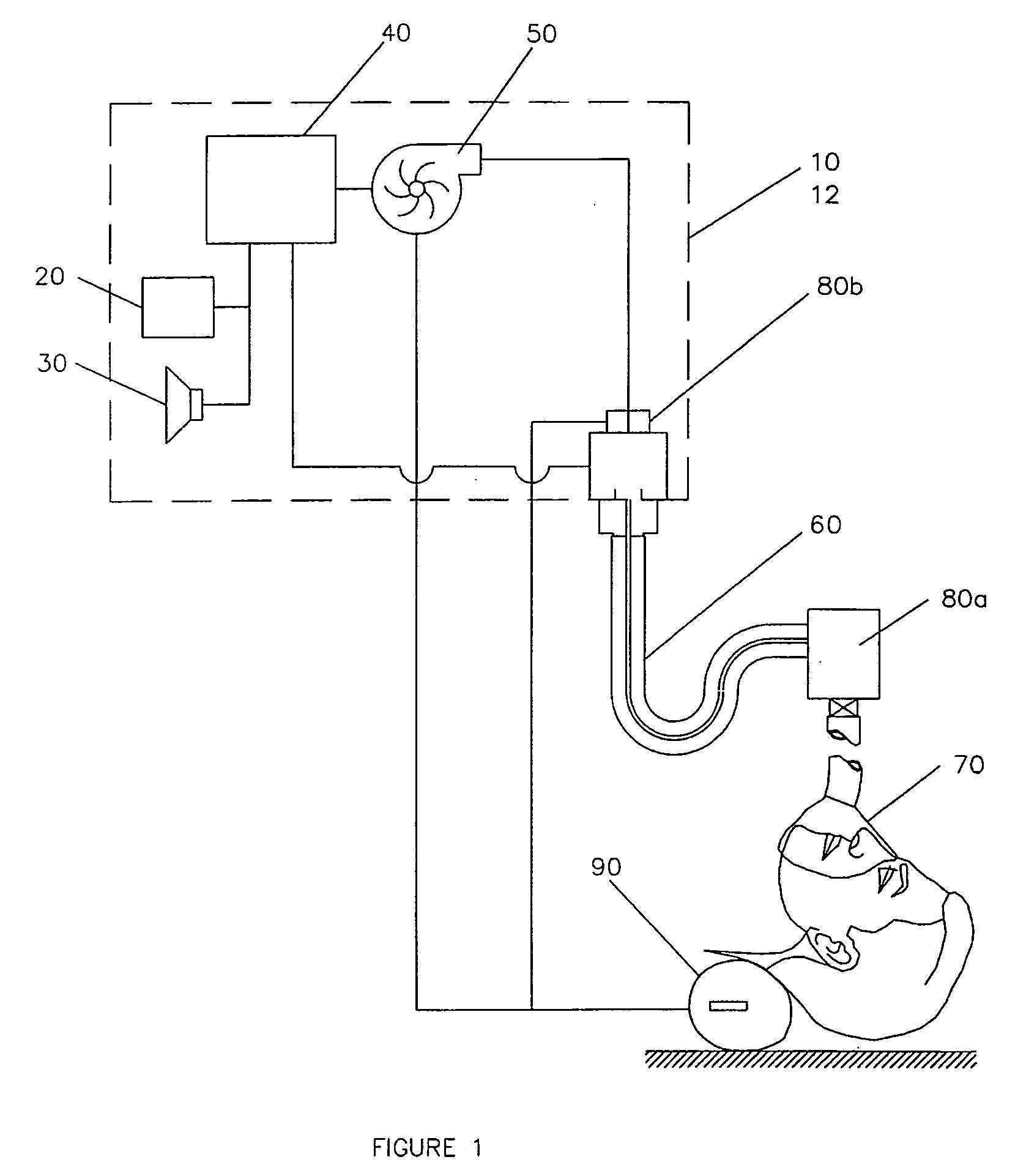
[0018] In FIG. 1 a ventilator 1 generally comprises a housing 10, a display 20, a speaker 30, a microprocessor 40, a source of pressurized gas 50, a tube 60, a mask 70, sensors 80a, 80b and a neck positioning device 90.

[0019] The housing 10 is preferably made of a durable polymer, and is as small as possible to house the various components. Housing 10 can advantageously include a carrying handle 12.

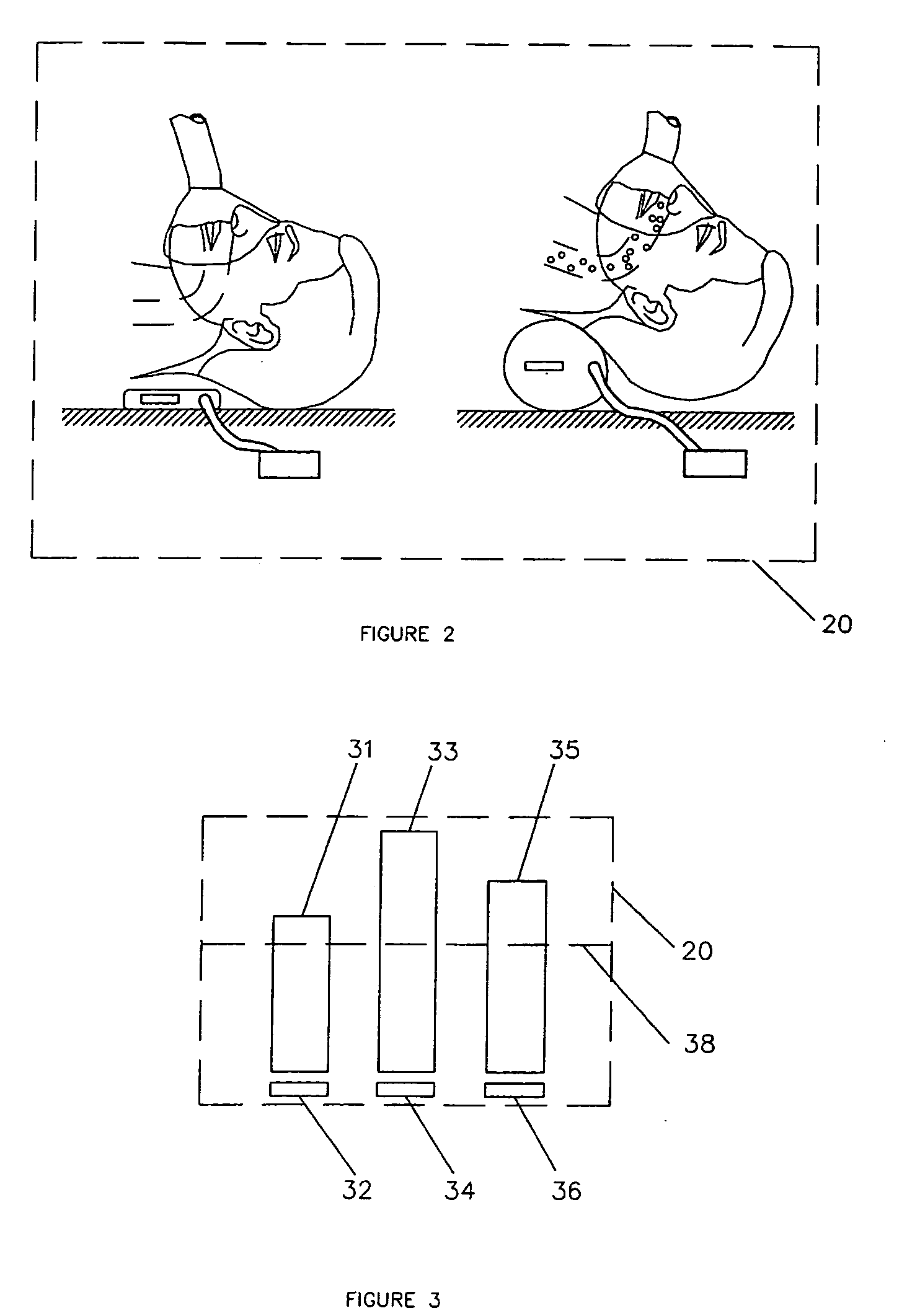
[0020] The display 20 is preferably a color LCD display, but can alternatively be a plasma screen or another display. Most preferably the display 20, as well as all the housing and all other components would meet any applicable military specifications. Display 20 can have any desired size and shape, but preferably measures at least 10 cm wide by 5 cm tall.

[0021] Speaker 30 is any suitable speaker providing sufficient loudness to instruct both a rescuer and a victim. A backup speaker (not shown) is also contemplated.

[0022] Microprocessor 40 can be any suitable off the shelf device, or ...