
Antifungal formulation containing Streptomyces s.p.p., method for preparing the composition and relevant use
a technology of streptomyces s.p.p. and composition, applied in the field of antifungal formulation, can solve the problems of substantial ecological deterioration, catastrophic global impact on ecosystems, and human immune system malfunction, and achieve the effect of increasing the secretion of chitinas
- Summary
- Abstract
- Description
- Claims
- Application Information
AI Technical Summary
Benefits of technology
Problems solved by technology
Method used
Image

Examples
example 1
Control of Pythium Damping Off Disease by Using Streptomyces spp.
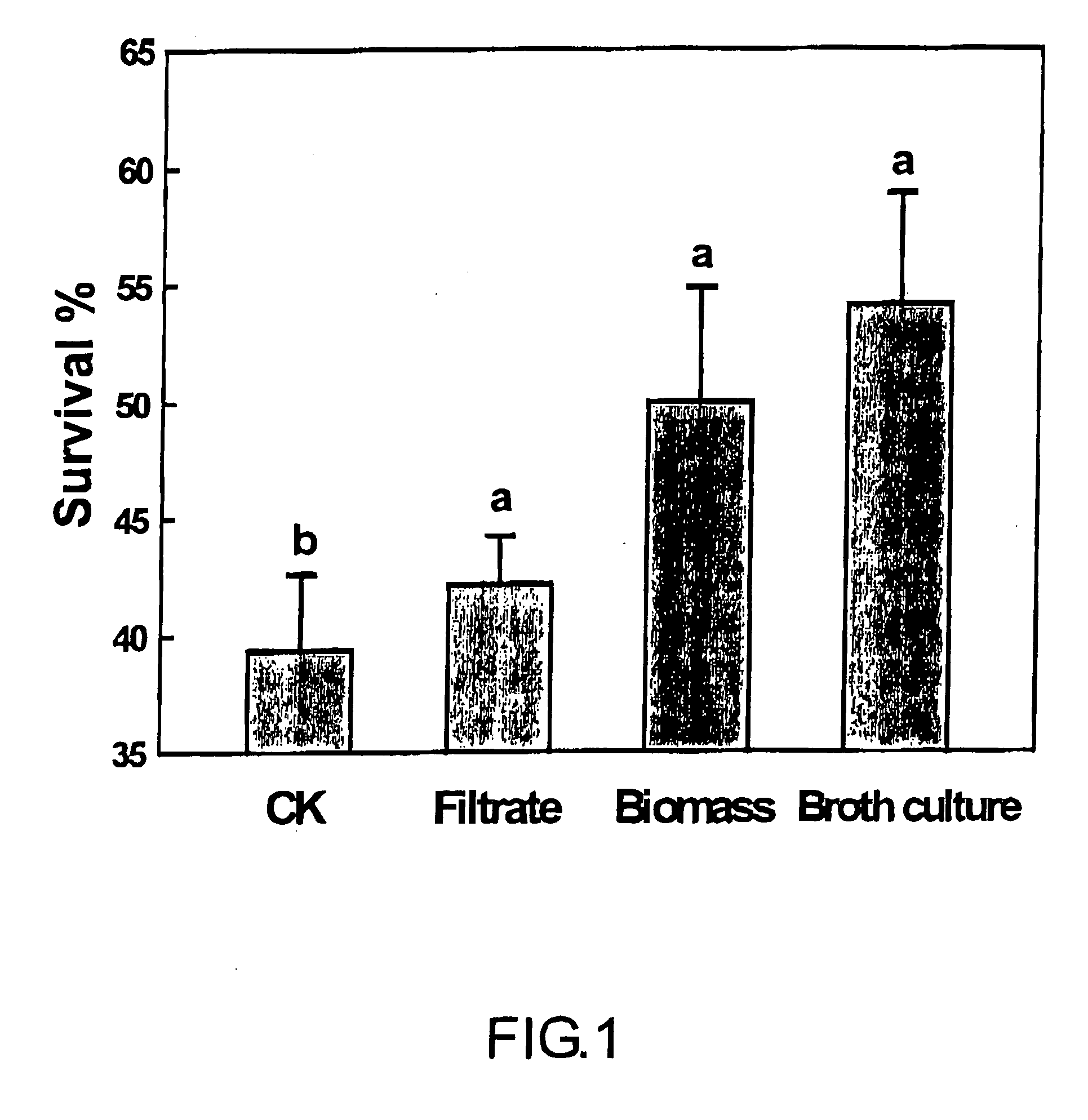
[0056] With reference to FIG. 1, an isolated strain of Streptomyces spp., S. griseobrunneus S3, was used as a test strain to understand the relevant mechanism on plant disease control. The broth culture of S. griseobrunneus S3 obtained from the fermentor culture was filtered to separate solid biomass from the broth medium. The solid biomass was then resuspended with sterile distilled water to its original concentration. The whole broth culture, the culture filtrate and the water resuspended biomass were diluted 100 times with tap water each respectively and applied to cucumber seedlings artificially inoculated with Pythium aphanidernialum. The compared control plants were drenching treated with water (CK). The survival rates of the seedlings were then scored to show the disease control efficacy of each applied treatment. As shown in FIG. 1, the best efficacy of disease control was by the whole broth culture and next t...
example 2
Mechanism of Disease Control by Streptomyces spp.
[0057] Activities of antibiotics and hydrolytic enzymes are the major factors known responsible for the inhibition or killing of fungal pathogens by Streptomyces spp. Whereas for efficacy of disease control observed, it is generally believed to due to a collective effect of the multiple modes of action including space and nutrient competition, antibiosis, mycoparasitism, soil fertility improvement, plant growth promotion and disease resistance enhancement.
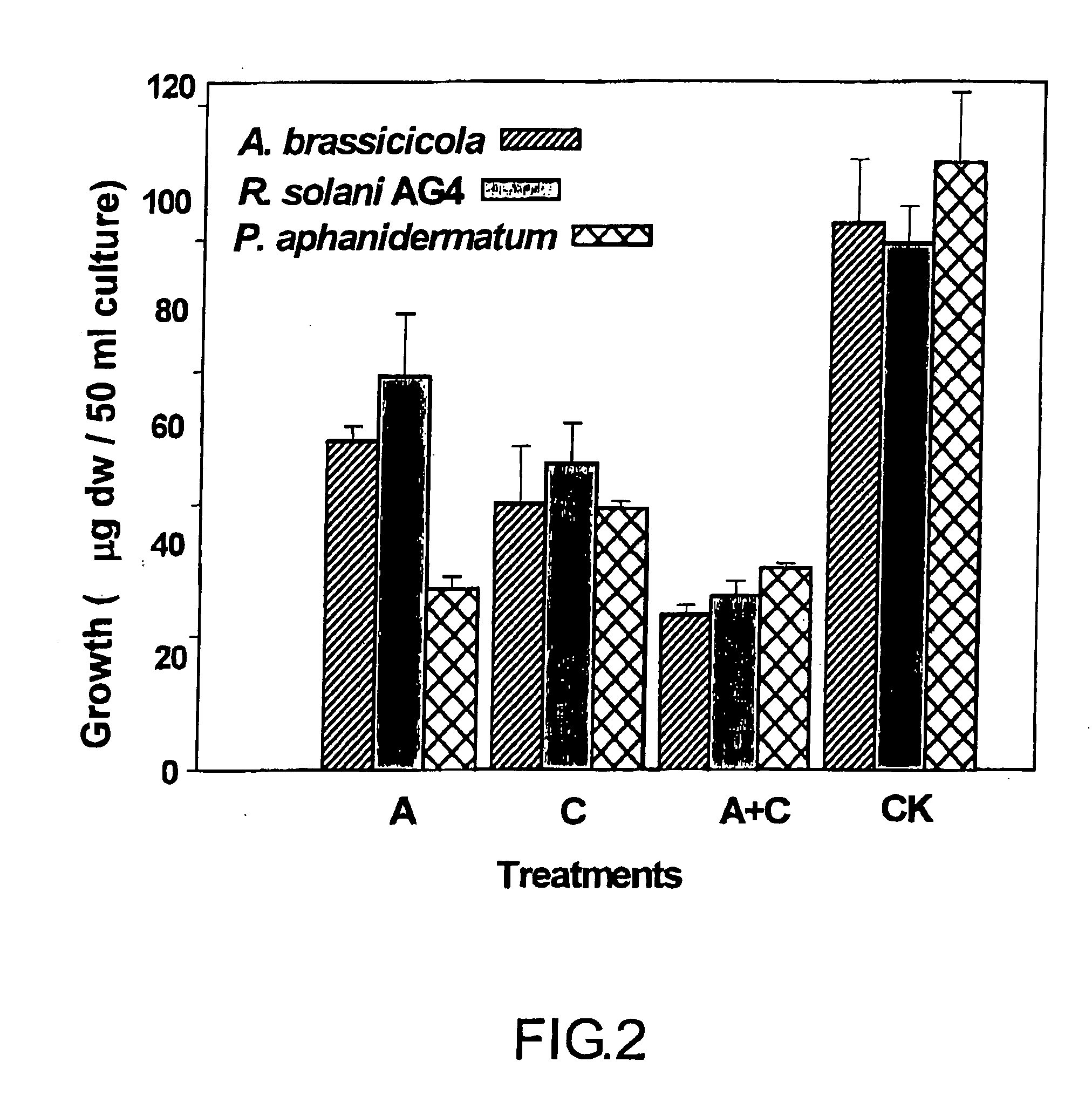
[0058] With reference to FIG. 2, an antibiotic (A) and a chitinase (C) were each respectively extracted from an S. saraceticus SS31 broth culture to illustrate their individual role in the anti-fungal activity of the test strain. The partially purified antibiotic and chitinase samples were tested in vitro respectively against Alternaria brassicicola, Rhizoctonia solani AG4 and Pythium aphanidermatum. The antibiotic (A) and chitinase (C) obtained from an SS31 strain cultured in a co...
example 3
Effect of Nutrient on Growth and Antibiotic Activity of Streptomyces spp.
[0059] A liquid culture medium in accordance with the present invention was prepared to test the nutrient requirement of the tested strain. For an SS31 strain, the applicant had demonstrated that the use of polysaccharide as a carbon source favors greatly the secretion of antibiotic and chitinase.
[0060] For the tested Carbon sources shown in Table 1 and Table 2, it is clear that sucrose, chitin and starch are the best to promote secretion of antibiotic and chitinase. In the experiment performed, the tested carbon sources were added at the same concentration to replace sucrose for preparation of the Czapek's culture medium. The test bacteria were cultured at 30° C. under continuous shaking at 120 rpm. The control treatment was cultured in the same medium without sugar addition. Enzyme activity was tested by a dot blotting method, where that “−” means no enzyme activity; and “+, ++, +++, and ++++” each respecti...
PUM
| Property | Measurement | Unit |
|---|---|---|
| diameter | aaaaa | aaaaa |
| diameter | aaaaa | aaaaa |
| pH | aaaaa | aaaaa |
Abstract
Description
Claims
Application Information
 Login to View More