
Structured combustion chamber for use in engine
- Summary
- Abstract
- Description
- Claims
- Application Information
AI Technical Summary
Benefits of technology
Problems solved by technology
Method used
Image

Examples
first embodiment
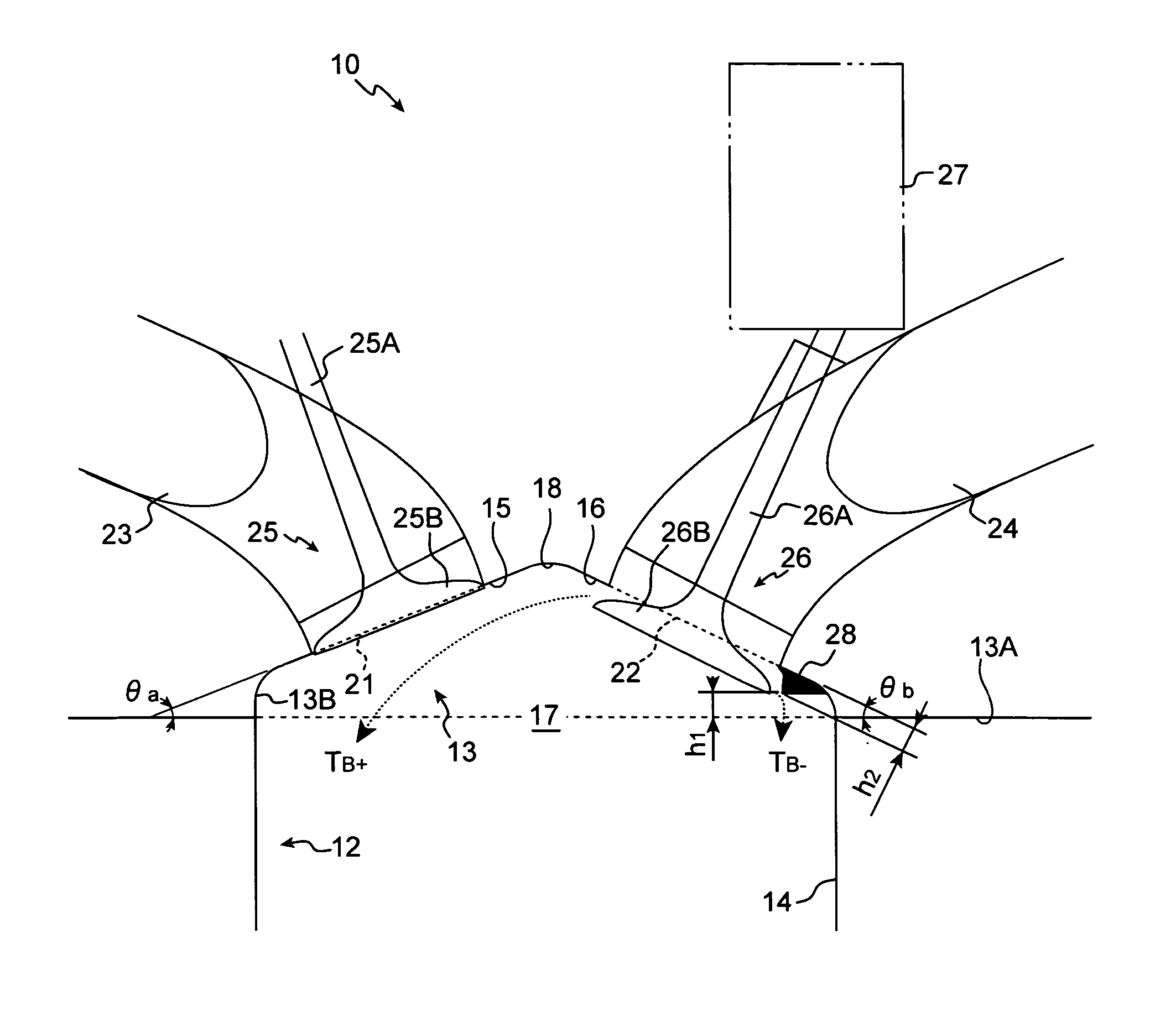
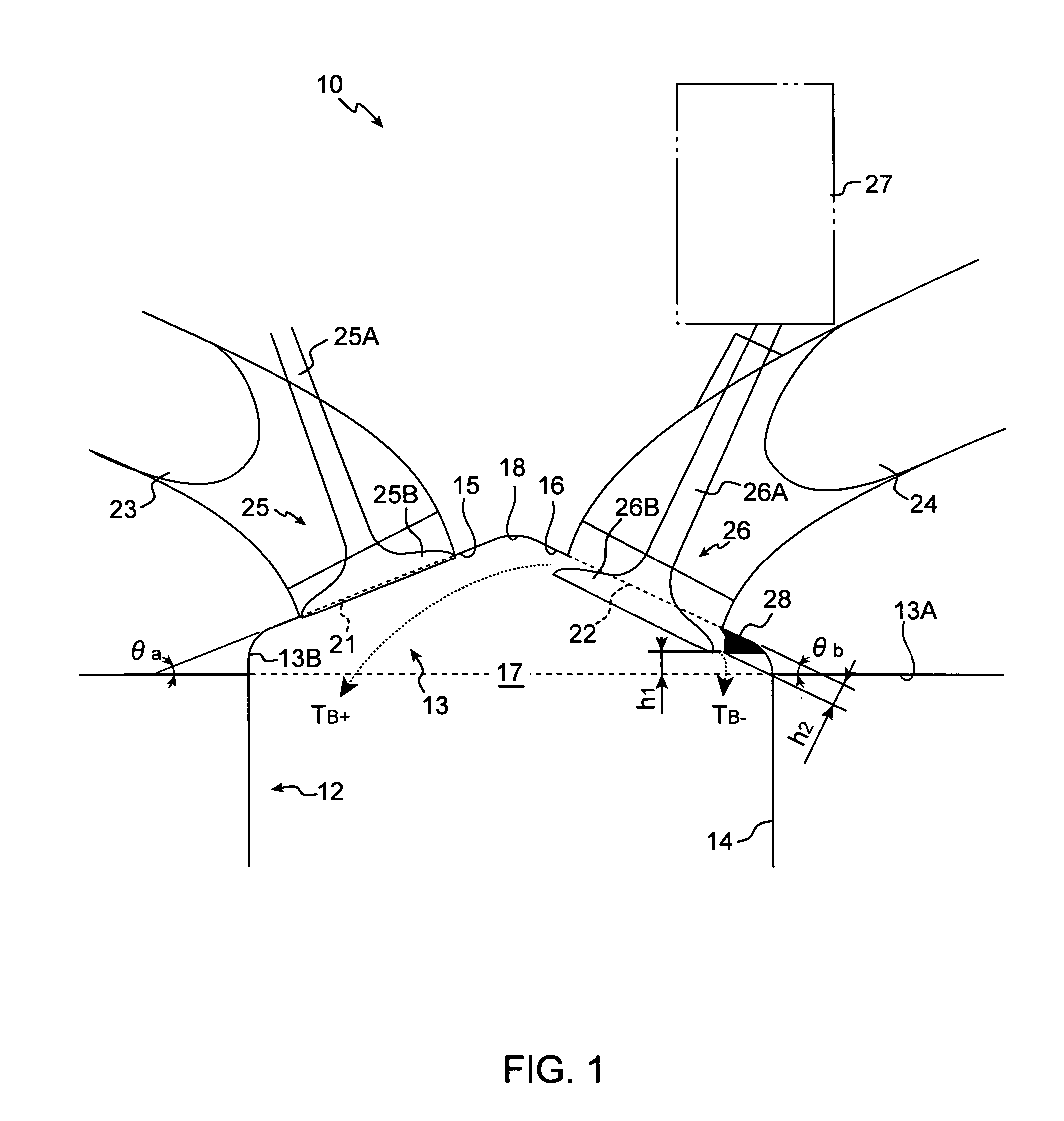
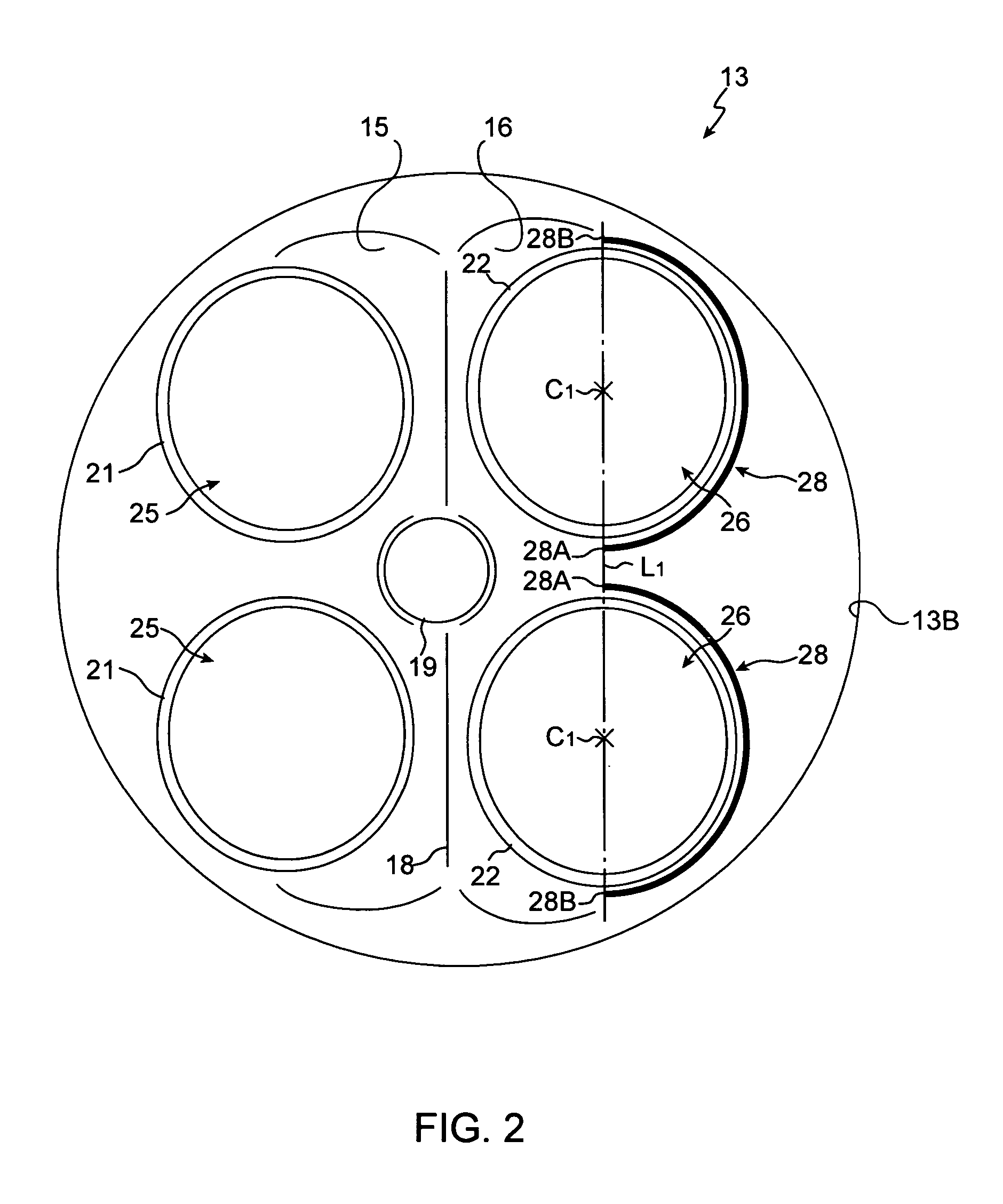
[0030] With reference to the drawings, a description will be given hereinbelow of a structure of a combustion chamber of an engine according to the present invention. FIG. 1 is a cross-sectional view illustratively showing a structure of a combustion chamber thereof, FIG. 2 is a plan view illustratively showing a cylinder head when viewed from a cylinder block side, FIG. 3 is an graphic diagram illustratively showing the relationship between the degree of air flow and a quantity of lift of an intake valve in the combustion chamber, and FIG. 4 is a graphic diagram illustratively showing the relationship between a suction flow into the combustion chamber and a quantity of lift of an intake valve.
[0031] As shown in FIGS. 1 and 2, an engine 10 is mainly made up of a cylinder block 12 and a cylinder head 13. A cylinder is formed in the cylinder block 12, and an exhaust side slope (first inclination surface) 15 and an intake side slope (second inclination surface) 16 are formed in the cyl...
second embodiment
[0088] Yet additionally, the one end portions 48A and 48A of the shroud 48 lies on the straight line L2 connecting the central points C2 and C2 of the intake valves 46 and 46 and are formed between the intake hole portions 42 and 42, while the other end portions 48B and 48B thereof reside on the intake side slope 36, at the outer edge portions of the intake hole portions 42 and 42 and in the vicinity of the cylinder lower end plane 33A.
[0089] Moreover, a lower edge portion 48E of the shroud 48 is made to have the same height as those of the lower end planes 33A and 33C.
[0090] Still moreover, as shown in FIG. 6, the shroud 48 is formed such that the height (see arrows h3 in FIG. 6) relative to the intake side slope 36 is approximately 1.0 millimeter. Incidentally, this height h3 is not limited to approximately 1.0 millimeter, but this height h3 can properly be changed provided that it is below 2.0 millimeters.
[0091] The structure of the engine combustion chamber according to the s...
PUM
 Login to View More
 Abstract
Description
Claims
Application Information
 Login to View More