
Digital camera devices and methods for implementing digital zoom in digital camera devices and corresponding program products
a digital camera and camera device technology, applied in the field of digital camera devices and methods for implementing digital zoom in digital camera devices and corresponding program products, can solve the problems of not introducing genuine new details to the image, prior art solutions that don't take into account different kinds of further use applications, and user's inability to enable smart zoom before he selects a lower resolution, etc., to achieve the effect of improving image quality, less memory and processing power, and improving image quality
- Summary
- Abstract
- Description
- Claims
- Application Information
AI Technical Summary
Benefits of technology
Problems solved by technology
Method used
Image

Examples
example 1
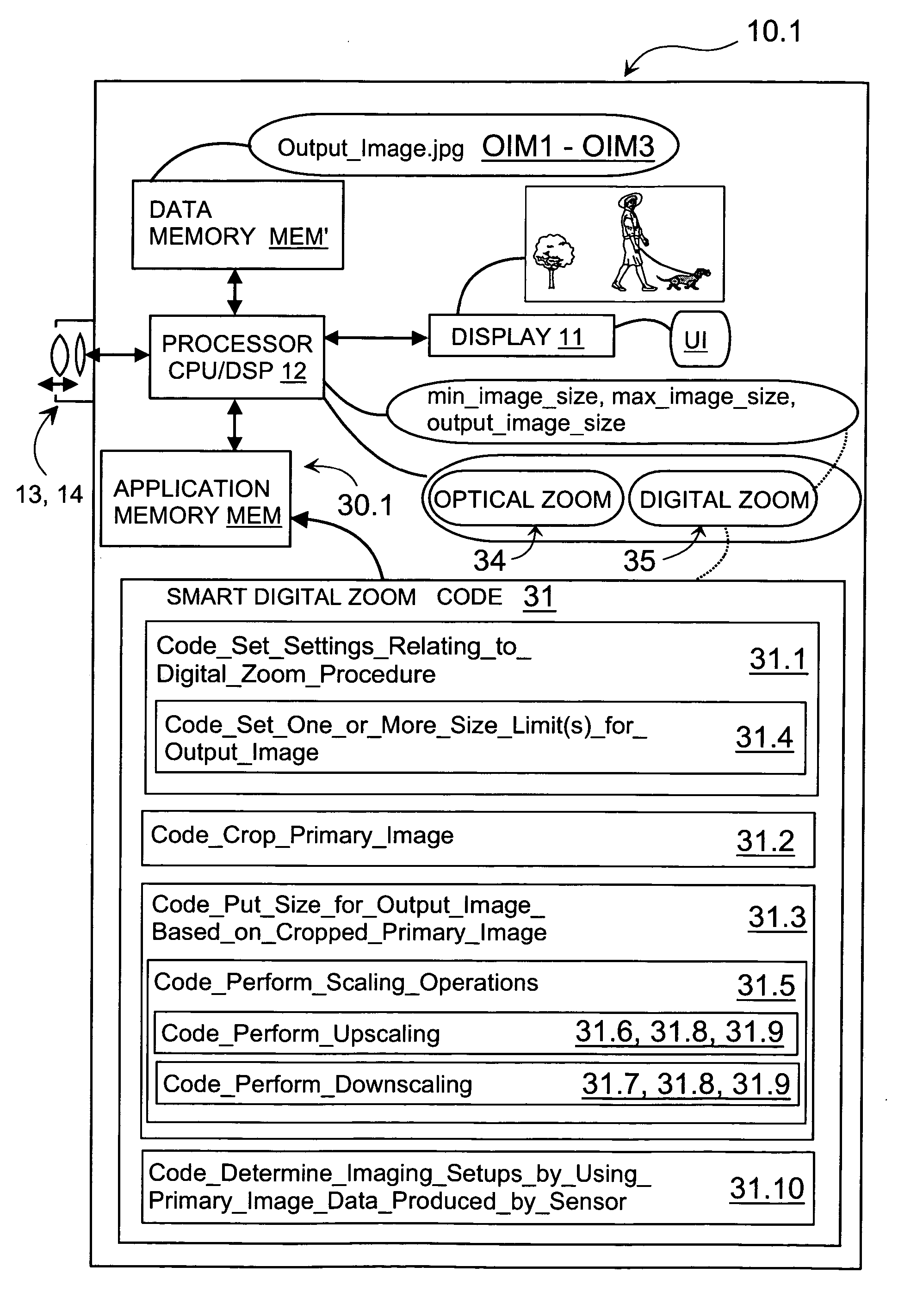
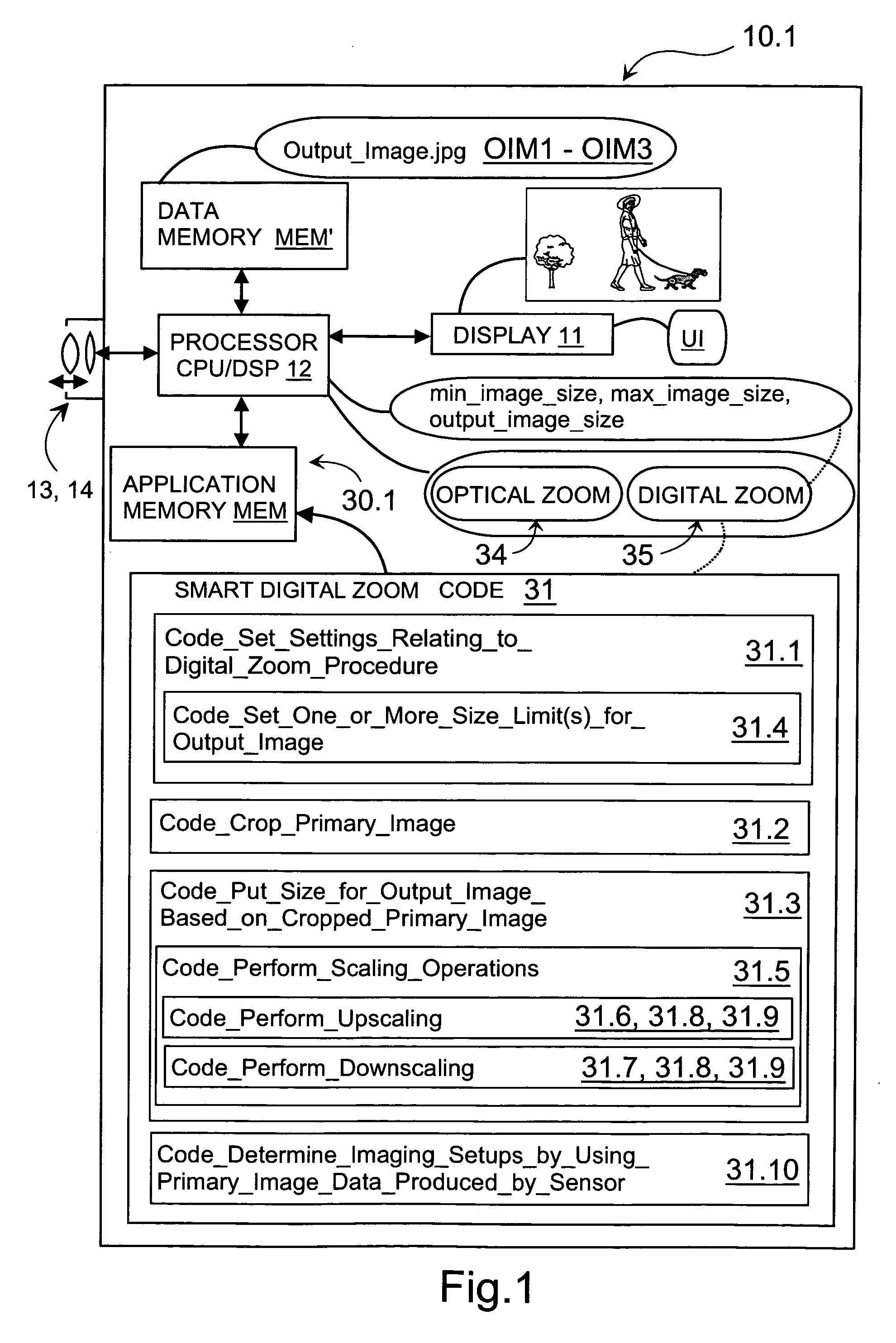
[0125] The photo print service company X uses 254 dpi printing resolution (typical at the moment of filing). User wants to take pictures with his 4 Mpix digital camera device and have postcard size (10×15 (=4″×6″)) printouts of them from this photo service X. Now, the user actually needs ˜1 Mpix images and not 4 Mpix images, because the image files will be downscaled to ˜1 Mpix size anyway in the photo service before printing. The accurate size for the image having postcard size (10×15) is 4×254×6×254=1548384 pix and for the image having postcard size (10×13) is 4×254×4×254×4 / 3=996×1354=1375664 pix. These exact sizes are cited above ˜1 Mpix. The user sets max_image_size to 4 Mpix and min_image_size to 1548384 pix or 1375664 pix, and can use digital camera 10.1 normally. It would not be wise to use the traditional approach, in which the cropped image is interpolated back to original resolution, and then the image is again downscaled before printing. Interpolating / downscaling back and...
example 2
[0127] Advanced users can have better control over the digital zoom operation (use of interpolation), and at the same time normal users don't have to know anything more about digital zoom than with any other approach.
example 3
[0128] User does not need to lower the target resolution when he wants to use smarter digital zoom (like in prior art solutions, for example), output resolution will be decreased automatically when digital zoom factor is bigger than x1.
PUM
 Login to View More
 Abstract
Description
Claims
Application Information
 Login to View More