
Rotary electric machine and electric wheelchair mounted with rotary electric machine
a technology of rotary electric machines and electric wheelchairs, which is applied in the direction of coupling device connections, magnetic circuit rotating parts, magnetic circuit shape/form/construction, etc., can solve the problems of energy loss, fear of being separated during the assembly process, and increase the cost of the circuit, so as to reduce the loss of induction current
- Summary
- Abstract
- Description
- Claims
- Application Information
AI Technical Summary
Benefits of technology
Problems solved by technology
Method used
Image

Examples
first embodiment
[0060] [First Embodiment]
[0061] The first embodiment of the present invention is represented by FIGS. 1 to 12.
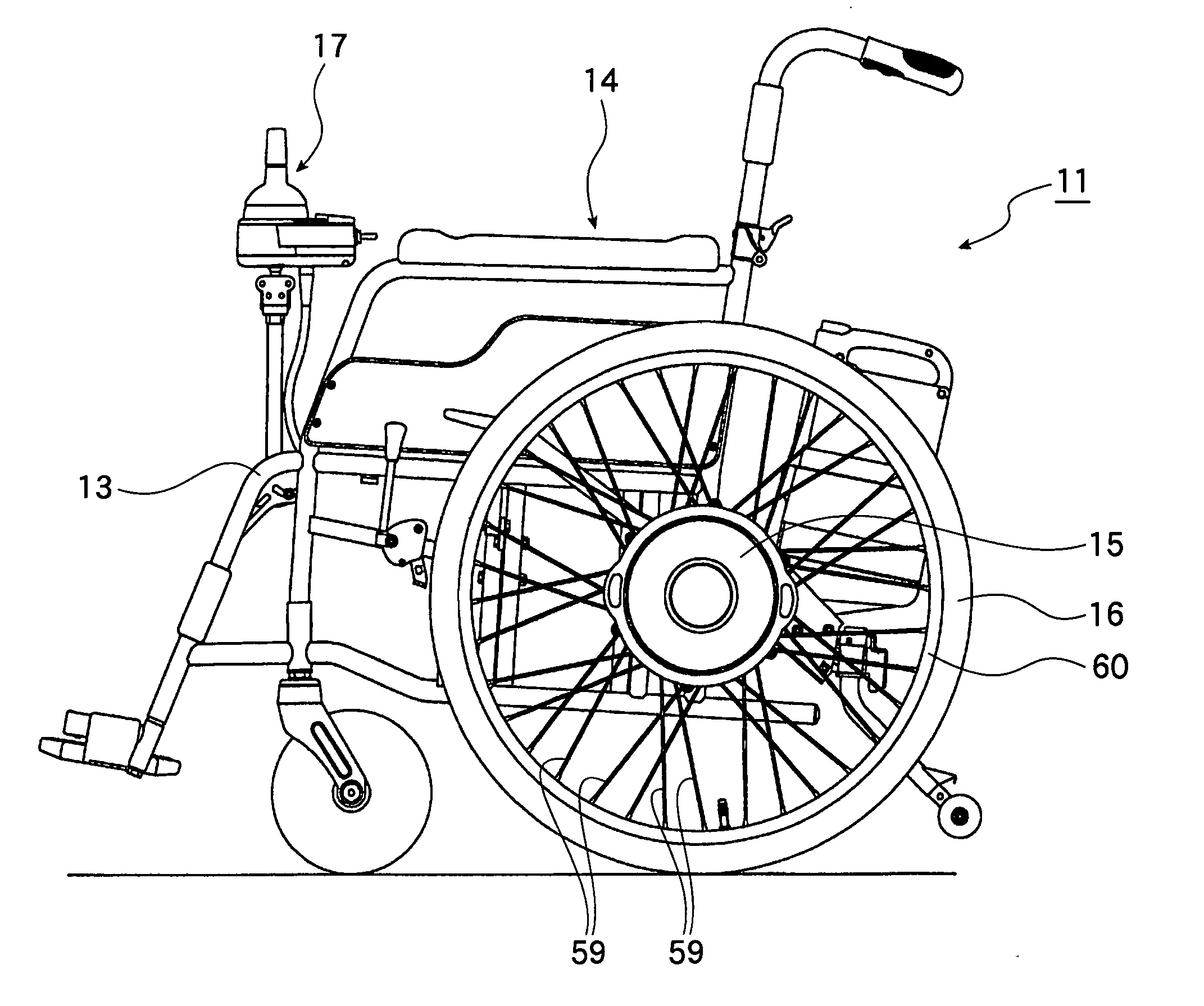
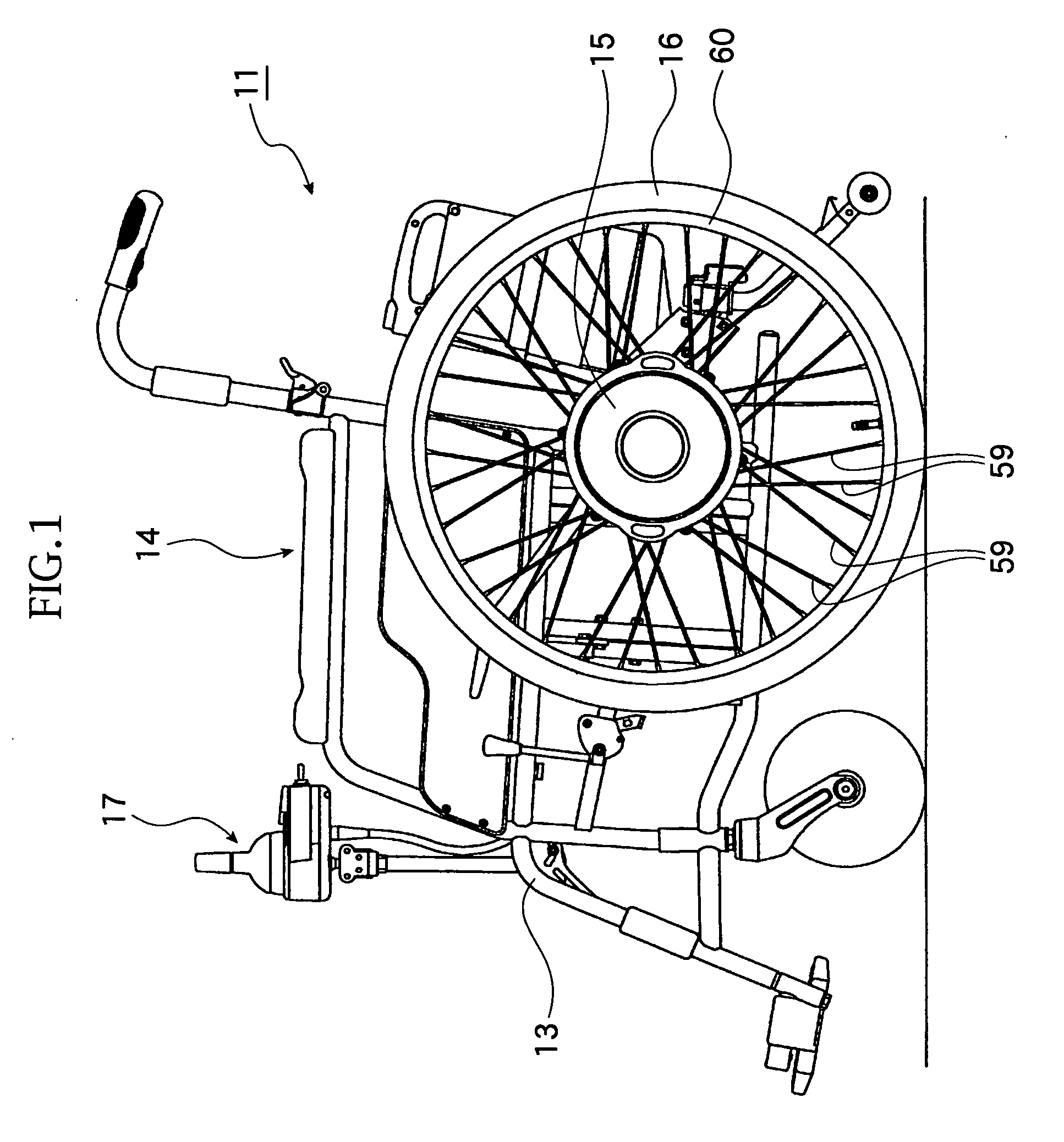
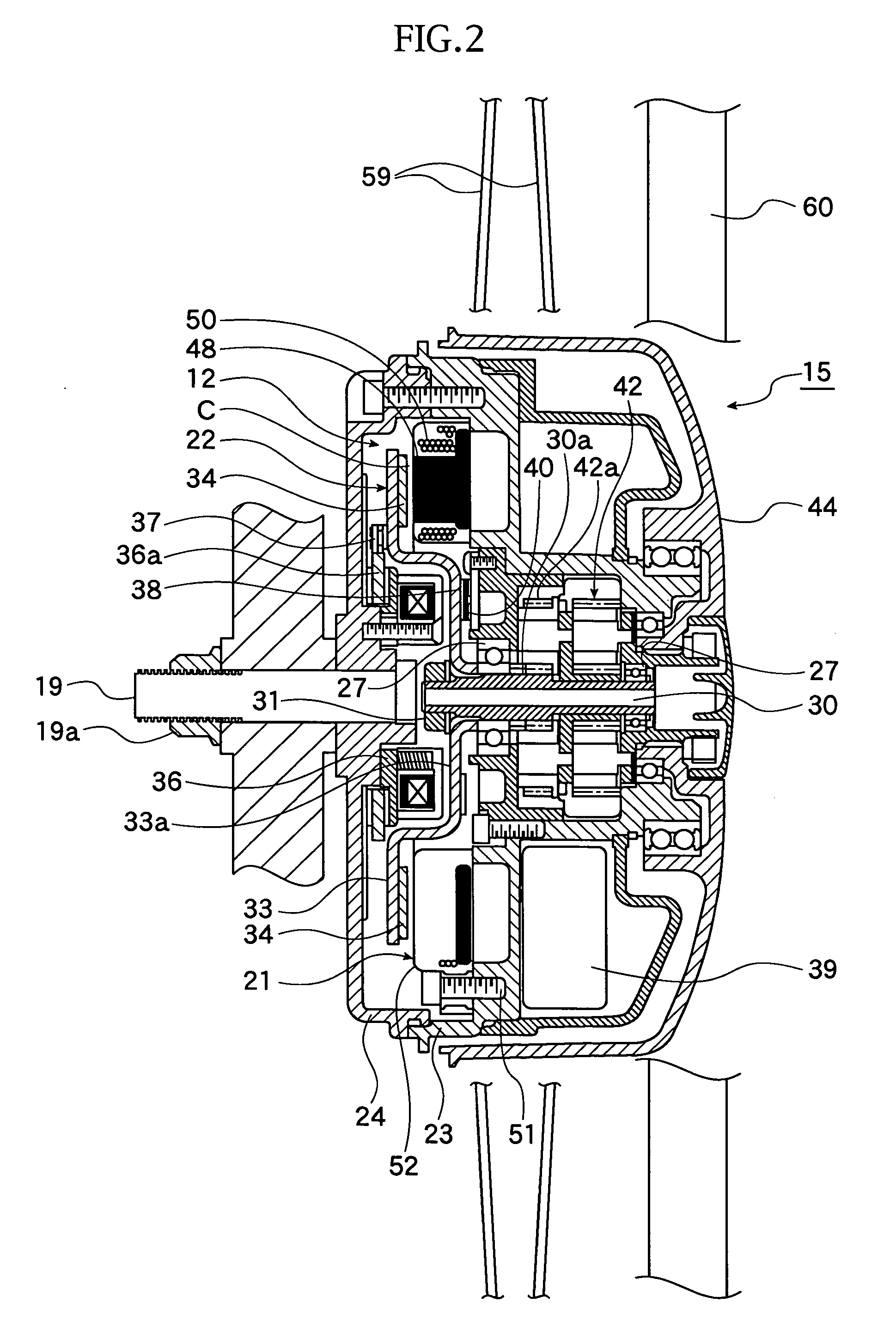
[0062] With reference to FIG. 1, reference numeral 11 denotes an electric wheelchair or electrically powered wheelchair mounted with an electric motor 12 as a “rotary electric machine” according to the present invention, and the electric wheelchair is driven and traveled by the driving force of the electric motor 12.
[0063] The electric wheelchair 11 is provided with a frame 13 as a framework of a vehicle (electric wheelchair body), a seat 14 on which a user sits and a pair of driving wheel units 15 in which the electric motors 12 are mounted. When an operation unit 17 of the electric wheelchair 11 is operated, the paired driving wheel units 15 are driven so as to drive driven wheels 16 by predetermined amount (distance). The driven wheels 16 are operated independently, and by the operation of the operation unit 17, the driven wheels 16 are changed in their rotating directi...
second embodiment
[0091] [Second Embodiment]
[0092]FIGS. 13 and 14 represent the second embodiment of the present invention.
[0093] In this second embodiment, the structure of the fitting portion differs from that of the first embodiment.
[0094] That is, in the first embodiment, the half pierce portion 57a has substantially the circular shape as a front view, but in this second embodiment, this portion has a rectangular shape in the direction along the center line O1 of the wind-up portion 48c as shown in FIG. 13, and the respective magnetic plates 57 are caulked and fixed together by V-shaped caulking portions 57f each showing V-shape as shown in FIG. 14 in cross-section. These two caulking portions 57f are arranged along or on the center line O1 of the wind-up portion 48c as like as the half pierce portions 57a of the first embodiment.
[0095] The structures other than the above are substantially the same as those in the first embodiment, so that explanation thereof is omitted herein.
[0096] It is to...
PUM
 Login to View More
 Abstract
Description
Claims
Application Information
 Login to View More