
Multiphase fluid characterization
a technology of fluid characterization and multiphase, which is applied in the direction of liquid/fluent solid measurement, specific gravity measurement, instruments, etc., can solve the problems of insufficient efficiency of such separators in achieving two pure streams of oil and water, water has no value, and becomes a disposal or environmental problem, etc., to achieve accurate determination of aqueous phase fraction, improve water percentage determination of crude petroleum oil, and reduce uncertainty
- Summary
- Abstract
- Description
- Claims
- Application Information
AI Technical Summary
Benefits of technology
Problems solved by technology
Method used
Image

Examples
example 1
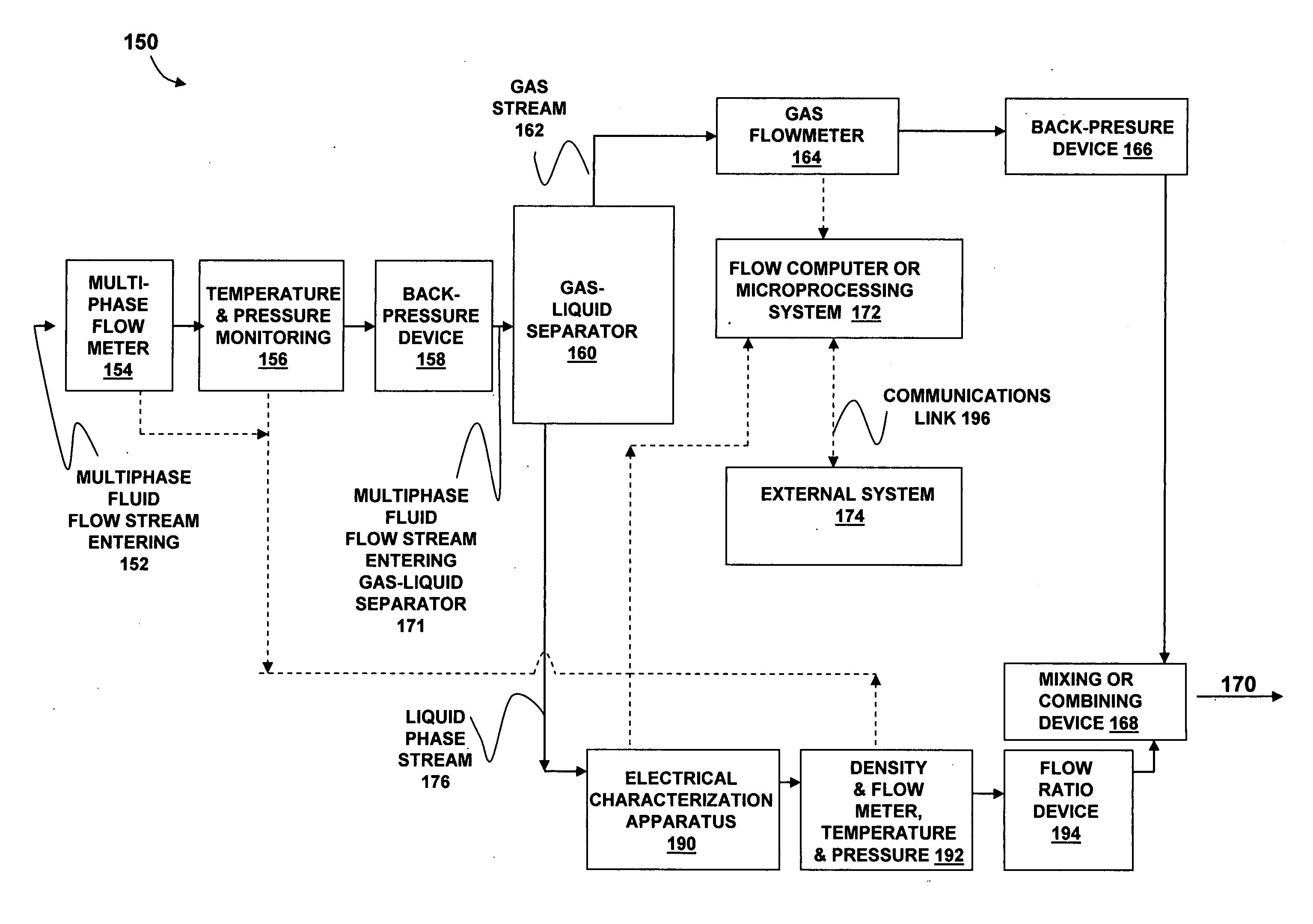
[0088] As an illustrative, non-limiting example, a preferred embodiment of the present invention can be applied to determine the water cut in 247,376 barrels of crude petroleum oil being off-loaded from an oil tanker 237. In this example, system 150 used the method of FIG. 5 and was located at point 239. An auto-sampler 226B was also present and the sample from the off-loading was analyzed using Karl Fischer titration as previously described, and arrived at a value of 0.32% water. In the ship unloading profile of FIG. 6, the flow started and stopped as shown in line 602, ran at half the rate for several hours, and had some very large spikes of water content in the oil, as shown in line 604, at points 606, 608, 610, and 612. Data was collected as per step 506. In normal ship unloading, it is expected to see water contents above 5% at some times during the unloading process FIG. 6A is the same unloading event with the no flow rate cases removed and the remaining data sorted by density...
example 2
[0090] This example is the generally the same experimental design as Example 1 except that heavy crude petroleum oil (API density of 21 degrees) was used instead of light crude petroleum oil (API density of 32 degrees) because it was known that this crude was from Argentina with a history of this density.
[0091] A total of 225,565 barrels of oil were transferred from a ship as shown in FIG. 7 over a 15 hour period. During the unloading, spikes of water content 702 can be seen on the instantaneous water cut from electrical characterization apparatus 190. FIG. 7A shows the sorted densities per step 508 and the sorted water cuts corrected for the density of the oil shipped per step 514. The flow-weighted average water cut by permittivity was 0.21% per step 520. The flow-weighted average water cut by density was 0.47% per step 518. The composite water cut by offline titration was 0.75%. Later, it was found that the titration value of 0.75% water was an invalid number due to interference...
PUM
 Login to View More
 Abstract
Description
Claims
Application Information
 Login to View More