Unlock instant, AI-driven research and patent intelligence for your innovation.

System and method for evolutionary clustering of sequential data sets

a sequential data and clustering technology, applied in the field of computer systems, can solve the problems of not accurately identifying and tracking annual clusters, and the clustering algorithm may produce poor clustering sequences

Inactive Publication Date: 2007-11-01
R2 SOLUTIONS
View PDF16 Cites 7 Cited by
  • Summary
  • Abstract
  • Description
  • Claims
  • Application Information

AI Technical Summary

Benefits of technology

[0007] Briefly, the present invention may provide a system and method for evolutionary clustering of sequential data sets. Evolutionary clustering of sequential data sets may be provided by a clustering server having an operably coupled clustering engine. The clustering engine may include a snapshot cost evaluator for determining a cost of clustering each data set in the sequence independent of the clusterings of the other data sets in the sequence. The clustering engine may also include a history cost evaluator for determining a cost of clustering the data set as part of a series of clusterings of the data sets in the sequence. The clustering engine may also include an overall cost evaluator for minimizing the combination of the snapshot cost of clustering the data set independently of the series of clusterings of the data sets in the sequence and the history cost of clustering the data set as part of the series of clusterings of the data sets in the sequence.
[0008] Advantageously any clustering method may be used to produce a series of evolutionary clusterings from a sequence of data sets. A snapshot cost may be determined for representing the data set for a particular clustering method used and may determine the cost of clustering the data set independently of a series of clusterings of the data sets in the sequence. A history cost may also be determined for measuring the distance between corresponding clusters of the data set and the previous data set in the sequence of data sets in order to determine a cost of clustering the data set as part of a series of clusterings of the data sets in the sequence. An overall cost may be determined for minimizing the combination of the snapshot cost of clustering the data set independently of the series of clusterings of the data sets in the sequence and the history cost of clustering the data set as part of the series of clusterings of the data sets in the sequence. Additionally, a greedy heuristic may be applied to minimize the distance between corresponding clusters of the data set and the previous data set in the sequence of data sets.
[0009] In various embodiments, a flat clustering engine may be provided for clustering the data set using a flat clustering of points, possibly in a vector space. For example, a k-means algorithm may be used in one embodiment to provide a flat clustering of points in a vector space. The snapshot cost for k-means may be determined to be the average distance from a point to its cluster center. The history cost for k-means may be determined to be the average distance from a cluster center to its closest equivalent in the previous clustering. The data set may then be clustered by minimizing the combination of the snapshot cost of using flat clustering to independently cluster the data set and the history cost of using flat clustering to cluster the data set as part of a sequence of clustered data sets.
[0010] In various other embodiments, a hierarchical clustering engine may be provided for clustering the data set using hierarchical clustering. For instance, a bottom-up agglomerative hierarchical clustering algorithm may be used in an embodiment to provide a hierarchical clustering. The snapshot cost of using agglomerative hierarchical clustering may be determined to be the average similarity encountered during a merge while creating a tree representing each cluster. The history cost of using agglomerative hierarchical clustering may be determined to be the sum of squared distances over all pairs of data points between a hierarchical clustering tree of the data set and a corresponding hierarchical clustering tree of the previous data set. The data set sequence may then be clustered by minimizing the combination of the snapshot cost of using hierarchical clustering to independently cluster the data set and the history cost of using hierarchical clustering to cluster the data set as part of a sequence of clustered data sets.

Problems solved by technology

As a result, static clustering techniques that may accurately identify monthly clusters of email membership may not identify and track annual clusters as accurately as those that model the email membership for the calendar year.
Unfortunately, such static clustering algorithms may produce a poor clustering sequence over time.

Method used

the structure of the environmentally friendly knitted fabric provided by the present invention; figure 2 Flow chart of the yarn wrapping machine for environmentally friendly knitted fabrics and storage devices; image 3 Is the parameter map of the yarn covering machine
View more

Image

Smart Image Click on the blue labels to locate them in the text.
Viewing Examples
Smart Image
  • System and method for evolutionary clustering of sequential data sets
  • System and method for evolutionary clustering of sequential data sets
  • System and method for evolutionary clustering of sequential data sets

Examples

Experimental program
Comparison scheme
Effect test

Embodiment Construction

Exemplary Operating Environment

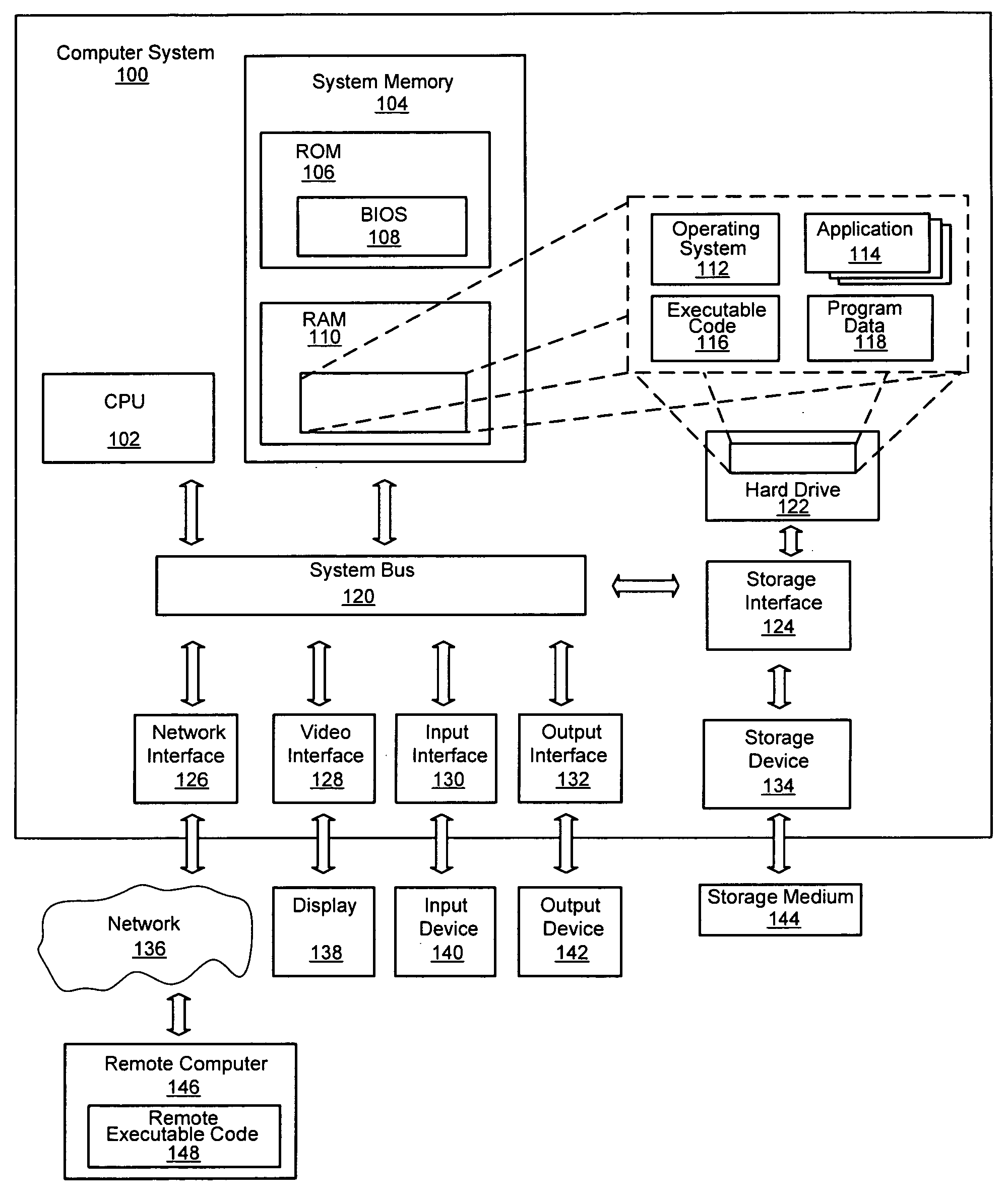
[0019]FIG. 1 illustrates suitable components in an exemplary embodiment of a general purpose computing system. The exemplary embodiment is only one example of suitable components and is not intended to suggest any limitation as to the scope of use or functionality of the invention. Neither should the configuration of components be interpreted as having any dependency or requirement relating to any one or combination of components illustrated in the exemplary embodiment of a computer system. The invention may be operational with numerous other general purpose or special purpose computing system environments or configurations.

[0020] The invention may be described in the general context of computer-executable instructions, such as program modules, being executed by a computer. Generally, program modules include routines, programs, objects, components, data structures, and so forth, which perform particular tasks or implement particular abstract data ty...

the structure of the environmentally friendly knitted fabric provided by the present invention; figure 2 Flow chart of the yarn wrapping machine for environmentally friendly knitted fabrics and storage devices; image 3 Is the parameter map of the yarn covering machine
Login to View More

PUM

No PUM Login to View More

Abstract

An improved system and method for evolutionary clustering of sequential data sets is provided. A snapshot cost may be determined for representing the data set for a particular clustering method used and may determine the cost of clustering the data set independently of a series of clusterings of the data sets in the sequence. A history cost may also be determined for measuring the distance between corresponding clusters of the data set and the previous data set in the sequence of data sets to determine a cost of clustering the data set as part of a series of clusterings of the data sets in the sequence. An overall cost may be determined for clustering the data set by minimizing the combination of the snapshot cost and the history cost. Any clustering method may be used, including flat clustering and hierarchical clustering.

Description

CROSS-REFERENCE TO RELATED APPLICATIONS [0001] The present invention is related to the following United States patent applications, filed concurrently herewith and incorporated herein in their entireties: [0002]“System and Method Using Flat Clustering for Evolutionary Clustering of Sequential Data Sets,” Attorney Docket No. 1140; and [0003]“System and Method Using Hierarchical Clustering for Evolutionary Clustering of Sequential Data Sets,” Attorney Docket No. 1150.FIELD OF THE INVENTION [0004] The invention relates generally to computer systems, and more particularly to an improved system and method for evolutionary clustering of sequential data sets. BACKGROUND OF THE INVENTION [0005] Typical software applications that may apply clustering techniques usually cluster static data sets. Many software applications today may also cluster a large static data set at one point in time and then may later cluster a changed representation of the large static data set. For example, the large ...

Claims

the structure of the environmentally friendly knitted fabric provided by the present invention; figure 2 Flow chart of the yarn wrapping machine for environmentally friendly knitted fabrics and storage devices; image 3 Is the parameter map of the yarn covering machine
Login to View More

Application Information

Patent Timeline
no application Login to View More
IPC IPC(8): G06F7/00
CPCG06K9/6218G06F17/30705G06F16/35G06F18/23
Inventor CHAKRABARTI, DEEPAYANRAVIKUMAR, SHANMUGASUNDARAMTOMKINS, ANDREW
Owner R2 SOLUTIONS
Features
  • R&D
  • Intellectual Property
  • Life Sciences
  • Materials
  • Tech Scout
Why Patsnap Eureka
  • Unparalleled Data Quality
  • Higher Quality Content
  • 60% Fewer Hallucinations
Social media
Patsnap Eureka Blog
Learn More