
Disease Prevention and Vaccination Prior to Thymic Reactivation
- Summary
- Abstract
- Description
- Claims
- Application Information
AI Technical Summary
Benefits of technology
Problems solved by technology
Method used
Image

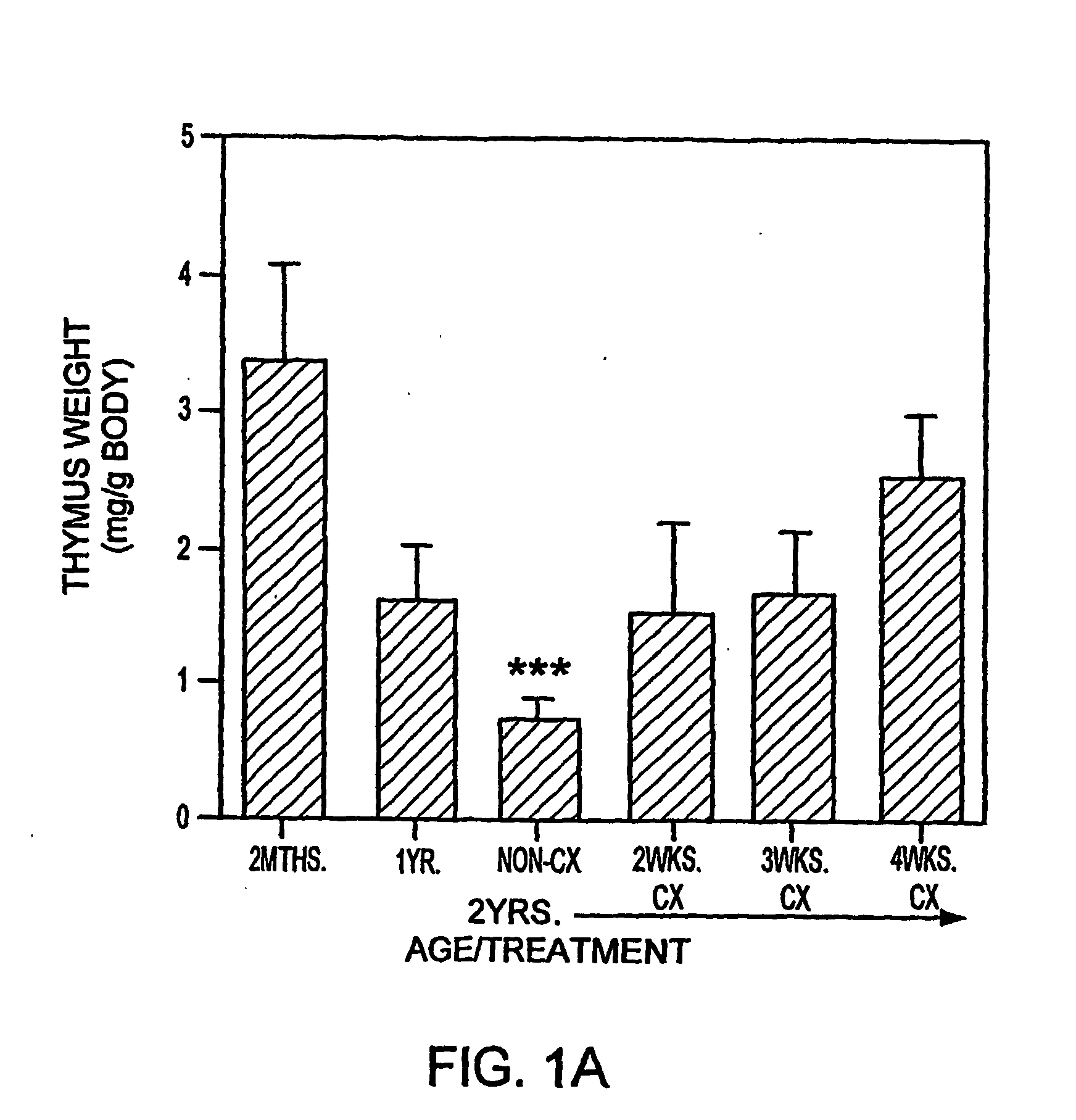
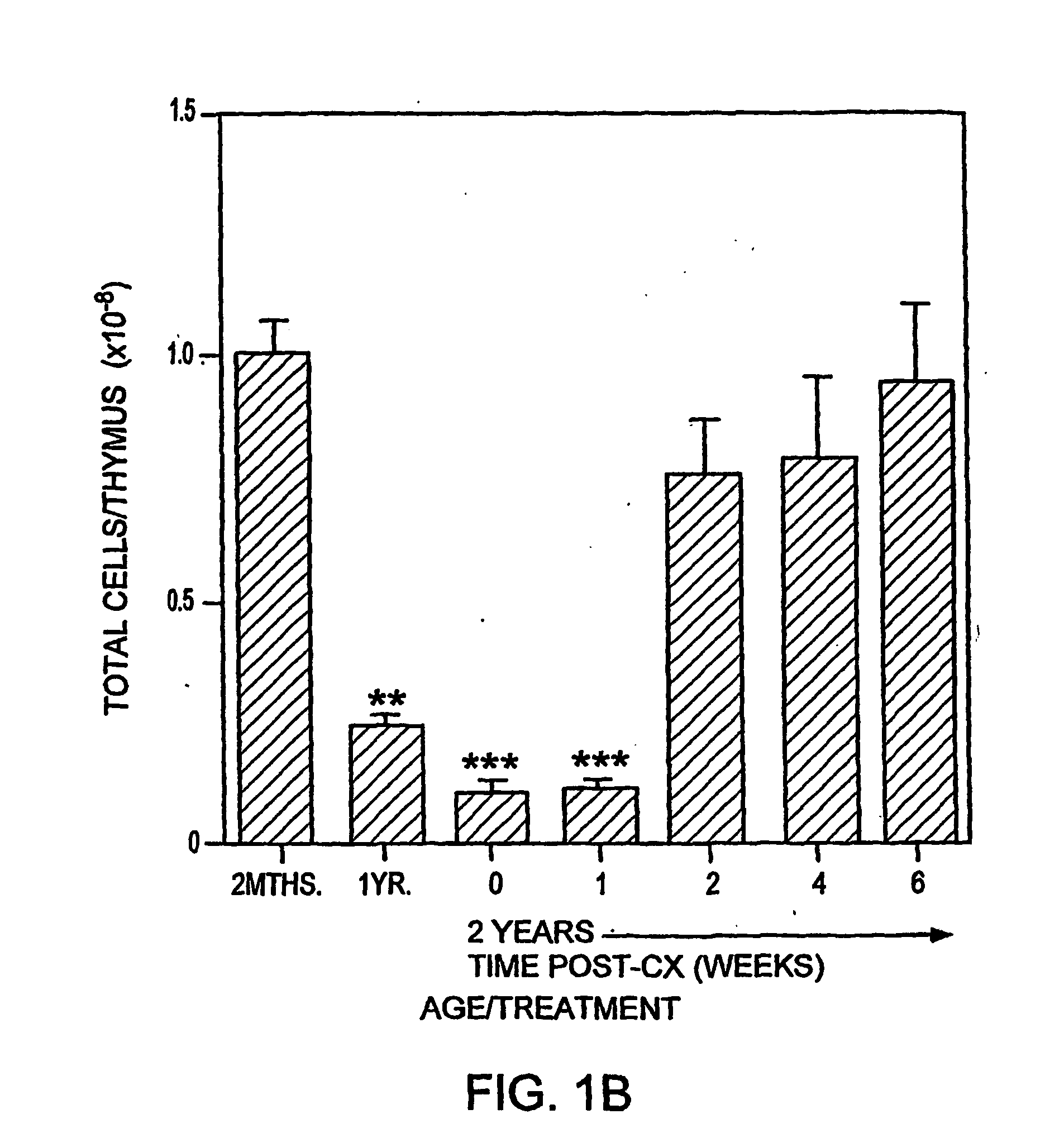
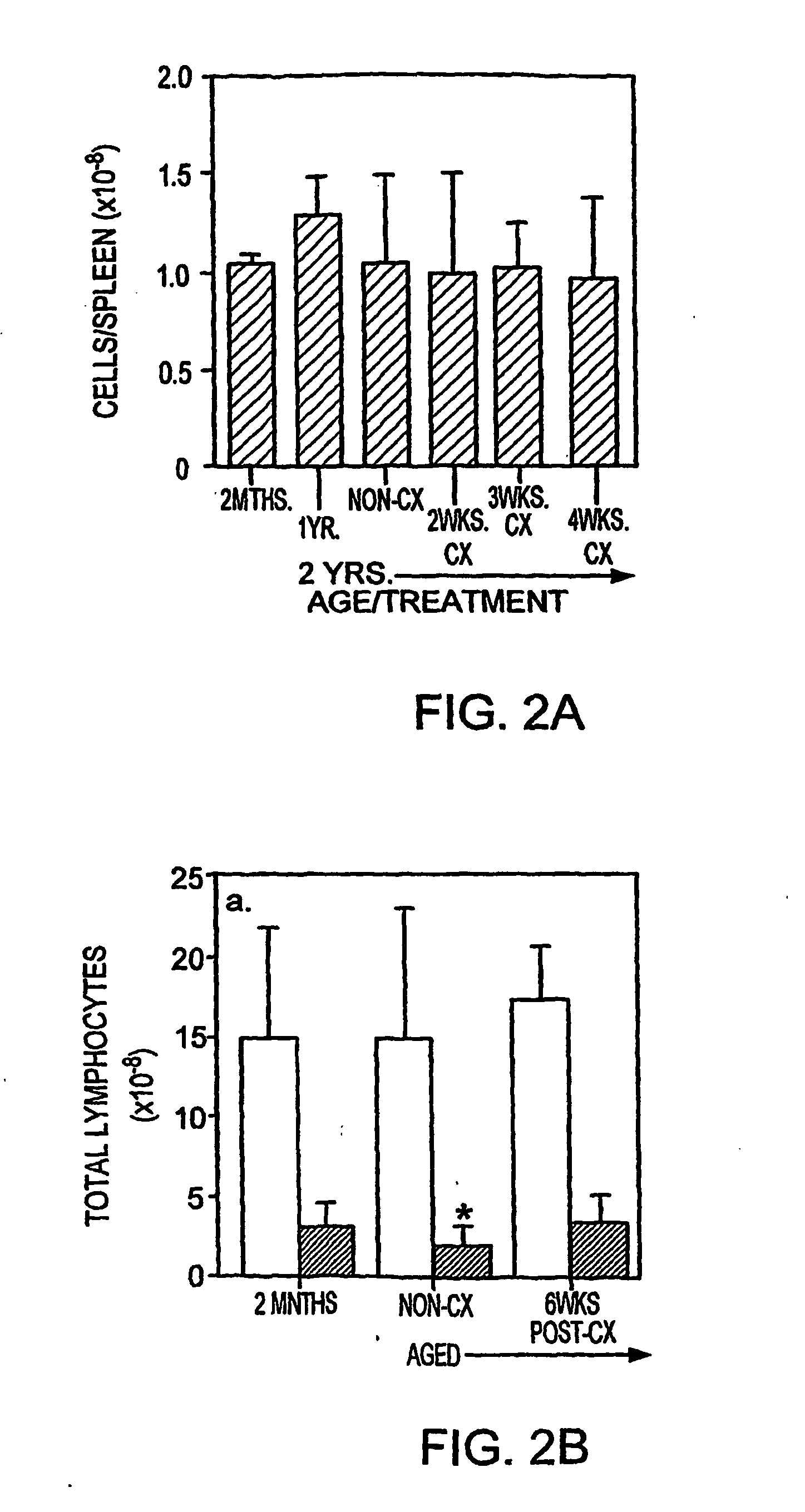
Examples
example 1
Reversal of Aged-Induced Thymic Atrophy
[0359]Materials and Methods
[0360]Animals. CBA / CAH and C57B16 / J male mice were obtained from Central Animal Services, Monash University and were housed under conventional conditions. C57B16 / J Ly5.1+ were obtained from the Central Animal Services Monash University, the Walter and Eliza Hall Institute for Medical Research (Parkville, Victoria) and the A.R.C. (Perth, Western Australia) and were housed under conventional conditions. Ages ranged from 4-6 weeks to 26 months of age and are indicated where relevant.
[0361]Surgical castration. Animals were anesthetized by intraperitoneal injection of 0.3 ml of 0.3 mg xylazine (Rompun®; Bayer Australia Ltd., Botany NSW, Australia) and 1.5 mg ketamine hydrochloride (Ketalar®; Parke-Davis, Caringbah, NSW, Australia) in saline. Surgical castration was performed by a scrotal incision, revealing the testes, which were tied with suture and then removed along with surrounding fatty tissue. The wound was closed us...
example 2
Reversal of Chemotherapy- or Radiation-Induced Thymic Atrophy
[0400]Materials and Methods
[0401]Materials and methods were as described in Example 1. In addition, the following methods were used.
[0402]BM Reconstitution. Recipient mice (34 month-old C57BL6 / J) were subjected to 5.5 Gy irradiation twice over a 3-hour interval. One hour following the second irradiation dose, mice were injected intravenously with 5×10⁶ donor BM cells. BM cells were obtained by passing RPMI-1640 media through the tibias and femurs of donor (2-month old congenic C57BL6 / J Ly5.1+) mice, and then harvesting the cells collected in the media.
[0403]Irradiation. 3-4 month old mice were subjected to 625 rads of whole body v-irradiation.
[0404]T cell Depletion Using Cyclophosphamide. Old mice (e.g., 2 years old) were injected with cyclophosphamide (200 mg / kg body wt over two days) and castrated.
[0405]Results
[0406]Castration-enhanced regeneration following severe T cell depletion (TCD). For both models of T cell deplet...
example 3
Thymic Regeneration Following Inhibition of Sex Steroids Results in Restoration of Deficient Peripheral T Cell Function
[0421]Materials and Methods
[0422]Materials and methods were as described in Examples 1 and 2. In addition, the following methods were used.
[0423]HSV-1 Immunization. Aged (≧18 months) mice were surgically castrated 6 weeks after castration (following thymus reactivation). Following anesthetic, mice were injected in the hind leg (foot-hock) with 4×10⁵ plaque forming units (pfu) of HSV-1 (KOS strain) in sterile PBS using a 20-gauge needle. Infected mice were housed in isolated cages and humanely killed on D5 post-immunization at which time the popliteal (draining) lymph nodes were removed for analysis.
[0424]Virus was obtained from Assoc. Prof. Frank Carbone (Melbourne University). Virus stocks were grown and titrated on VERO cell monolayers in MEM supplemented with 5% FCS (Gibco-BRL, Australia).
[0425]Analysis of the draining (popliteal) lymph nodes was performed on D5 ...
PUM
| Property | Measurement | Unit |
|---|---|---|
| Time | aaaaa | aaaaa |
Abstract
Description
Claims
Application Information
 Login to View More