
Integrating a voice browser into a web 2.0 environment
a voice browser and web 2.0 technology, applied in the field of speech processing and web 2.0 technologies, can solve the problems that speech capabilities cannot enter many important software market segments, and the creation of interfaces to networked speech processing systems, and achieve the effect of reducing the complexity of the voice browser
- Summary
- Abstract
- Description
- Claims
- Application Information
AI Technical Summary
Benefits of technology
Problems solved by technology
Method used
Image

Examples
Embodiment Construction
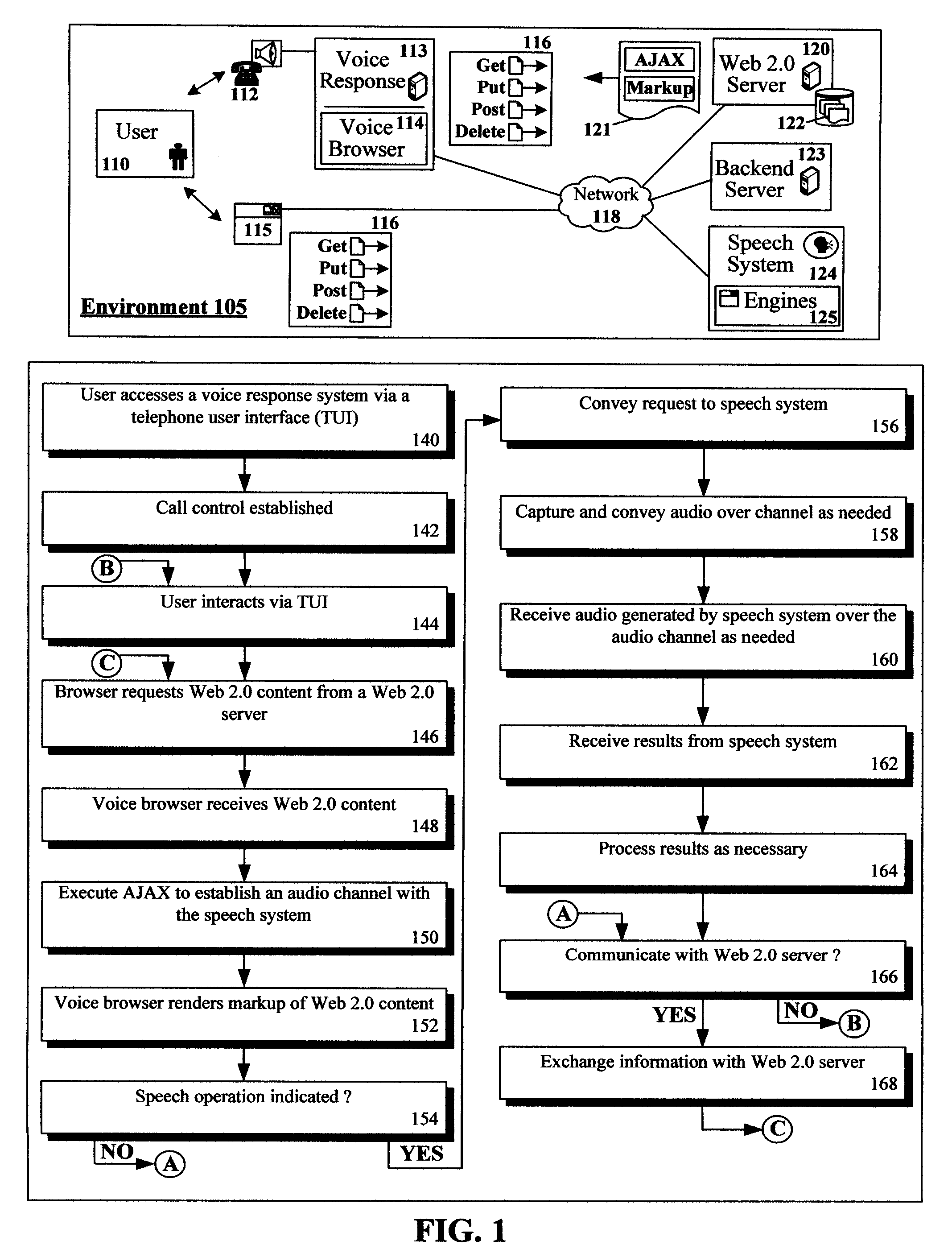
[0022]FIG. 1 is a flow diagram illustrating a voice browser 114 integrated into a speech-enabled Web 2.0 environment 105 in accordance with an embodiment of the inventive arrangements disclosed herein. In illustrated environment 105, an end-user 110 can use a voice only interface 112 to interact with a voice response system 113. The voice response system 113 interfaces with a Web 2.0 server 120 over a network 118. The Web 2.0 server 120 can serve Web content 121 of speech-enabled applications 122. Speech processing operations for the applications 122 can be performed by speech engines 125 of a speech system 124. Further, the Web 2.0 server 120 can serve backend content from server 123 to the user 110 and can provide user responses to the back-end server 123 as appropriate. In one embodiment, user 110 can alternatively use a Web browser 115 to interact with the Web 2.0 server 120. Common interface mechanisms can be used by both voice browser 114 and Web browser 115.
[0023]For example,...
PUM
 Login to View More
 Abstract
Description
Claims
Application Information
 Login to View More