[0004]The present invention is based on this problem and has the object of providing passengers with information about the status of their airline baggage quickly and reliably even after the baggage has been handed over at the check-in
desk, and of providing the necessary information in the event of loss in order to make binding statements about the loss of the airline baggage.
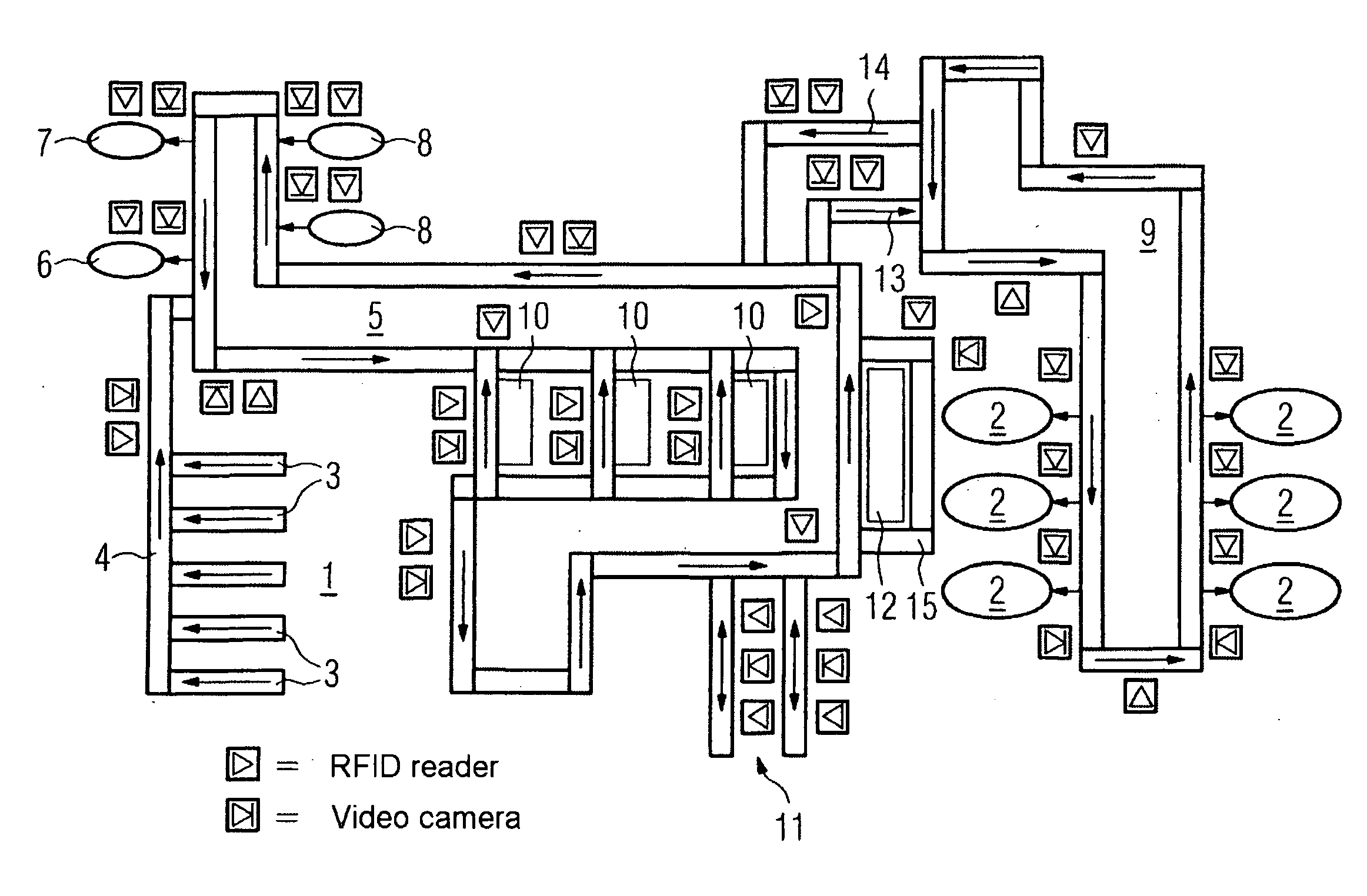
[0007]In order to allow tracking, particularly in the latter case, where a piece of luggage has disappeared from the installation and where it is missing, it is helpful to know the appearance of the piece of luggage. A further feature of the invention therefore proposes that, before the airline baggage is passed to the transport route, each piece of airline baggage is recorded photographically, and the image is stored to allow subsequent evaluation. The stored photograph helps the identification of the piece of airline baggage during the subsequent video analysis, thus assisting further investigations for its loss. Together with the photograph, the passenger-related data is recorded in the control computer, thus allowing association with the passenger without any problems.
[0008]In order to ensure that the information carriers which have been applied to the piece of airline baggage are read correctly, the invention provides that, before being passed to the transport route, the piece of airline baggage is checked for any old unusable information carriers which may be present, and if appropriate these are removed. This makes it possible to ensure that a data storage medium which has inadvertently remained on a suitcase from a previous journey does not corrupt the reading result, or make it unusable.
[0009]One advantageous refinement of the invention provides that, before being passed to the transport route, each piece of airline baggage is provided with an RFID tag, possibly in addition to the information carrier on which a
barcode is printed. The identification of a piece of airline baggage and the storage of flight
information data can best be achieved by RFID tags, because any desired information can be stored on them and read from them. In general, pieces of airline baggage are provided with
barcode labels, which are normally looped around the
handle of the piece of baggage, and are secured. RFID tags can additionally be adhesively bonded to the piece of baggage and / or to this information carrier in the form of a
barcode strip, thus allowing redundant monitoring when the information carriers are read. The invention may, of course, be carried out just as well with pure barcode information carriers, in the same way as with information carriers which have only RFID tags.
[0014]Finally, it is also possible for the ground personnel to give the airline passenger the information on leaving the gate that his airline baggage is not
on board, and that further steps are being or have been initiated. In the same way, if it has not been possible to provide the airline passenger with the information on departure, the message can be passed to him on arrival at the destination airport that the airline baggage was not
on board, thus avoiding unnecessary waiting times at the carousel. The airline passenger can then immediately check, for example with the “lost baggage”
desk, and can be provided with information about the loss of the baggage. If the baggage has been misplaced, then the piece of baggage can be identified and searched for specifically with the aid of the photographs which have been taken during the check-in process at the departure airport and can be transmitted digitally to the destination airport.



 Login to View More
  Login to View More