Apparatus for detecting brain function

a brain function and apparatus technology, applied in the field of apparatus for detecting brain function, can solve the problems of difficult to maintain the electrode position in a predetermined positional relationship, difficult to arrange the electrodes at the correct position, etc., and achieve the effect of greater certainty and greater accuracy in detecting the brain function status

a brain function and apparatus technology, applied in the field of apparatus for detecting brain function, can solve the problems of difficult to maintain the electrode position in a predetermined positional relationship, difficult to arrange the electrodes at the correct position, etc., and achieve the effect of greater certainty and greater accuracy in detecting the brain function status

US20090171181A1Inactive Publication Date: 2009-07-02OLYMPUS CORP +1

Image

Smart Image Click on the blue labels to locate them in the text.
Viewing Examples
Smart Image
  • Apparatus for detecting brain function
  • Apparatus for detecting brain function
  • Apparatus for detecting brain function

Examples

Experimental program
Comparison scheme
Effect test

Embodiment Construction

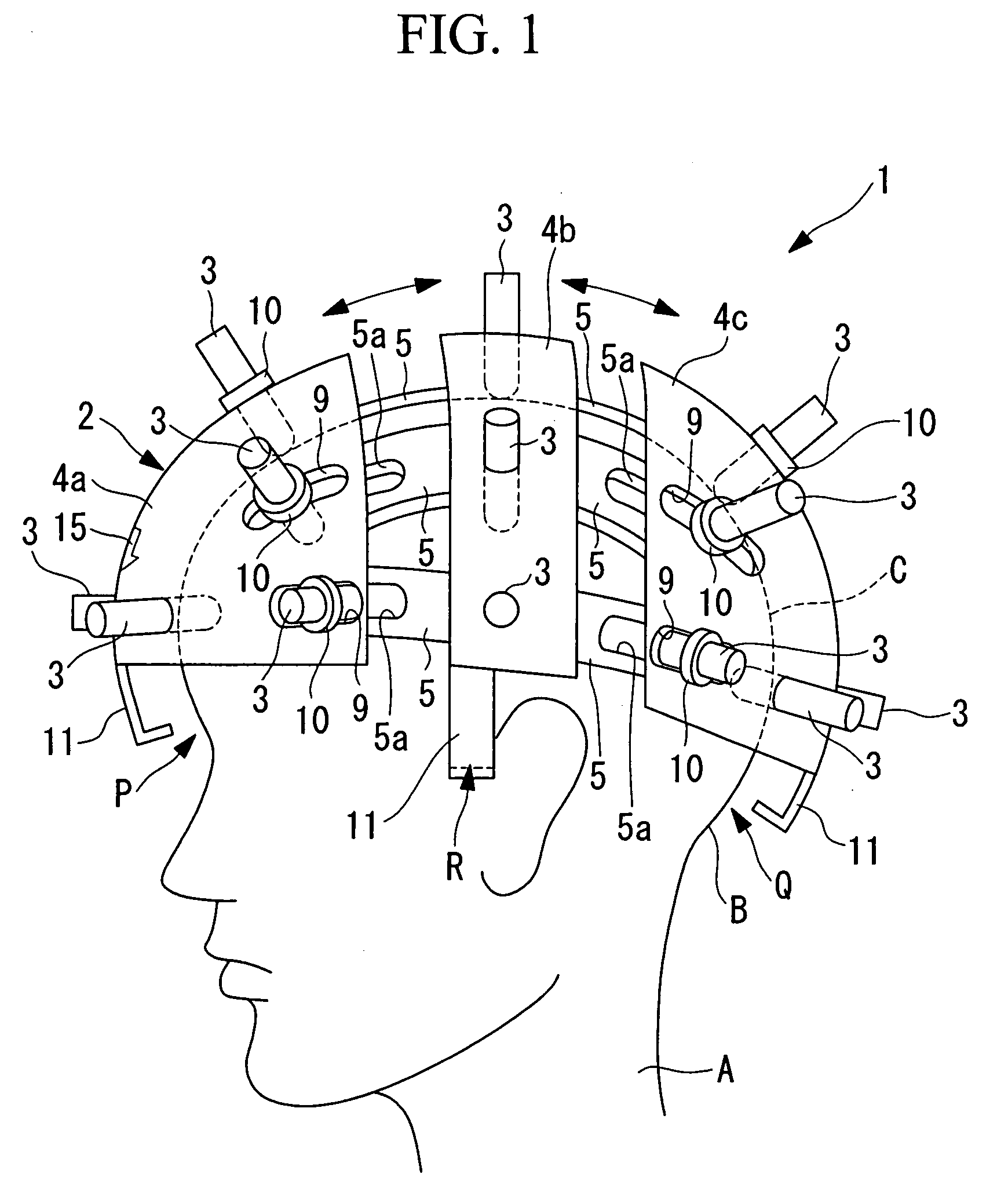
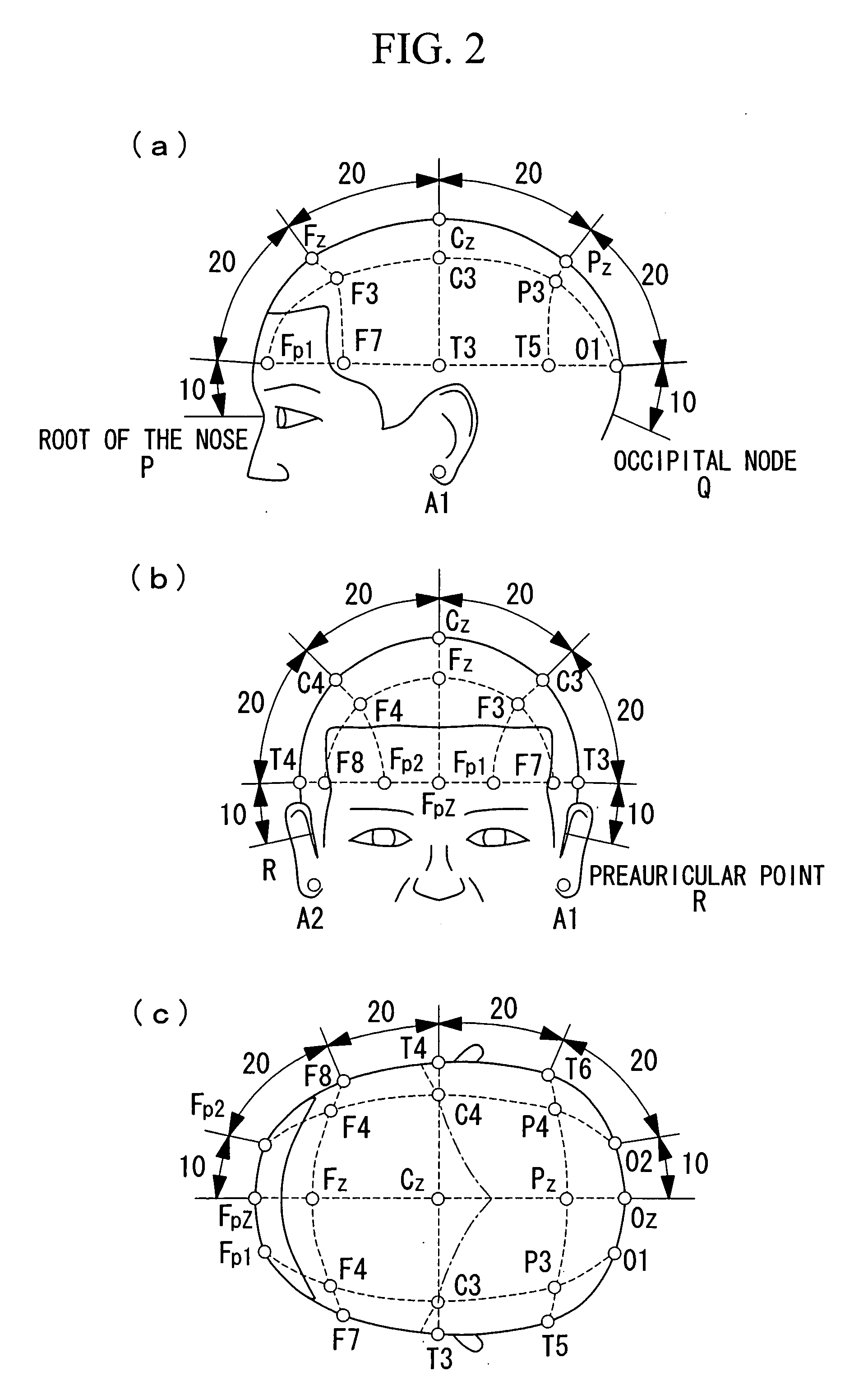
[0036]A brain function detection apparatus according to a first embodiment of the present invention will be explained in the following with reference to FIGS. 1 and 2.

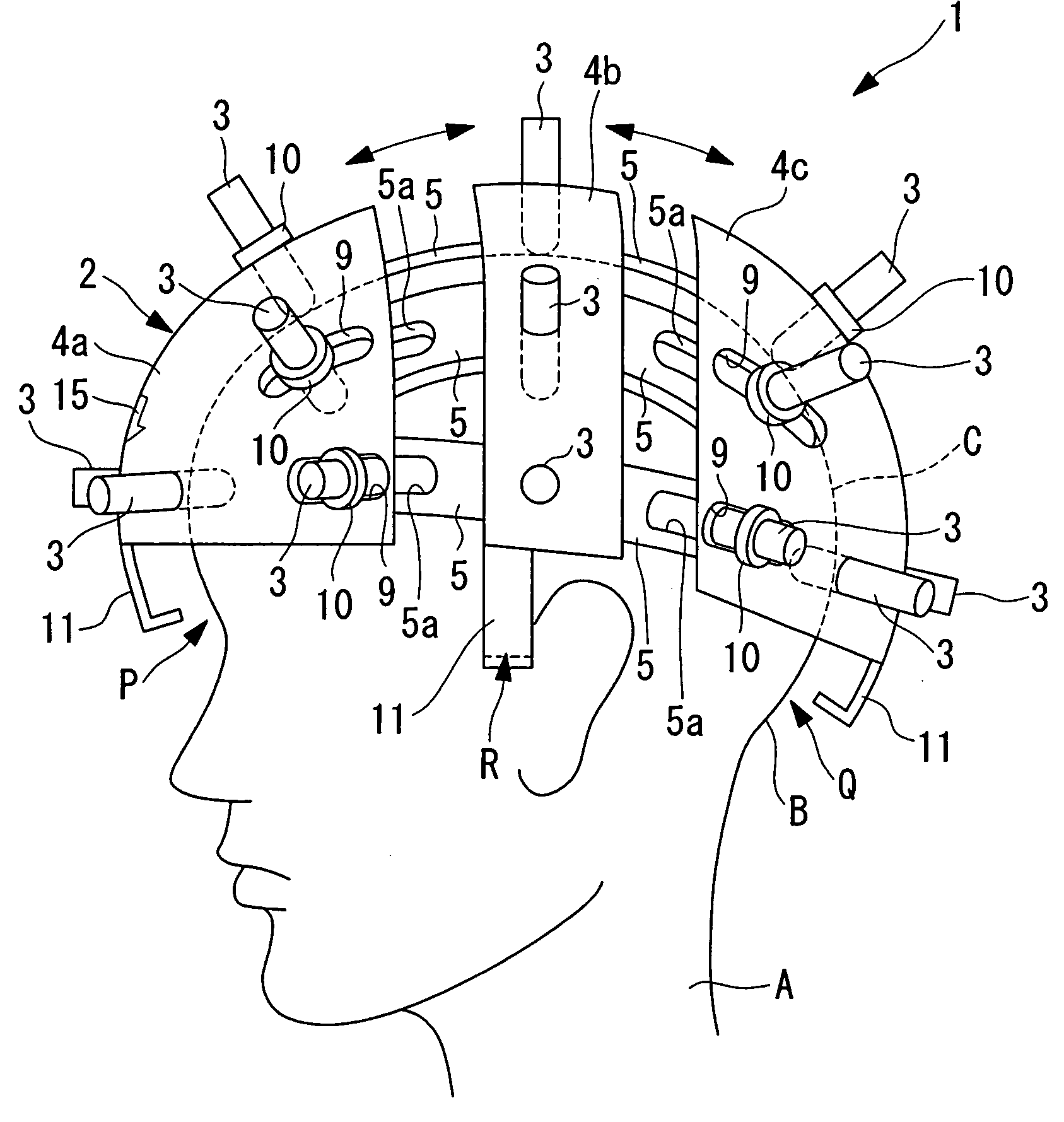
[0037]As shown in FIG. 1, a brain function detection apparatus 1 according to the present embodiment has a hat-shaped apparatus main body 2 which is mounted on the head B of a subject A being examined and a plurality of electrodes 3 mounted on the apparatus main body 2.

[0038]As the electrode 3, as shown in FIGS. 2(a) to (c), normally twenty-one electrodes 3 are arranged on the scalp C at a predetermined ratio using reference positions comprising the root of the nose P, the occipital node Q, and the preauricular point R as a reference.

[0039]The apparatus main body 2 has a plurality of holder pieces 4a, 4b, 4c, and a belt 5 which connects these holder pieces 4a, 4b, 4c. The holder pieces 4a, 4b, and 4c are made from resin, or the like, having relative hardness, and the belt 5 is made from a resin, or the like, having rel...

the structure of the environmentally friendly knitted fabric provided by the present invention; figure 2 Flow chart of the yarn wrapping machine for environmentally friendly knitted fabrics and storage devices; image 3 Is the parameter map of the yarn covering machine
Login to View More

PUM

No PUM Login to View More

Abstract

It is possible for the tips of all the electrodes to make contact with the scalp with greater reliability even with respect to different subjects, by adaptation to individual differences in the heads of subjects, and the functional status of the brain can be detected with greater accuracy. A brain function detection apparatus is provided which has a hat-shaped apparatus main body for mounting on the head of a subject, a plurality of electrodes for detecting brain wave signals, which are mounted in the apparatus main body separated from each other at intervals, and which are arranged in contact with the scalp, and the apparatus main body has a plurality of holder pieces in which at least one electrode is mounted, a bendable belt for linking the holder pieces, and a holder piece interval-adjusting apparatus for adjusting the distance between the holder pieces.

Description

TECHNICAL FIELD[0001]The present invention relates to an apparatus for detecting brain function.BACKGROUND ART[0002]Conventionally, with the goal of the early detection of Alzheimer's disease, analysis of the functional status of the brain has been performed and various analytical methods of the functional status of the brain have been proposed (for example, refer to Non-patent Document 1 and 15, Non-patent Document 2). In these analytical methods, brain wave signals are detected and judgments are made based on the smoothness of the spatial transmission of the brain wave signals and the standard deviation thereof. When the activity of the brain nerve cells is normal, the brain wave signals are transmitted smoothly and the variation therein is small, but when Alzheimer's disease is progressing and the activity of brain nerve cells has deteriorated, there is a tendency for the smoothness of the spatial transmission of brain wave signals to be lost and for the standard deviation thereo...

Claims

the structure of the environmentally friendly knitted fabric provided by the present invention; figure 2 Flow chart of the yarn wrapping machine for environmentally friendly knitted fabrics and storage devices; image 3 Is the parameter map of the yarn covering machine
Login to View More

Application Information

Patent Timeline
02 Jul 2009
Publication
US20090171181A1
IPC
A61B5/0478; A61B5/296
CPC
A61B5/0478; A61B5/4088; A61B5/291
Inventors
KUMADA, YOSHIYUKI; MUSHA, TOSHIMITSU