
Bellows for a joint arrangement, comprising a receiver for a retainer ring
a joint arrangement and receiver technology, applied in the direction of yielding couplings, engine seals, engine components, etc., can solve the problem of greater damage during operation
- Summary
- Abstract
- Description
- Claims
- Application Information
AI Technical Summary
Benefits of technology
Problems solved by technology
Method used
Image

Examples
Embodiment Construction
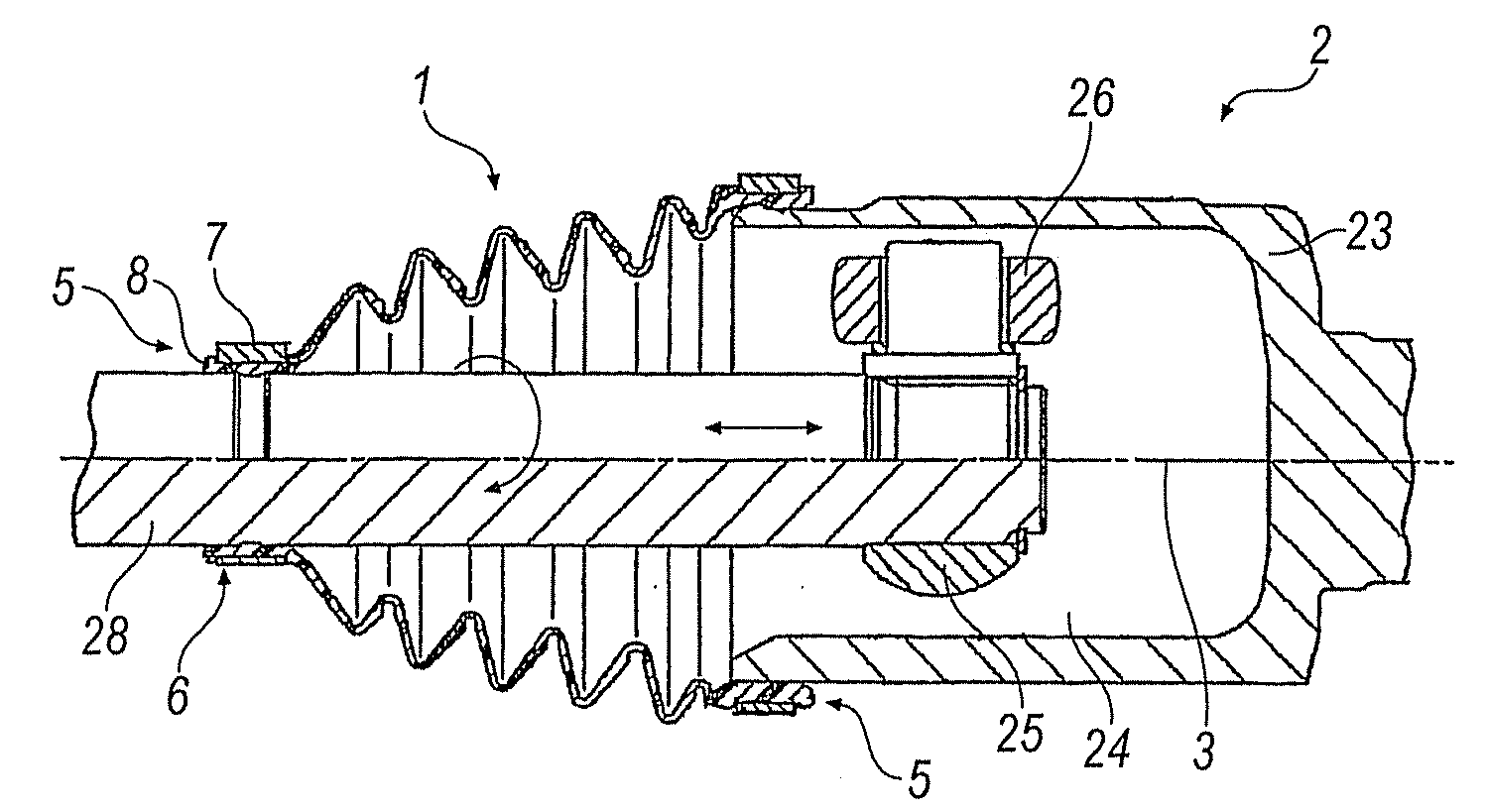
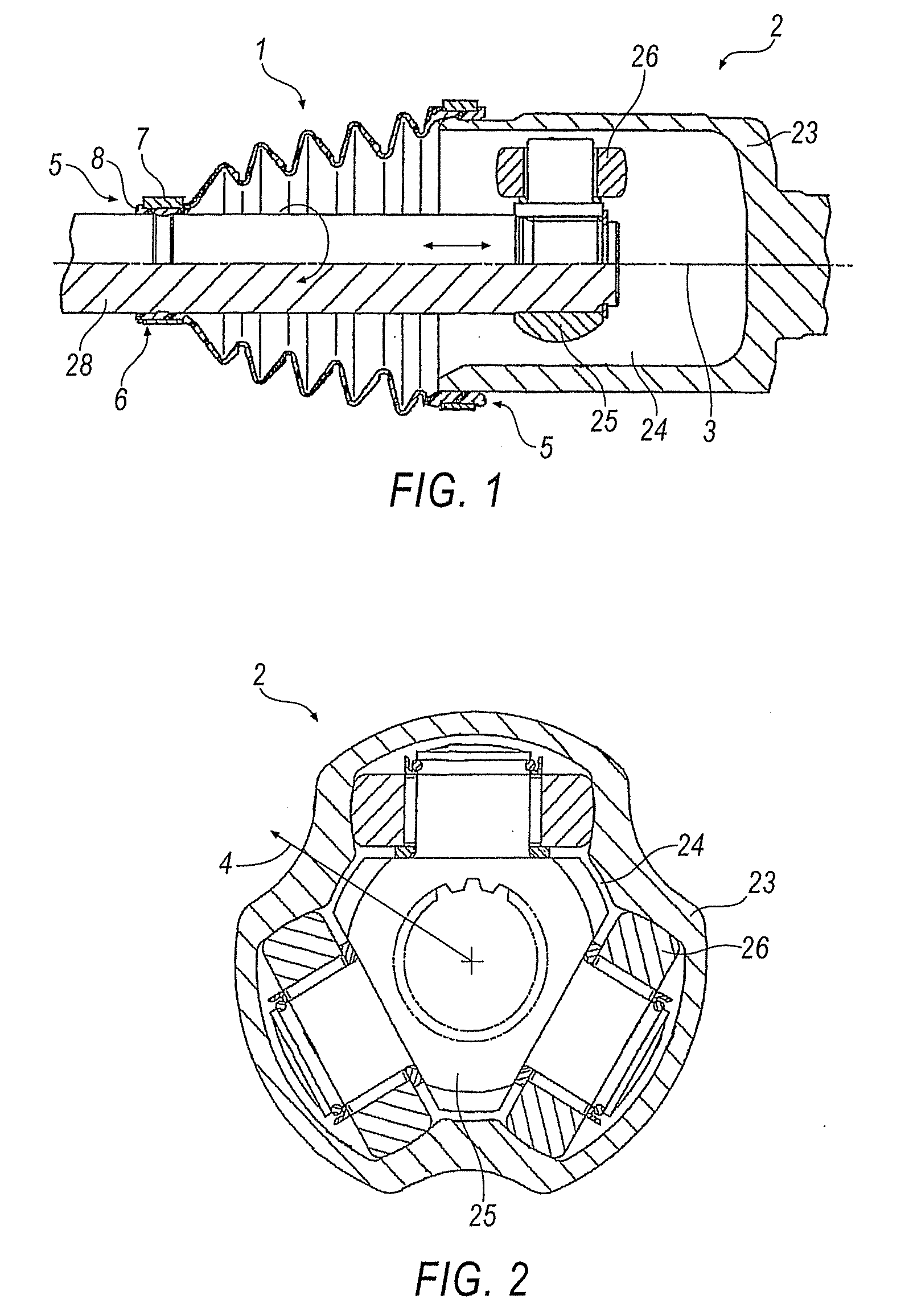
[0034]FIG. 1 schematically illustrates in partial cross-section, a possible embodiment variant of a joint arrangement 2 with a bellows 1 which collectively span a region from a shaft 28 to a joint outer part 23. In this case, bellows 1 is embodied on both ends 5 with a receiver 6 in which a retaining ring 7 is positioned. The receiver 6 ensures connection of the bellows 1 to shaft 28 or to joint outer part 23. It is also illustrated here that material elevations 8 are provided at end 5 that serves to join to shaft 28, which therefore forms the smaller opening cross-section.
[0035]Joint arrangement 2 is used to transmit a torque, wherein shaft 28 rotates. This rotational movement is transmitted via joint inner part 25 fastened on shaft 28. There, a plurality of rollers 26 which adjoin in joint outer part 23 are provided in the direction of radius 4 (cf. also FIG. 2). In order to ensure a bending angle between shaft 28 and joint outer part 23 and / or to ensure an axial relative movement...
PUM
 Login to View More
 Abstract
Description
Claims
Application Information
 Login to View More