
Cryptographic method for a white-box implementation
a technology of white-box implementation and cryptography method, which is applied in the field of cryptography method, can solve the problems of complicated published attacks on white-box implementations and propagation of bit errors to a larger portion of data
- Summary
- Abstract
- Description
- Claims
- Application Information
AI Technical Summary
Benefits of technology
Problems solved by technology
Method used
Image

Examples
Embodiment Construction
[0045]AES is a block cipher with a block size of 128 bits or 16 bytes. The plaintext is divided in blocks of 16 bytes which form the initial state of the encoding algorithm, and the final state of the encoding algorithm is the ciphertext. To conceptually explain AES, the bytes of the state are organized as a matrix of 4×4 bytes. AES consists of a number of rounds. Each round is composed of similar processing steps operating on bytes, rows, or columns of the state matrix, each round using a different round key in these processing steps.
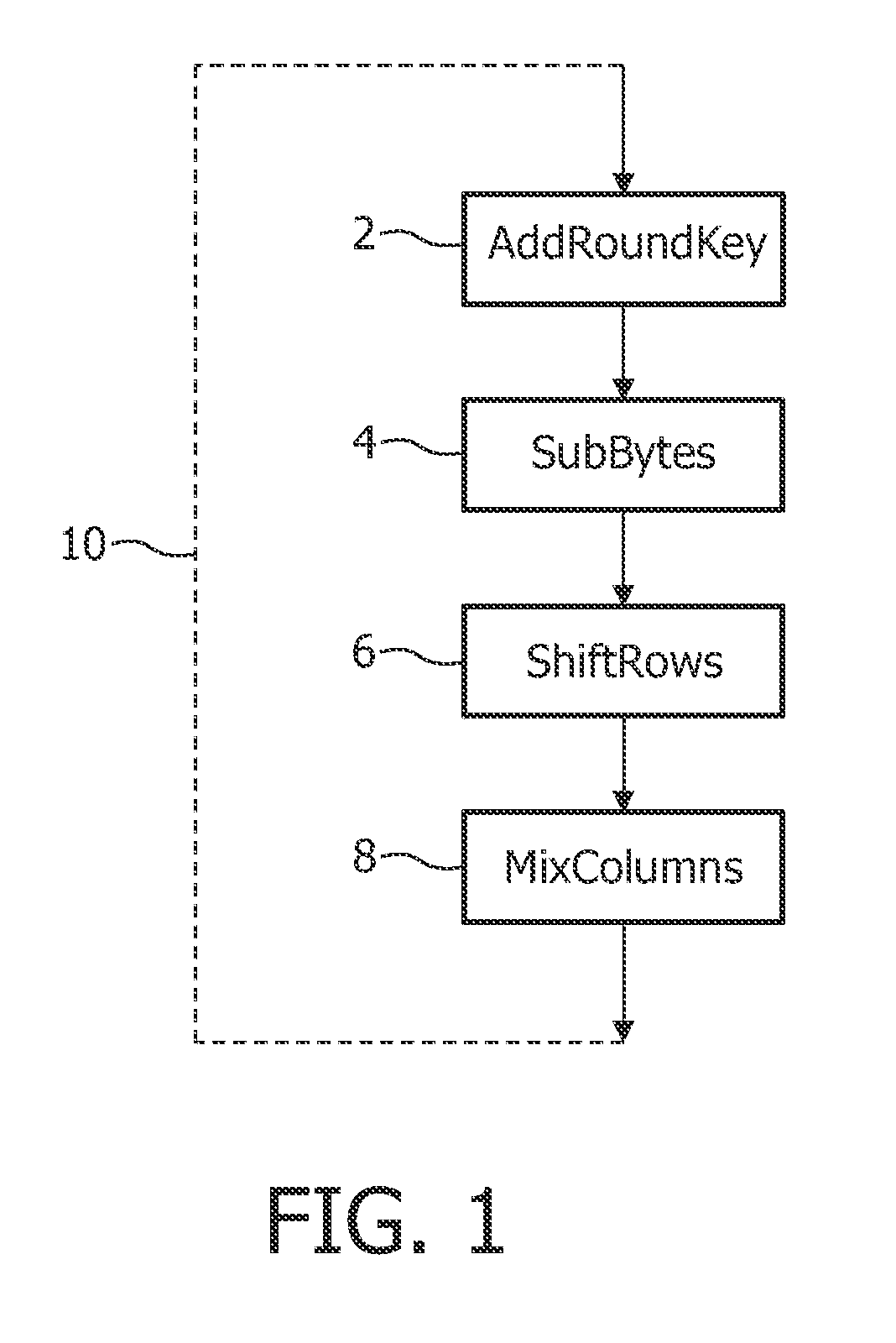
[0046]FIG. 1 illustrates some main processing steps of a round of AES. The processing steps include:
[0047]AddRoundKey 2—each byte of the state is XOR'ed with a byte of the round key.
[0048]SubBytes 4—A byte-to-byte permutation using a lookup table.
[0049]ShiftRows 6—Each row of the state is rotated a fixed number of bytes.
[0050]MixColumns 8—Each column is processed using a modulo multiplication in GF(28).
[0051]The steps SubBytes 4, ShiftRows 6, and MixCo...
PUM
 Login to View More
 Abstract
Description
Claims
Application Information
 Login to View More