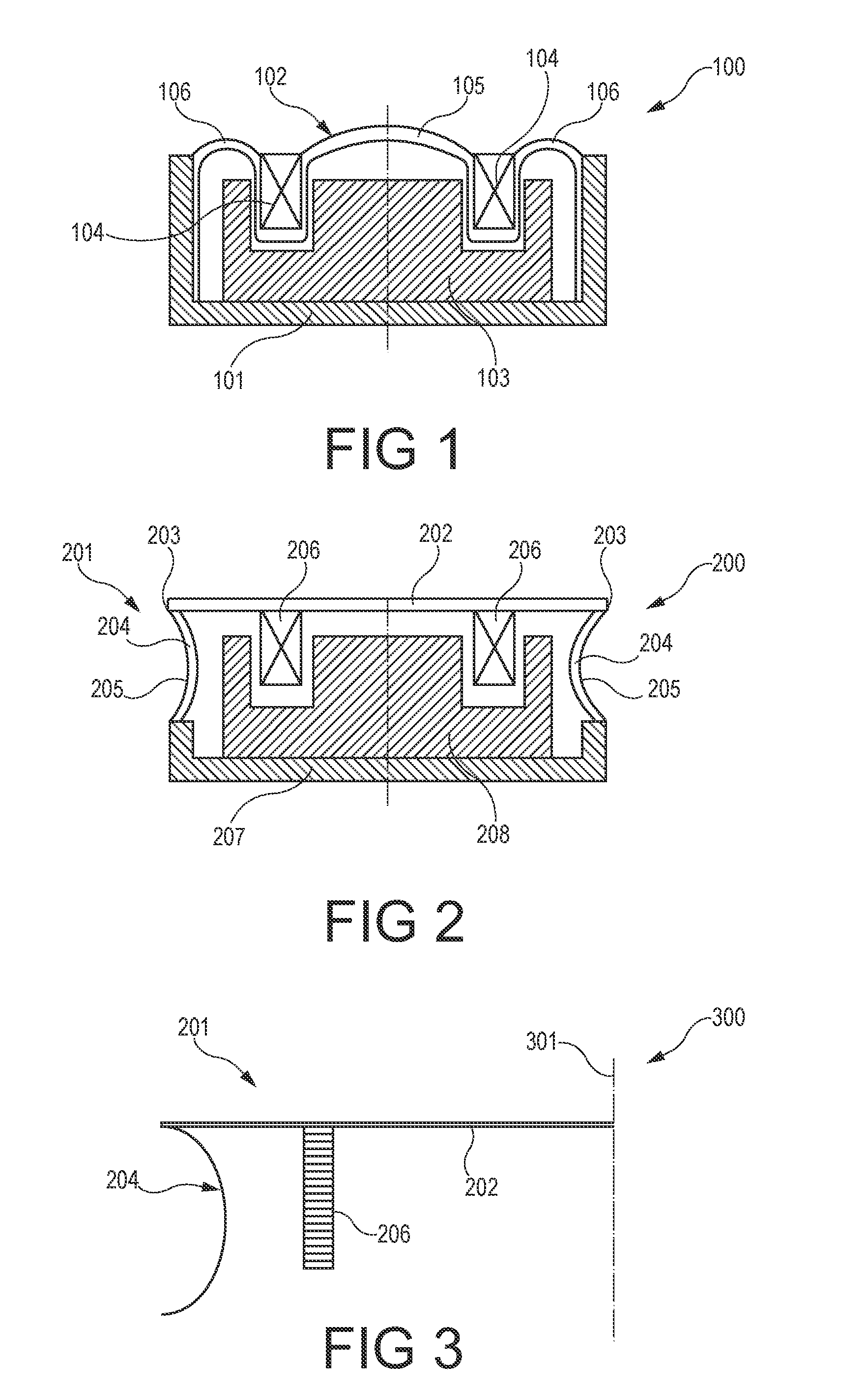
[0020]When a transducing element (e.g. a coil attached to the membrane being in a
magnetic field) excites the membrane (i.e. the rigid and the flexible parts in common), the rigid part is moved in a manner to essentially maintain its shape (i.e. translatory moved), whereas the value of the curvature of the flexible portion is changed, so that both the rigid and the flexible portion of the membrane contribute to a volume of a shifted air. Therefore, it is possible to increase the sound
pressure level (SPL) and thus improve the performance of an acoustic device significantly. This is particularly advantageous for the design of small dimensioned acoustic devices, for instance for loudspeakers of mobile phones. Such small dimensioned acoustic devices usually suffer from a non-sufficient
loudness. Because according to the invention also the flexible portion contributes to the moved
air volume, it is possible to obtain a higher sound pressure with the same size of the membrane. Alternatively, the same sound pressure can be obtained with a smaller size of the membrane. This allows to manufacture miniaturized acoustic devices.
[0023]The rigid membrane portion may be essentially planar. Therefore, the rigid membrane portion may function in a similar manner as a
piston shifting a large amount of air in an upward direction. Furthermore, a planar surface is easy to manufacture so that the membrane may be, in its entirety, easy to manufacture. Beyond this, a planar geometry may allow to manufacture the membrane in a flat and space-saving manner. Thus, the manufacture of flat loudspeakers with proper audio performance is possible. Alternatively, the rigid portion may have any other desired shape, like a bent or curved shape.
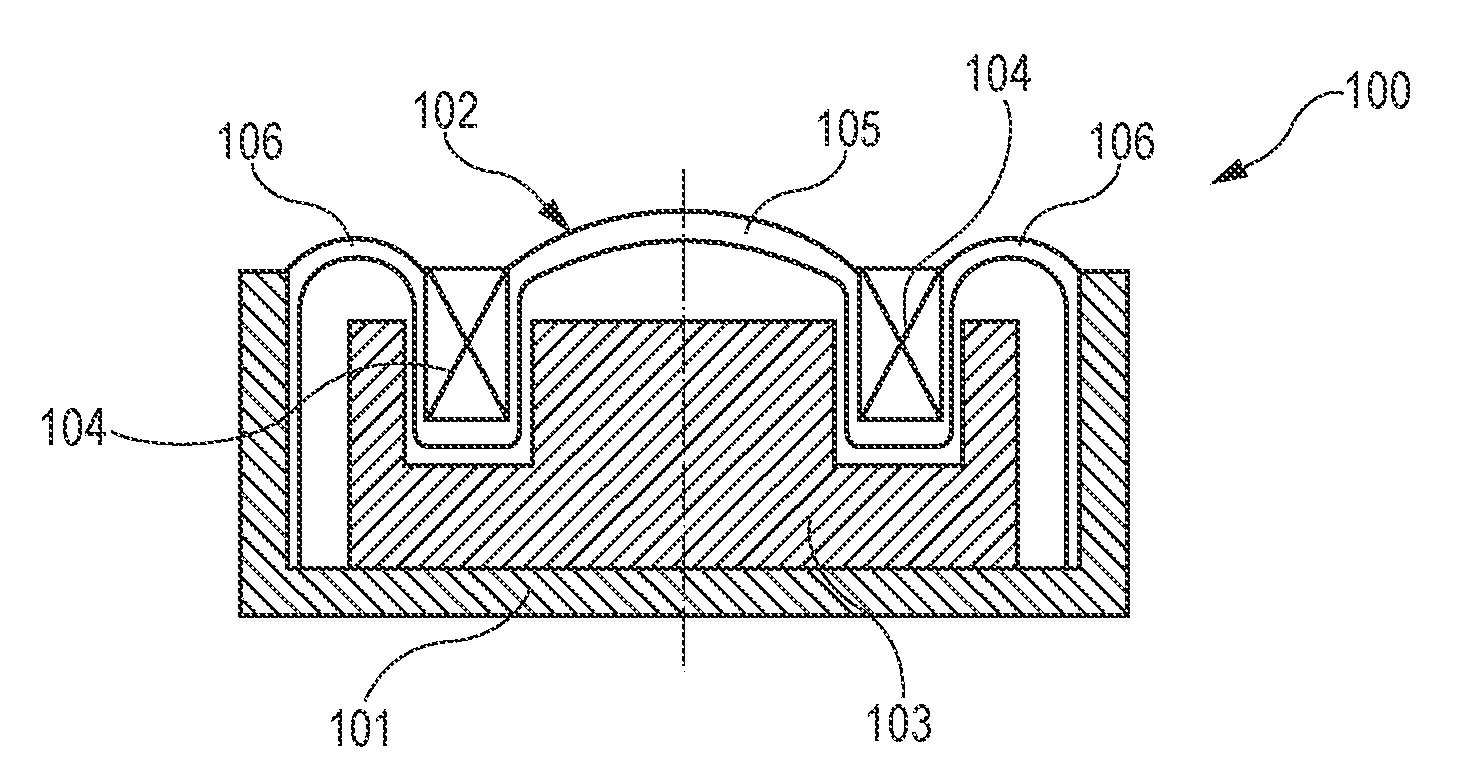
[0024]The flexible membrane portion may be essentially wheel-rim shaped. Such a wheel-rim is shown, for instance, in FIG. 5. “Wheel-rim shaped” denotes the shape of a deformed cylinder in which the curved surface of the cylinder is arced, or an indentation, particularly with an elliptic shape, is formed into the curved portion. Such a configuration is mechanically stable, easy to manufacture and contributes significantly to the shifted air volume, thereby achieving a proper performance of the
loudspeaker.
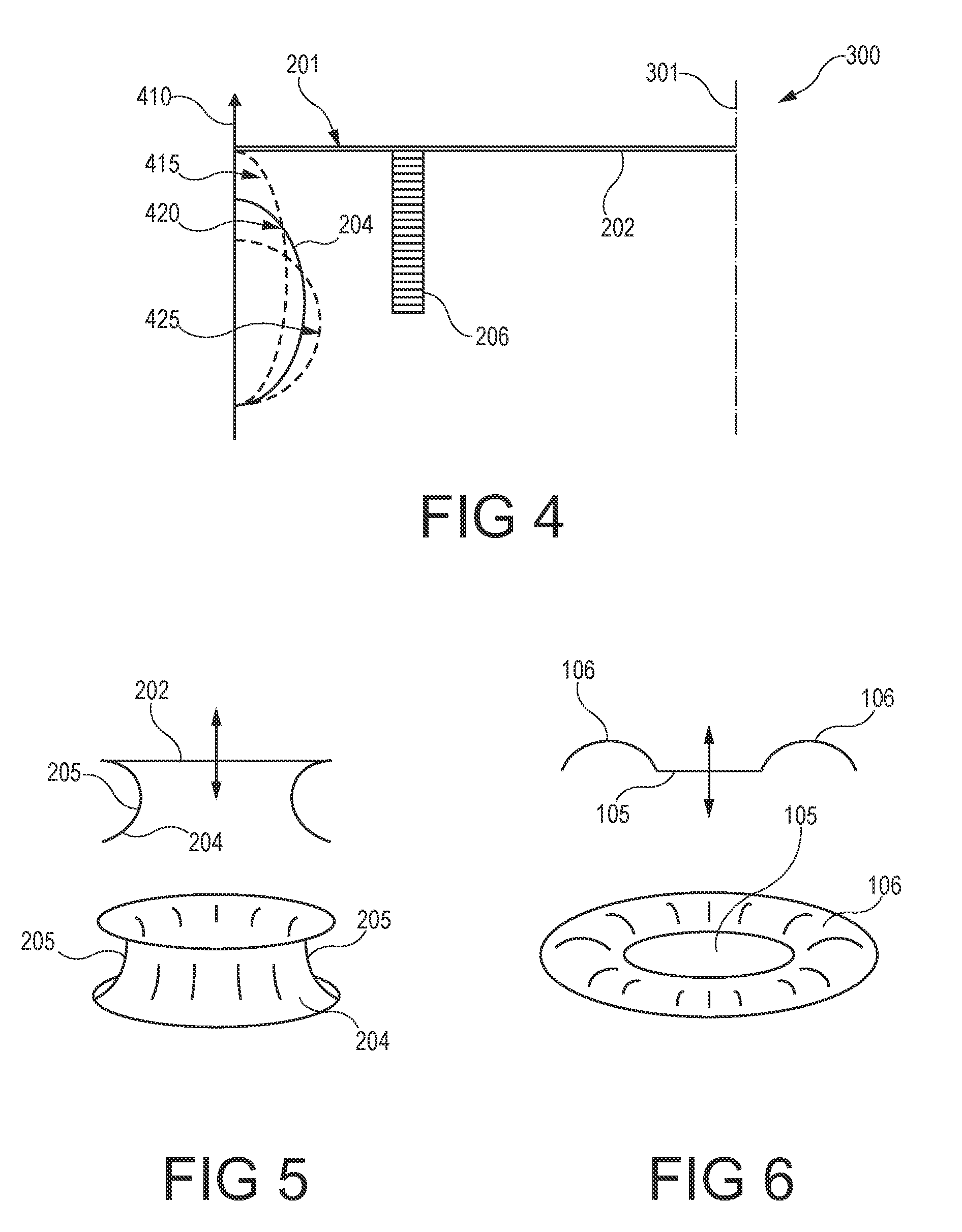
[0027]It is advantageous if an exterior surface of the flexible membrane portion has, in a lower dead point of the membrane (that is to say when the flexible membrane portion is compressed to a maximum extent), a semi-circular curvature. A lower dead point is a reversion point in which the membrane motion changes from a downward motion to an upward motion. When the lower dead point of the membrane coincides with a semi-circular shape of the flexible membrane portion, an efficient air volume shift over an entire
duty cycle is obtained. When the rigid membrane portion moves beyond said optimum lower dead point the smaller half axis becomes the longer half axis, which is then essentially normal to the
motion direction of the
loudspeaker. In this state, no additional sound is generated. Even worse, the
loudspeaker becomes more quiet since the air
stream caused by the flexible membrane portion changes its direction.
[0028]The membrane may further be adapted in such a manner that a
total harmonic distortion of the flexible membrane portion is essentially compensated by a
total harmonic distortion of the rigid membrane portion. In some cases, the membrane is designed such that the total THD is as small as possible. Since the THD of the flexible membrane portion is, in a rough approximation, independent of THD which is generated by the motion of the rigid portion of the membrane, the THD of the rigid portion can (partially or entirely) be compensated by the THD of the flexible portion. Accordingly, the total THD (of the entire membrane) can be made as small as possible. For this reason, the length of the semi-major axis is adjusted accordingly. In this case, it may also be advantageous if the membrane moves beyond the lower
dead centre given by the half circle shape of the flexible membrane portion. Therefore, exemplary embodiments of the invention may allow to obtain more SPL with smaller loudspeakers, and / or a compensation of THD. Such advantages may be particularly obtained in loudspeakers or receivers. For such embodiments, the materials of membrane, the thickness of the membrane portions, and the geometric shapes of the membrane portions are adjusted accordingly. This allows to obtain a loudspeaker with a proper audio performance and quality.



 Login to View More
  Login to View More