Unlock instant, AI-driven research and patent intelligence for your innovation.

Cathode active material, cathode, and nonaqueous secondary battery

a secondary battery and active material technology, applied in the field cathode active material, and nonaqueous secondary batteries, can solve the problems of cathode active material structural destruction, high cost, thermal runaway reaction in the battery, etc., and achieve the effect of reducing the risk of li insertion/desorption, reducing the risk of li insertion and desorption, and prolonging the life of the battery

Inactive Publication Date: 2010-05-20
SHARP KK
View PDF18 Cites 12 Cited by
  • Summary
  • Abstract
  • Description
  • Claims
  • Application Information

AI Technical Summary

Benefits of technology

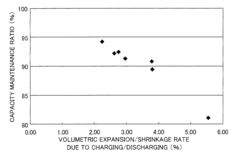
The present invention provides a cathode active material that can provide a battery with a long life. The material has reduced volumetric expansion and shrinkage during charging and discharging, which prevents damage to the structure of the material and increases the capacity of the battery. The material is represented by the general formula (1), wherein a part of the P site is substituted with Al, and a part of at least either the Li site or the Fe site is substituted with the other atom. This results in charge compensation and suppresses the volumetric change caused by Li insertion / desorption. The technical effect of the invention is to provide a cathode active material that overcomes the problem of short battery life caused by volumetric expansion and shrinkage of the cathode material during charging and discharging.

Problems solved by technology

The oxygen desorption could cause thermal runaway reaction in the battery.
Cobalt (Co) is not favorable costwise because of its low crustal abundance resulting in its high cost.
It is a problem in view of life of the battery that the cathode active material will undergo structural destruction as a result that Li insertion / desorption repeatedly occurs in the cathode active material due to charging / discharging.
In a case where lithium iron phosphate having an olivine structure is adopted as the cathode active material of a battery, there arises a problem of its low charge-discharge characteristics such as insufficient electron conductivity and a low average electric potential.

Method used

the structure of the environmentally friendly knitted fabric provided by the present invention; figure 2 Flow chart of the yarn wrapping machine for environmentally friendly knitted fabrics and storage devices; image 3 Is the parameter map of the yarn covering machine
View more

Image

Smart Image Click on the blue labels to locate them in the text.
Viewing Examples
Smart Image
  • Cathode active material, cathode, and nonaqueous secondary battery
  • Cathode active material, cathode, and nonaqueous secondary battery

Examples

Experimental program
Comparison scheme
Effect test

example 1

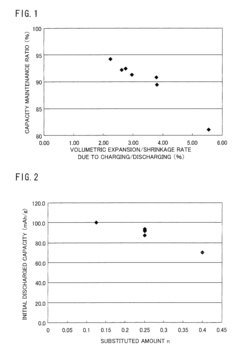
[0158]Starting materials used in Example 1 are as follows: L2CO3 as a lithium source; FeC2O4 as an iron source; ZrO2 as a zirconium source; (NH4)2HPO4 as a phosphorous source; and Al(OH)3 as an aluminum source. There starting materials were mixed together at a ratio of Li:Fe:Zr:P:Al=1:0.75:0.25:0.75:0.25. Then, precursor synthesis described above was performed with the mixed starting materials, so as to obtain an amorphous precursor. The amorphous precursor was calcinated at 650° C. for 6 hours in a nitrogen atmosphere. Thus synthesized was a single-phase powder LiFe0.75Zr0.25P0.75Al0.25O4 which was a cathode active material having an olivine structure. Results of the above measurements on the cathode active material are shown on Table 1.

example 2

[0159]Starting materials used in Examples 2 were as follows: Li2CO3 as a lithium source; KOH as a potassium source; FeC2O4 as an iron source; WO3 as a tungsten source; (NH4)2HPO4 as a phosphorous source, and Al(OH)3 as an aluminum source. The starting materials were mixed together at a ratio of Li:K:Fe:W:P:Al=0.875:0.125:0.875:0.125:0.875. Then, the precursor synthesis described above was performed with the mixed starting materials, so as to obtain an amorphous precursor. The amorphous precursor was calcinated at 650° C. for 6 hours in a nitrogen atmosphere. Thus synthesized was a single-phase powder Li0.875K0.125Fe0.875W0.125P0.875Al0.125O4 which was a cathode active material having an olivine structure. Results of the above measurements on the cathode active material are shown on Table 1.

example 3

[0160]Starting materials used in Examples 2 were as follows: Li2CO3 as a lithium source; NaOH as a sodium source; FeC2O4 as an iron source; SnO2 as a tin source; (NH4)2HPO4 as a phosphorous source; and Al(OH)3 as an aluminum source. The starting materials were mixed together at a ratio of Li:Na:Fe:Sn:P:Al=0.75:0.25:0.75:0.25:0.75:0.25. Then, the precursor synthesis described above was performed with the mixed starting materials, so as to obtain an amorphous precursor. The amorphous precursor was calcinated at 650° C. for 6 hours in a nitrogen atmosphere. Thus synthesized was a single-phase powder Li0.75Na0.25Fe0.75Sn0.25P0.75Al0.25O4 which was a cathode active material having an olivine structure. Results of the above measurements on the cathode active material are shown on Table 1.

the structure of the environmentally friendly knitted fabric provided by the present invention; figure 2 Flow chart of the yarn wrapping machine for environmentally friendly knitted fabrics and storage devices; image 3 Is the parameter map of the yarn covering machine
Login to View More

PUM

PropertyMeasurementUnit
temperatureaaaaaaaaaa
volumeaaaaaaaaaa
valenceaaaaaaaaaa
Login to View More

Abstract

The present invention realizes a cathode active material which not only excels in safety and cost but also makes it possible to provide a long-life battery. The cathode active material is represented by the general formula (1):Li1-xAxFe1-yMyP1-zAlzO4  (1)wherein A is at least one selected from the elements of groups 1 through 13; M is at least one selected from the elements of groups 2 through 14; and 0≦x≦0.25, 0≦y≦0.25, 0<z≦0.25, and x+y>0.

Description

[0001]This Nonprovisional application claims priority under 35U.S.C. §119(a) on Patent Application No. 2008-294707 filed in Japan on Nov. 18, 2008, the entire contents of which are hereby incorporated by reference.TECHNICAL FIELD[0002]The present invention relates to a cathode active material, a cathode made from the cathode active material, and a nonaqueous secondary battery (lithium secondary battery) including the cathode. More specifically, the present invention relates to (i) a cathode active material which makes it possible to provide a battery which not only excels in safety and cost but has a long life, (ii) a cathode made from the cathode active material, and (iii) a nonaqueous secondary battery which includes the cathode and is highly recyclable.BACKGROUND ART[0003]Lithium secondary batteries have been used for portable electronic devices practically and widely. In addition, recent years, the lithium secondary batteries have attracted attention not only as small ones for t...

Claims

the structure of the environmentally friendly knitted fabric provided by the present invention; figure 2 Flow chart of the yarn wrapping machine for environmentally friendly knitted fabrics and storage devices; image 3 Is the parameter map of the yarn covering machine
Login to View More

Application Information

Patent Timeline
no application Login to View More
Patent Type & Authority Applications(United States)
IPC IPC(8): H01M4/525
CPCC01B25/45C01G49/009C01P2002/76Y02E60/122H01M4/136H01M4/5825H01M10/052C01P2006/40Y02E60/10
Inventor OHIRA, KOJINISHIJIMA, MOTOAKITANAKA, ISAOKOYAMA, YUKINORI
Owner SHARP KK