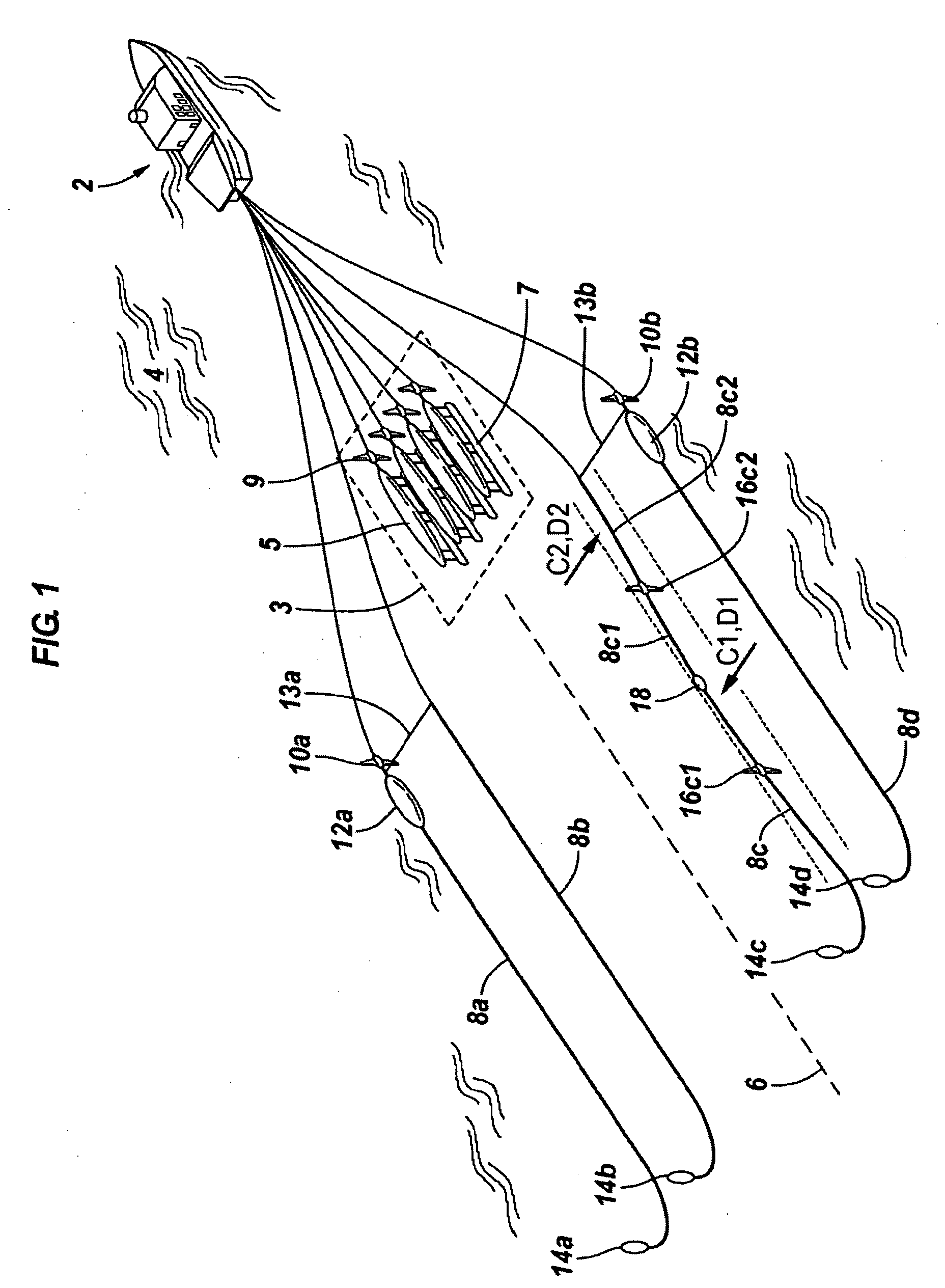
[0007]In accordance with the present invention, methods and apparatus are described for controlling position of at least portions of seismic streamers, which may or may not be in over / under configuration, referring to a cross-section of the streamer geometry in a
vertical plane. The methods and apparatus of the invention reduce or overcome problems with previous methods and apparatus in acquiring marine seismic data using seismic streamers. More specifically, the invention relates to methods and apparatus for improved steering of seismic streamers, reduction of
noise due to currents, swell, etc., and enabling better acoustic network for positioning. Methods and apparatus of the invention may be used to increase the ability of deployed spread control elements (for example steerable birds, streamer deflectors, and source deflectors) to perform their tasks of positioning streamers during a marine
seismic survey. In inventive methods and apparatus, the possibility for selecting tow depth based on lack of or presence of currents to steer or position a multicomponent streamer (or an over / under streamer configuration, or other streamer configuration) to desired lateral positions, or to minimize current-induced
noise, is exploited. This has not been possible before with conventional streamers since tow depth has largely been determined by the presence of
receiver-side ghosts reducing low- and high-frequency content.
[0008]The inventive methods and apparatus may rely on two aspects of the data recorded along a multicomponent streamer, an over / under streamer configuration, or other configuration. Both aspects are direct consequences of seismic data deghosting: the depth at which the streamers are towed does not introduce notches within the frequency-band of interest, and deghosted data acquired with
receiver locations at different depths can easily be redatumed to a common
depth level. The methods and apparatus of the current invention lend themselves to implementation which may be enabled through automatic advanced spread control, particularly in marine environments that may exhibit very complex lateral, temporal and / or in-depth varying current regimes.
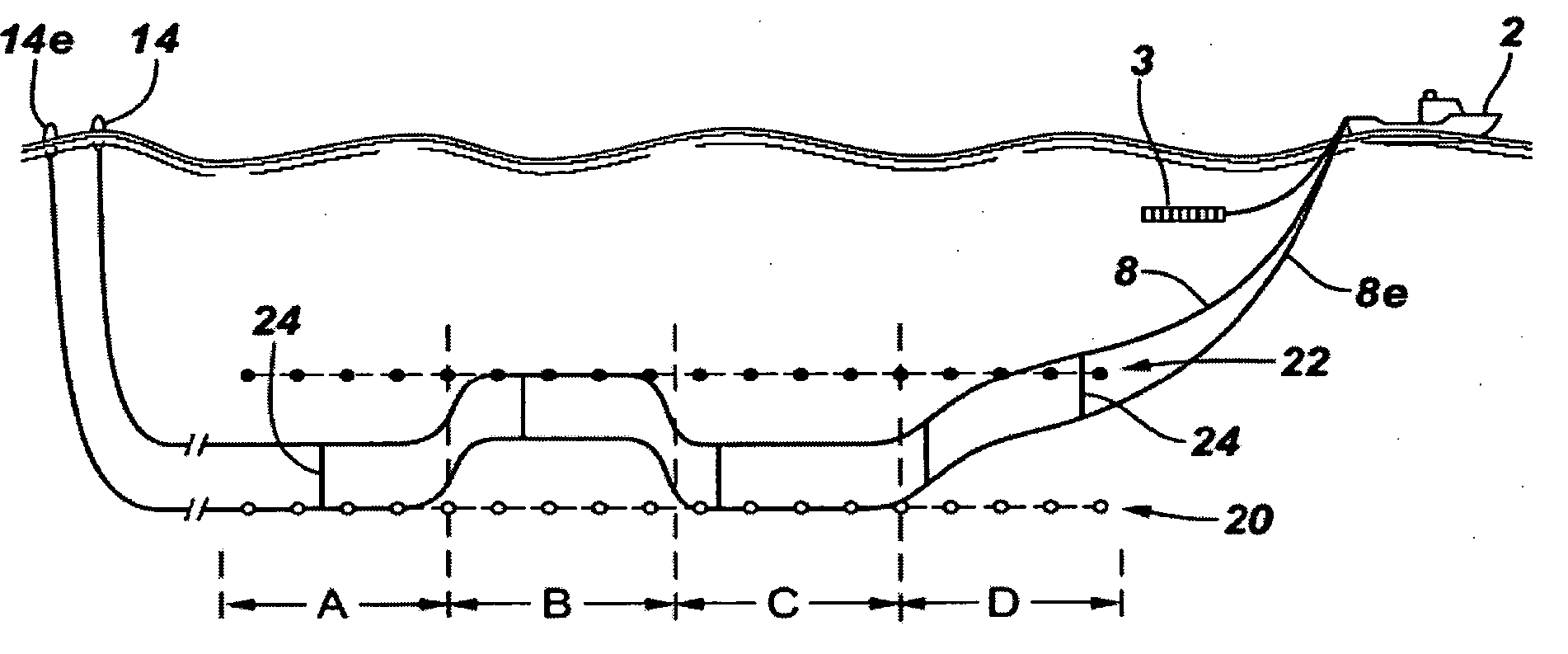
[0012](b) positioning selected portions of the streamer in different shear current regimes, thereby balancing the
net force on the streamer to control lateral motion of the streamer during seismic
data acquisition.
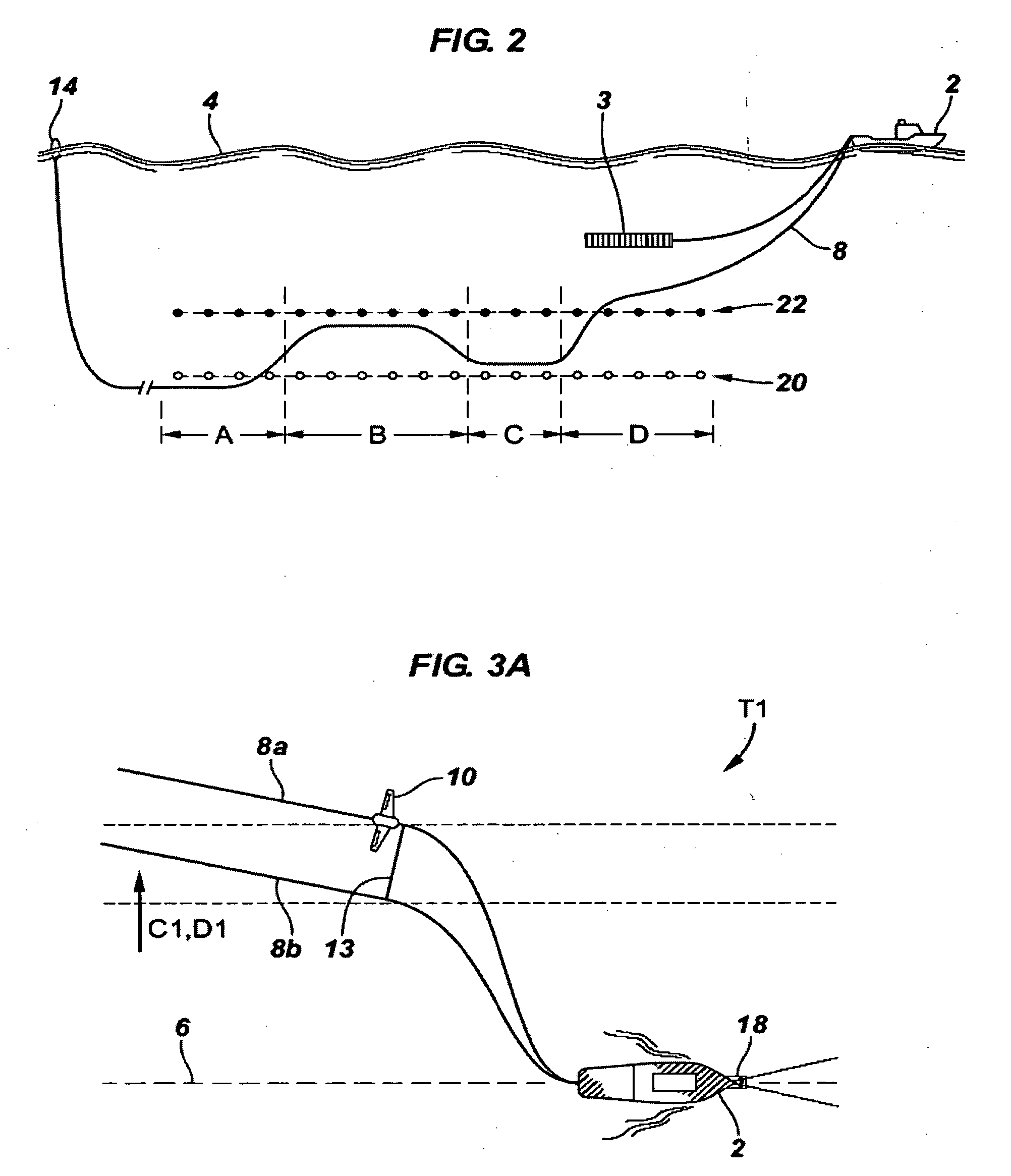
[0015](b) raising or lowering the streamer to a second depth at which there is sufficient current in a second lateral direction substantially opposite to the first lateral direction to allow the current to force the streamer back toward a desired position during seismic
data acquisition.In this fashion, current-induced
noise may be minimized or avoided, while the streamers are moved back- and forth within an acceptable range on either side of a predetermined
lateral position.
[0016]Methods of the invention may include varying the depth of each receiver in a streamer, or a group of receivers, as a function of time, space, and currents, receiving a first set of seismic data signals at first time and space coordinates for the receiver or receiver group, deghosting the first set of seismic data signals to produce a deghosted
data set, and redatuming the deghosted
data set of seismic data signals to a common
depth level. The redatuming is fairly straightforward after deghosting (separating up- and down-going
waves) and may advantageously be carried out using one or more mathematical algorithms functioning as
signal filters, such as compact space-time redatuming operators, such that the depth can be considered to be constant over the redatuming filter aperture. Methods of the invention may allow minimization or
elimination of current-induced noise. This result was not possible with conventional seismic streamer technologies since tow depth was largely determined by where the operators wanted the ghost signals to be.


 Login to View More
  Login to View More