
System, method and apparatus for fabricating a c-aperture or e-antenna plasmonic near field source for thermal assisted recording applications
a technology of thermal assisted recording and near field source, which is applied in the field of thermal assisted recording (tar) applications, can solve the problems of inability to exceed the write field capability of the recording head, data loss, and costly and time-consuming methods, and achieve the shape of the c-aperture notch itself. precise and consistent
- Summary
- Abstract
- Description
- Claims
- Application Information
AI Technical Summary
Benefits of technology
Problems solved by technology
Method used
Image

Examples
Embodiment Construction
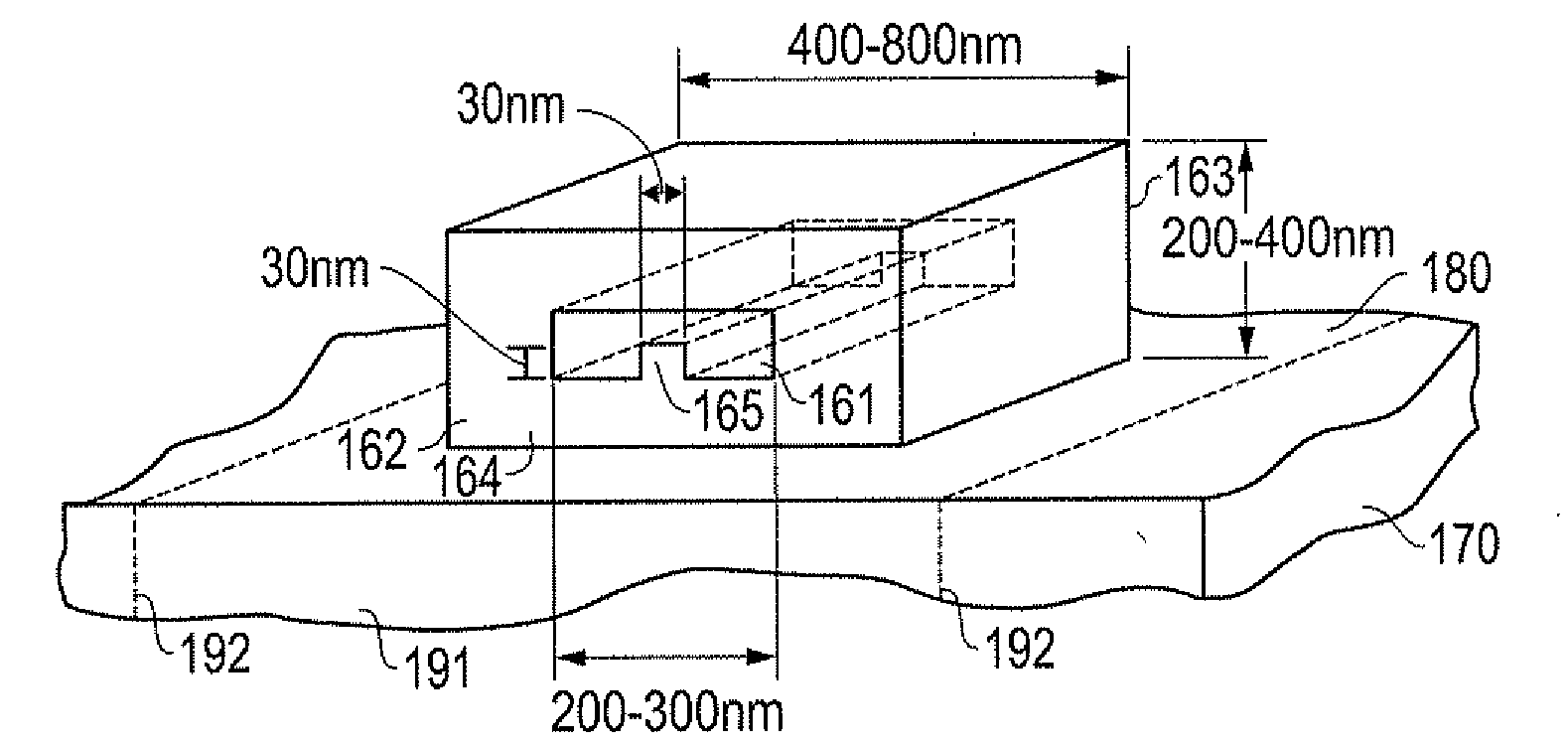
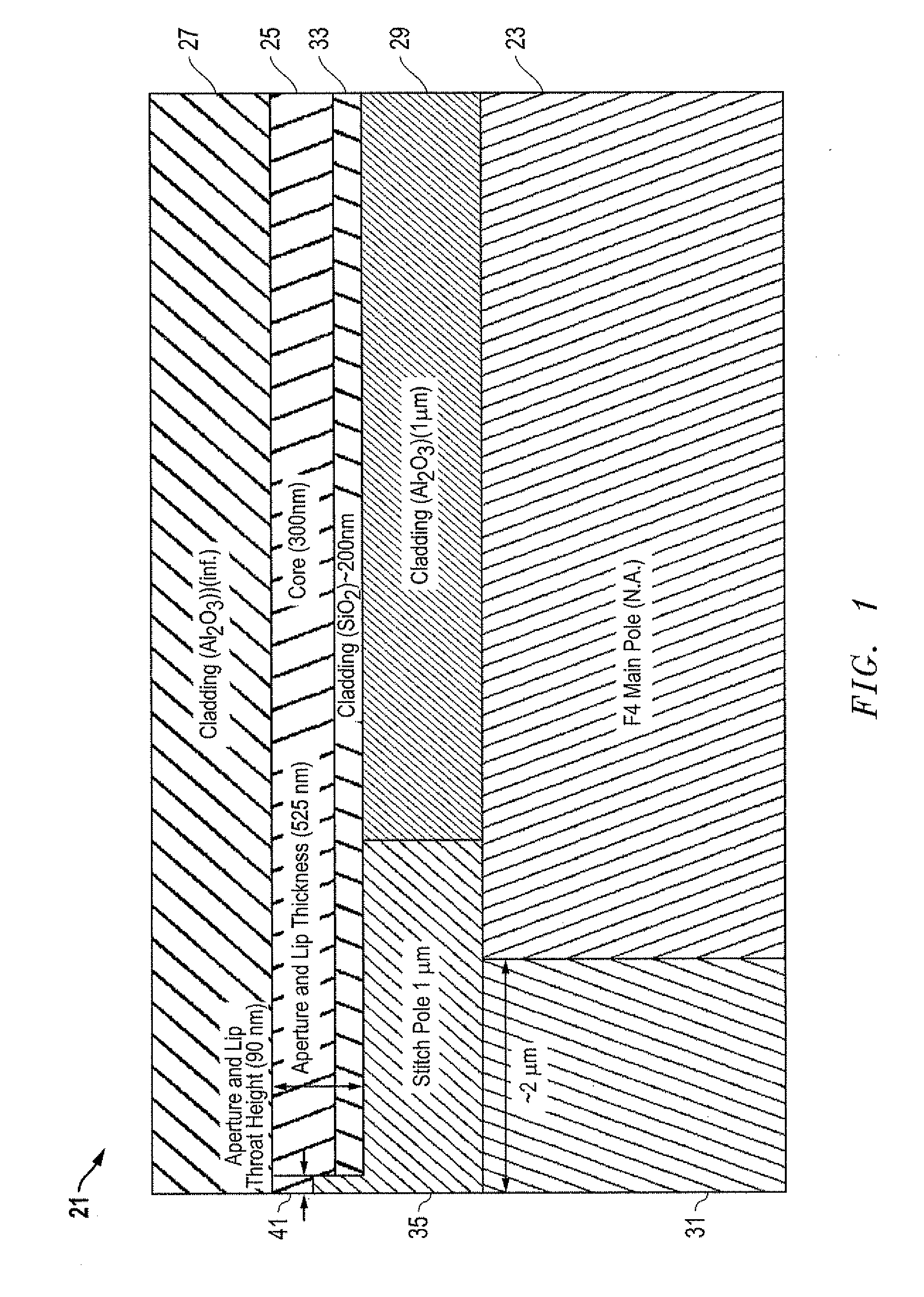
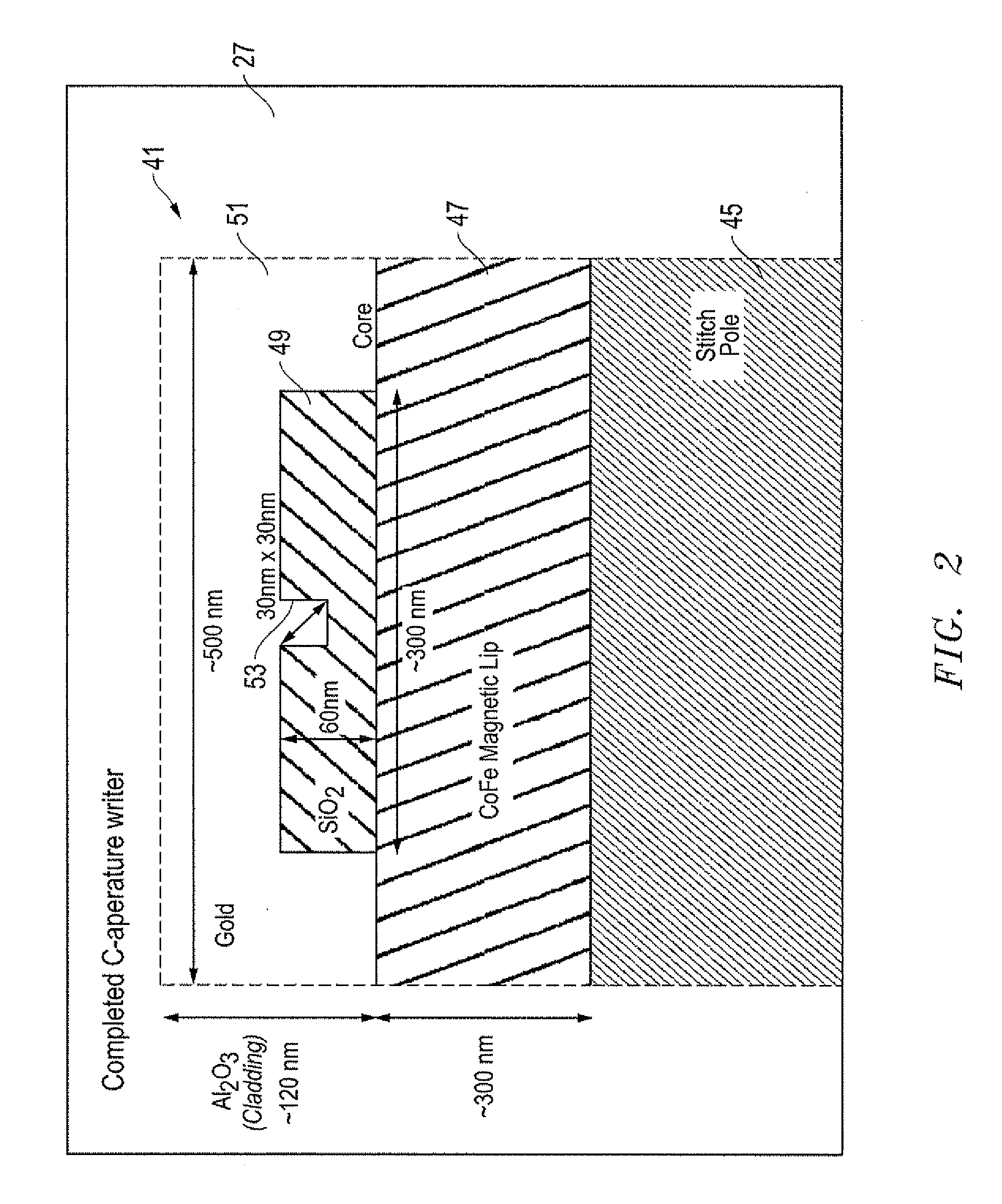
[0019]Referring to FIGS. 1-17, embodiments of a system, method and apparatus for fabricating a c-aperture or F-antenna plasmonic near field source for thermal assisted recording applications in hard disk drives are disclosed.
[0020]For example, FIG. 14 is a sectional view through a portion of an air-bearing slider 110 and associated perpendicular magnetic recording disk for a TAR disk drive of the type that uses an optical channel for directing heat to the disk. The disk 140 includes a substrate 142, an optional “soft” or relatively low-coercivity magnetically permeable underlayer (SUL) 144, and a perpendicular magnetic recording layer (RL) 146. The SUL 144 is not required for a TAR disk drive but if used is typically any alloy material suitable as the magnetically-permeable flux-return path, such as NiFe, FeAlSi, FeTaN, FeN, CoFeB and CoZrNb. The RL 146 may be any media with perpendicular magnetic anisotropy, such as a cobalt-chromium (CoCr) alloy granular layer grown on a special g...
PUM
| Property | Measurement | Unit |
|---|---|---|
| wavelength | aaaaa | aaaaa |
| thickness | aaaaa | aaaaa |
| thickness | aaaaa | aaaaa |
Abstract
Description
Claims
Application Information
 Login to View More