

Filling and sealing of beverage containers
a beverage container and sealing technology, applied in the field of beverage container filling and sealing, can solve problems such as lid flexur
- Summary
- Abstract
- Description
- Claims
- Application Information
AI Technical Summary
Benefits of technology
Problems solved by technology
Method used
Image

Examples
Embodiment Construction
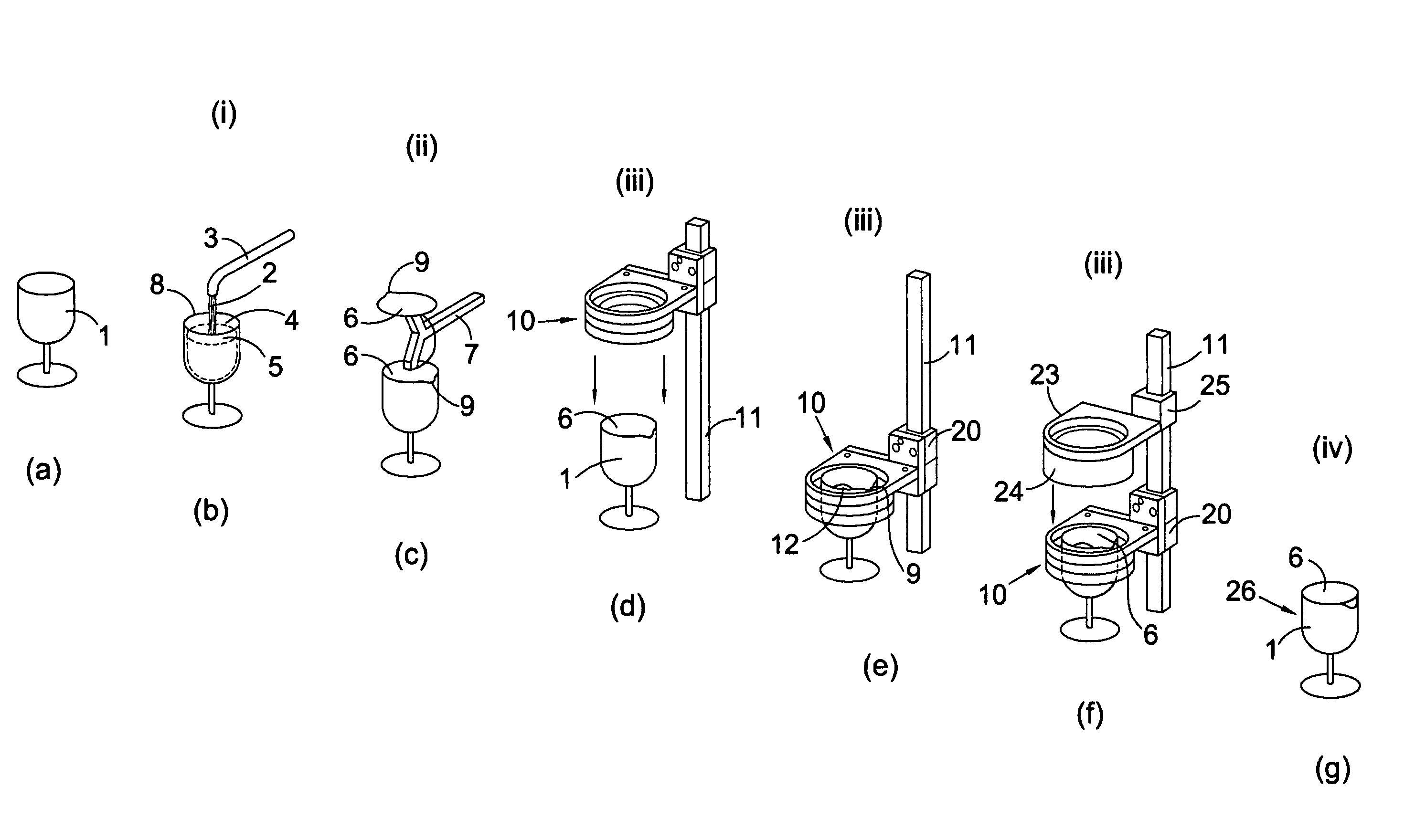
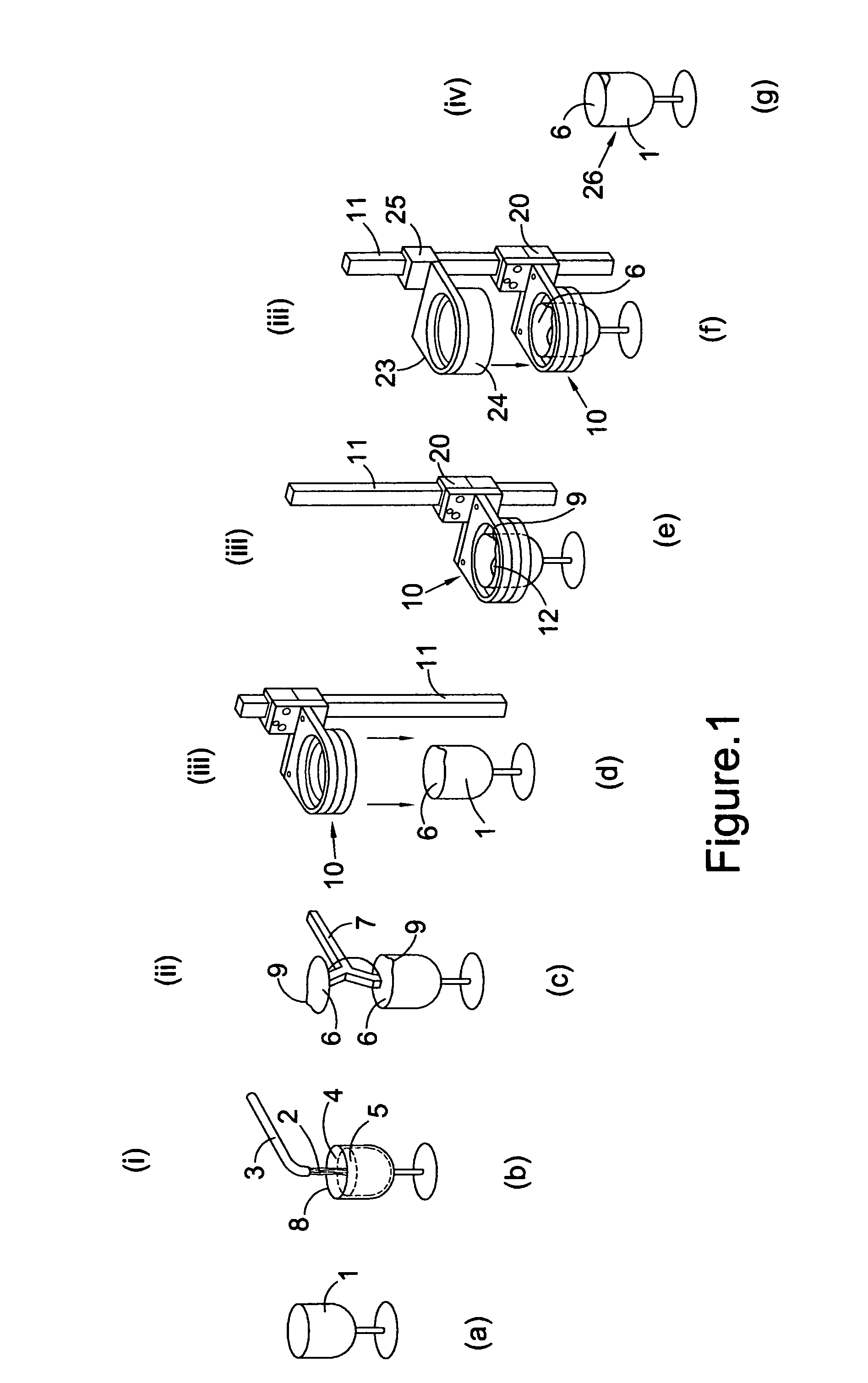
[0025]A beverage container, here a clear goblet 1 formed of PET, is supplied in Step (a) to a turntable (not shown). The turntable presents the glass 1 to a plurality of indexed stations as it rotates. At the first index position (i) a predetermined volume of a beverage, here wine 2, is dispensed via fill nozzle 3 into the open top 4 of glass 1 in Step (b).
[0026]This disclosure is not concerned with details of the beverage supply, measured dispensing or filling systems. Any suitable such systems may be employed and persons engaged in the beverage industry will have wide knowledge of such systems. Other beverage containers other than a clear plastics goblet may equally well be employed.
[0027]A clear headspace 5 is left between the level of wine 2 and open top 4 of glass 1. The filled glass is carried by the turntable to the second index position (ii), where a generally flat flexible film lid 6 is applied to the open top 4 of glass 1 in step (c). In the illustrated arrangement, a swiv...
PUM
| Property | Measurement | Unit |
|---|---|---|
| flexible | aaaaa | aaaaa |
| circumference | aaaaa | aaaaa |
| area | aaaaa | aaaaa |
Abstract
Description
Claims
Application Information
 Login to View More