Check patentability & draft patents in minutes with Patsnap Eureka AI!

Certificate status information protocol (CSIP) proxy and responder

a certificate status and information protocol technology, applied in the field of certificate status information protocol (csip) proxy and responder, can solve the problems of increasing practical problems, challenges to adoption, restricted content distribution, etc., to reduce the level of connectivity to the csip responder, reduce significant delays, and improve the capability of device certificate revocation status checking.

Inactive Publication Date: 2010-12-16
GOOGLE TECH HLDG LLC
View PDF59 Cites 28 Cited by
  • Summary
  • Abstract
  • Description
  • Claims
  • Application Information

AI Technical Summary

Benefits of technology

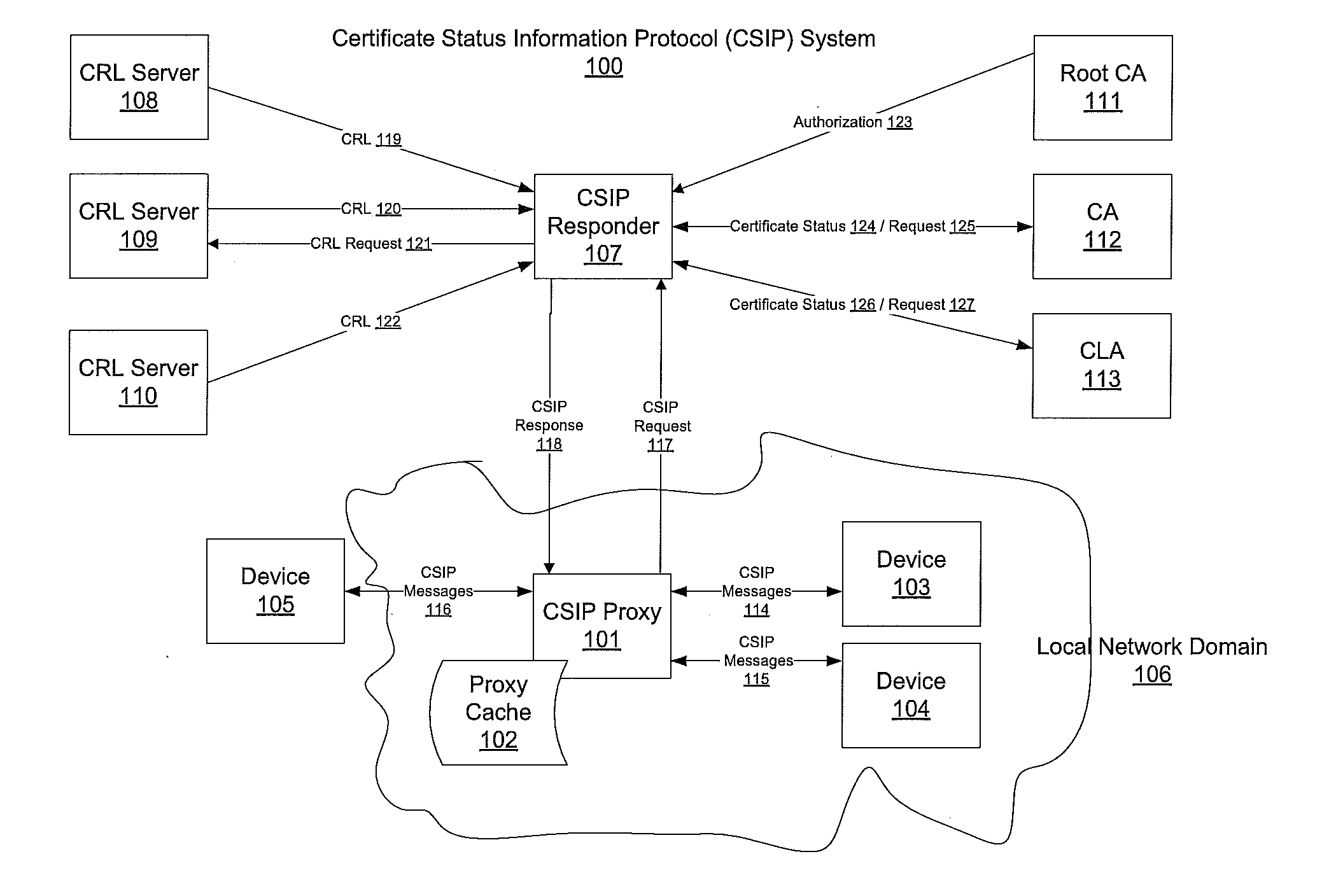
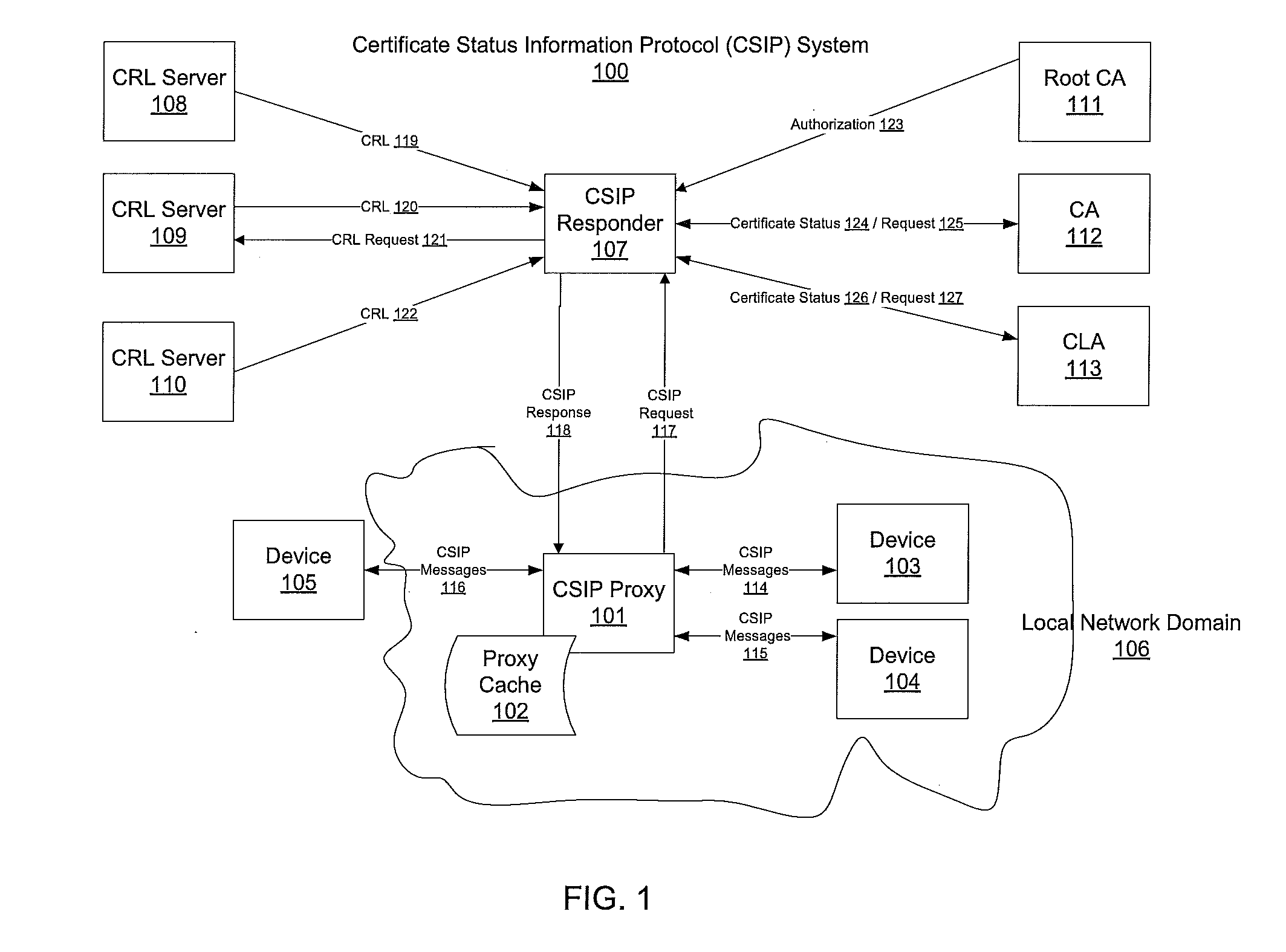
[0014]The embodiments described above provide the advantage of allowing the use of a Certificate Status Information Protocol (CSIP) proxy device within a local network to improve the capability of device certificate revocation status checking for devices in a local network without a need for downloading large CRLs into the local network for the devices in the network. The embodiments also provide the advantage of removing the need for regular or constant connectivity, of devices in the local network, to the Internet and / or to other infrastructure, which is external to the local network for providing CRLs, such as a CRL server. This also reduces the significant delays associated with two-way communications between a device and a CRL server. Embodiments directed to a CSIP proxy including a CSIP proxy memory also provide the advantage of reducing the level of connectivity to the CSIP responder, by using the certificate status information in CSIP proxy memory for at least part of the certificate revocation status verification process, rather than accessing the CSIP responder. Another advantage relates to the use of CSIP protocol for enhancing the communications involving certificates based on different standards.

Problems solved by technology

In many instances, the distribution of content is restricted by download rights management (DRM) schemes and content protection requirements.
However, the use of SRM messaging has introduced challenges to the adoption of any standard in a local network which relies on a different standard for a local network domain.
Also using SRM for device certificate revocation status verification presents growing practical problems.
As the certificate revocation lists (CRL) grow larger, transporting them over local network domains with limited bandwidth is becoming less and less desirable.
Some devices which share content may not have sufficient memory to store and process large CRLs, which can grow to many megabytes in size.
So the devices may not have sufficient capacity to search the large CRLs for a revoked certificate status.
This process may not be practical for some devices which are isolated in a local network.
So these devices do not have ready access to updated CRLs.
These devices cannot always determine the revocation status of the certificates they receive in a timely manner before sharing content.
In addition, the SRM messaging format is not readily adaptable to an optimization of the process of device certificate revocation status verification, and the SRM messaging format limits adding additional data to expand its format.
According to the existing scheme, SRM messages containing large amount of data can overflow a home network, or another local network, and otherwise consume excessive bandwidth in bringing a CRL into the network and in distributing it among content sharing devices in the network.

Method used

the structure of the environmentally friendly knitted fabric provided by the present invention; figure 2 Flow chart of the yarn wrapping machine for environmentally friendly knitted fabrics and storage devices; image 3 Is the parameter map of the yarn covering machine
View more

Image

Smart Image Click on the blue labels to locate them in the text.
Viewing Examples
Smart Image
  • Certificate status information protocol (CSIP) proxy and responder
  • Certificate status information protocol (CSIP) proxy and responder
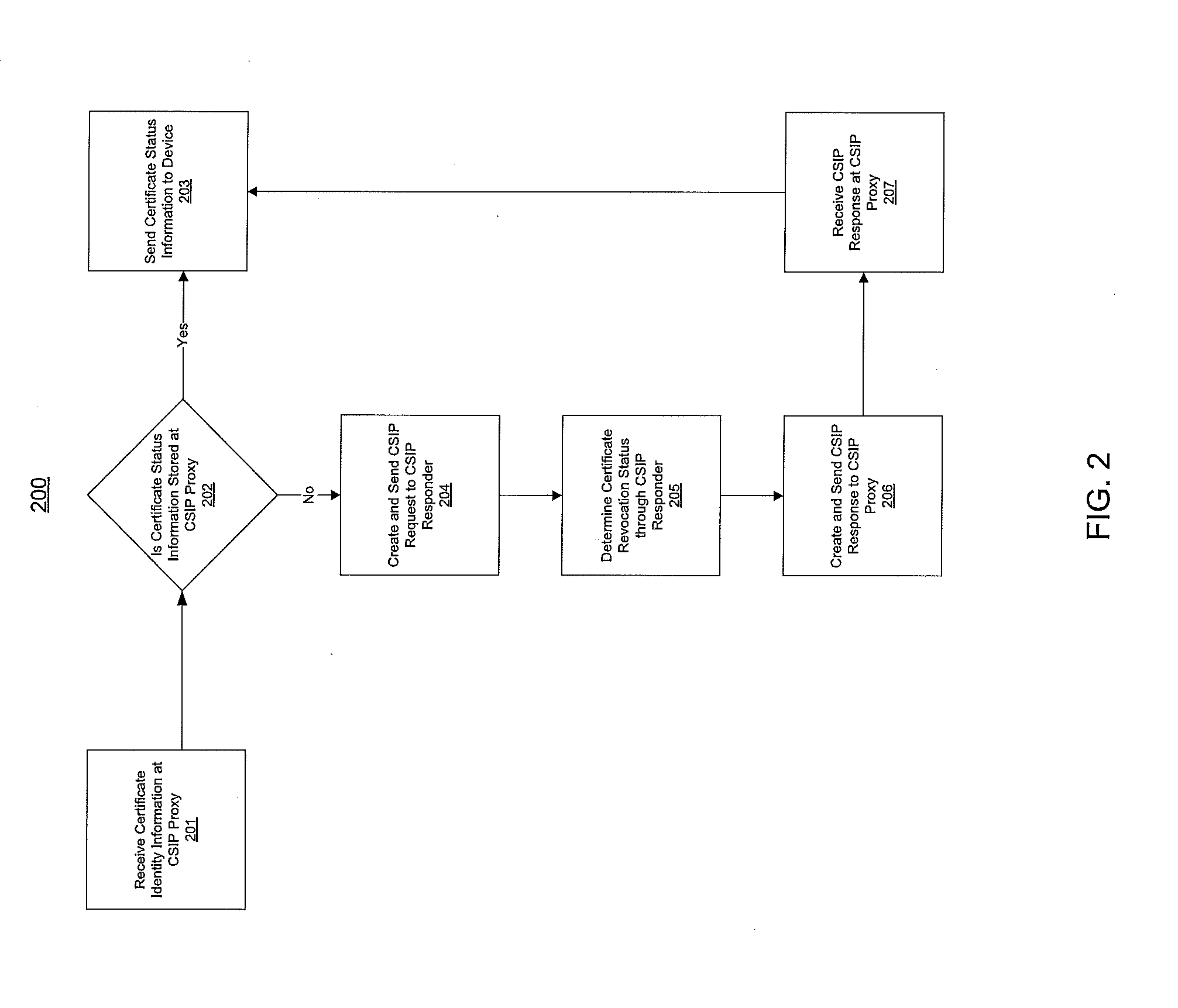
  • Certificate status information protocol (CSIP) proxy and responder

Examples

Experimental program
Comparison scheme
Effect test

example 1

CSIP or OCSP Format for the CSIP Request 117 Extended for Use with DTLA Issued Certificates

[0028]CSIP / OCSP requests based on RFC 5019, another protocol based on and similar to the OCSP protocol, like the RFC 2560 protocol, can be defined as follows. RFC 5019 does not allow the requester to request the status for more than one certificate at a time. The CSIP request 117 is not signed and thus the identity of the requestor is not included in the request either.

[0029]In order to be as compatible as possible to the Internet Engineering Task Force (IETF) specifications, the use of DTLA-specific extensions for the CSIP request 117 and response 118 can be avoided. Instead the CSIP responder 107 relies on the issuer name and issuer public key hash to determine that it involves a DTLA certificate. This is explained further below. Furthermore, to adopt use of standard OCSP messaging to DTLA certificates, which may not include a certificate serial number as the certificate identity information...

example 2

OCSP Response According to RFC 5019

[0032]Table 2 below gives examples of data fields in a CSIP response, such as the CSIP response 118 shown in FIG. 1.

TABLE 2Examples of Data Fields in a CSIP ResponseField NameRFC2560 typeValuetbsResponseDataSEQUENCE{ versionINTEGERv1 responderIDCHOICEHash (e.g. SHA1) ofresponder's public key. producedAtGeneralized Time responses {SEQUENCE OFSHOULD include only oneentry per RFC 5019.However more than oneresponse is allowed ifperformance of pre-generation or caching isimproved.  certID {hashAlgorithmAlgorithmIdentifierIdentifies hash algorithm.OCTET STRINGHash of issuer's name.issuerNameHashissuerKeyHashOCTET STRINGHash of issuer's key.serialNumber }INTEGERCertificates's serial numberfor which status informationis returned.Use DTLA assignedDeviceID of the certificate asserialNumber. certStatusgood, revoked, or unknown thisUpdateGeneralizedTimeTime when the status isknown to be correct. nextUpdateGeneralizedTimeTime at which or before newinformation w...

example 3

DLNA / UPnP Device Discovery Extension for Advertising OCSP Capabilities

[0034]Device discovery and control enables a device on the home network to discover the presence and capabilities of other devices on the network and collaborate with these devices in a uniform and consistent manner. As part of device discovery, a device capability is a set of device functions (at least one) aggregated to be used in a CSIP system usage that enables home networking use case scenarios. A device capability does not provide support for all layers in the DLNA architecture. An example of a device capability is any DLNA device that incorporates the additional feature (capability) of pushing content to a rendering device, such as a “Push Controller”.

the structure of the environmentally friendly knitted fabric provided by the present invention; figure 2 Flow chart of the yarn wrapping machine for environmentally friendly knitted fabrics and storage devices; image 3 Is the parameter map of the yarn covering machine
Login to View More

PUM

No PUM Login to View More

Abstract

Systems and methods are disclosed for providing certificate status information about a certificate includes receiving, at a Certificate Status Information Protocol (CSIP) proxy device the certificate identity information about the certificate of the second device. Then determining, using the CSIP proxy device, whether the certificate status information is stored in a CSIP proxy device memory. If the certificate status information is not stored in the CSIP proxy device memory, creating a CSIP request based on the certificate identity information and sending the CSIP request, including the certificate identity information, to a CSIP responder computer outside the local network domain. If the certificate status information is stored in the CSIP proxy device memory, sending the certificate status information to the first device. Also, a system and method are disclosed for using a CSIP responder computer.

Description

PRIORITY[0001]This application claims priority to U.S. Provisional Patent Application Ser. No. 61 / 186,498, filed Jun. 12, 2009, entitled “OCSP Proxy in Home Network”, by Shamsaasef et al., based on Attorney Docket No. BCS05754, which is incorporated by reference herein in its entirety.BACKGROUND[0002]Pushing content over the Internet to view on a variety of different types of devices, such as mobile devices and devices for home entertainment, is becoming more and more prevalent. The distribution of content may include distribution over local area networks, such as home networks. In many instances, the distribution of content is restricted by download rights management (DRM) schemes and content protection requirements. These DRM schemes have been developed through different organizations concerned with maintaining sources of trust as a basis for sharing content among such devices.[0003]One DRM scheme used among devices used in a home network, such as smart phones, DVD players and tel...

Claims

the structure of the environmentally friendly knitted fabric provided by the present invention; figure 2 Flow chart of the yarn wrapping machine for environmentally friendly knitted fabrics and storage devices; image 3 Is the parameter map of the yarn covering machine
Login to View More

Application Information

Patent Timeline
no application Login to View More
IPC IPC(8): H04L29/06
CPCH04L63/0823H04L63/10H04L2209/76H04L2209/603H04L9/3268
Inventor SHAMSAASEF, RAFIEMEDVINSKY, ALEXANDERNAKHJIRI, MADJID F.PETERKA, PETR
Owner GOOGLE TECH HLDG LLC
Features
  • R&D
  • Intellectual Property
  • Life Sciences
  • Materials
  • Tech Scout
Why Patsnap Eureka
  • Unparalleled Data Quality
  • Higher Quality Content
  • 60% Fewer Hallucinations
Social media
Patsnap Eureka Blog
Learn More