Preventing unauthorized use of optical discs
- Summary
- Abstract
- Description
- Claims
- Application Information
AI Technical Summary
Benefits of technology
Problems solved by technology
Method used
Image



Examples
Embodiment Construction
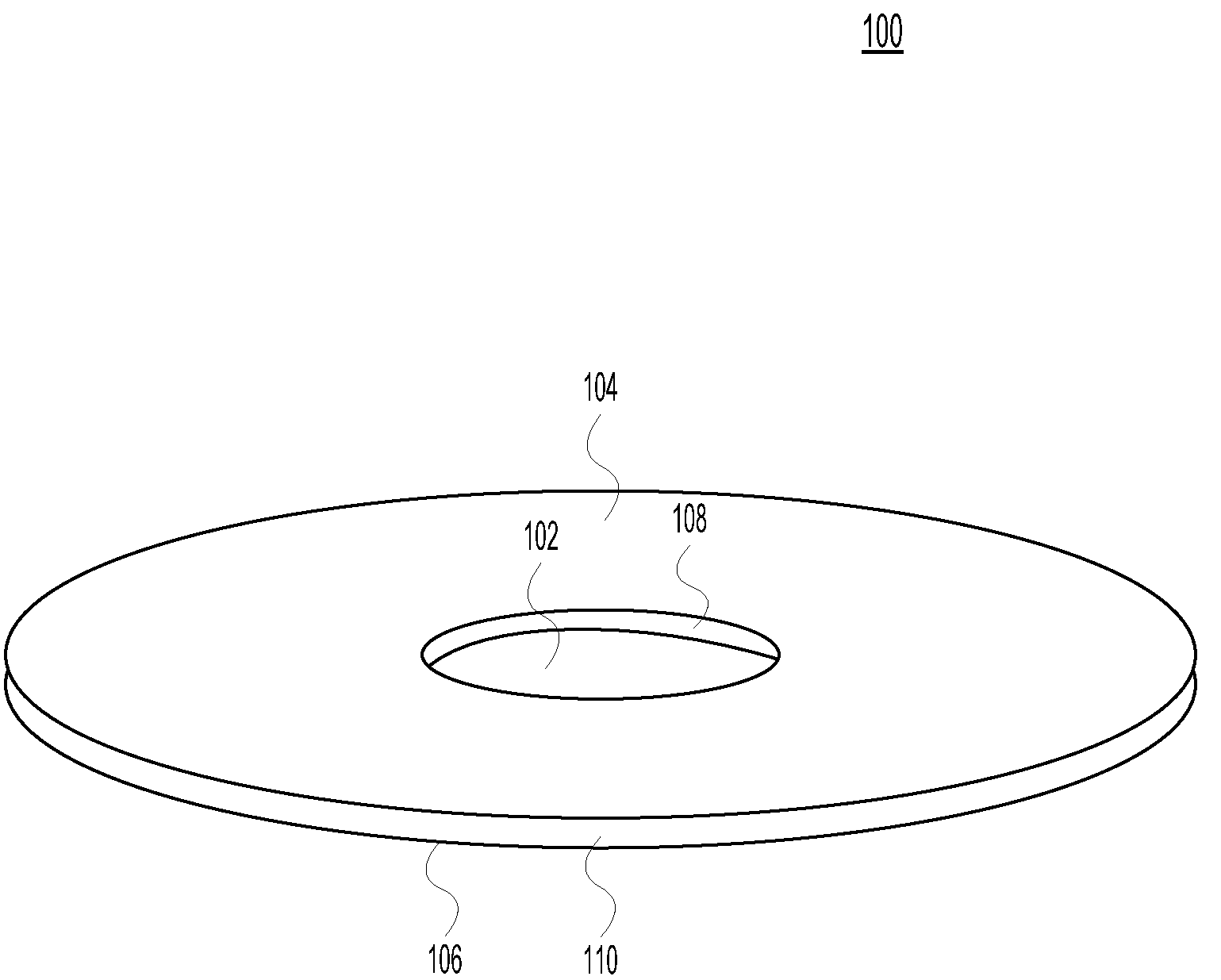
[0019]FIG. 1 is a depiction of a typical optical disc 100. Typical optical disc 100 is a flat, circular disc comprising a central spindle hole 102, and four surfaces: upper surface 104, bottom surface 106, inner edge 108, and outer edge 110. The four surfaces, collectively, are referred to herein as the surface of optical disc 100. There are different types of optical discs, e.g., CD, DVD, Blu Ray, each of which has different physical characteristics defined by a specification. For example, the popular compact-disc read-only format (CD-ROM) is defined by ECMA standard 130“Data interchange on read-only 120 mm optical data disks (CD-ROM)”, i.e., ECMA-130, which specification is hereby incorporated by reference in its entirety. ECMA-130 defines a CD-ROM as an optical disc with a thickness of 1.2 millimeters, a radius of 60 millimeters, and a spindle hole that is 15 millimeters in diameter.
[0020]FIG. 2 is a cross-section of a portion of typical optical disc 100. Optical disc 100 compris...
PUM
 Login to View More
 Abstract
Description
Claims
Application Information
 Login to View More