Fastening members may be subject to varying forces, resulting from tugging during application, and from the wearer's movements at the hips, particularly if the diaper is snugly applied.
These forces may have various undesirable effects.
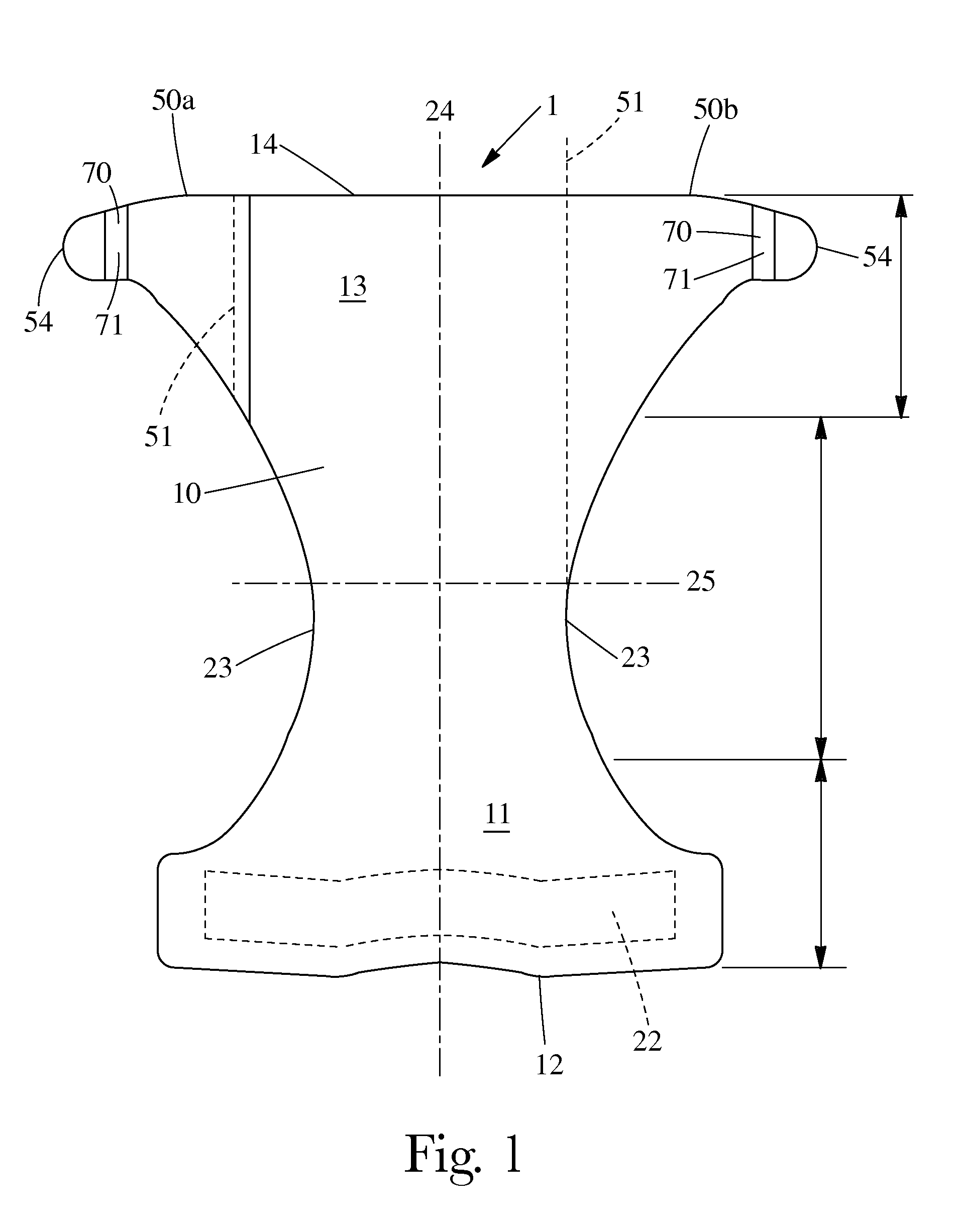
Longitudinal force components acting within the fastening member may create the likelihood that portions of the fastening member such as a panel region and / or extensible zone thereof will undesirably laterally buckle and / or flip away from the wearer.
With increasing length and surface area of the panel region, undesirable buckling / flipping of the panel region material
proximate either the top or bottom edges may be more likely, particularly when the wearer bends at the hips.
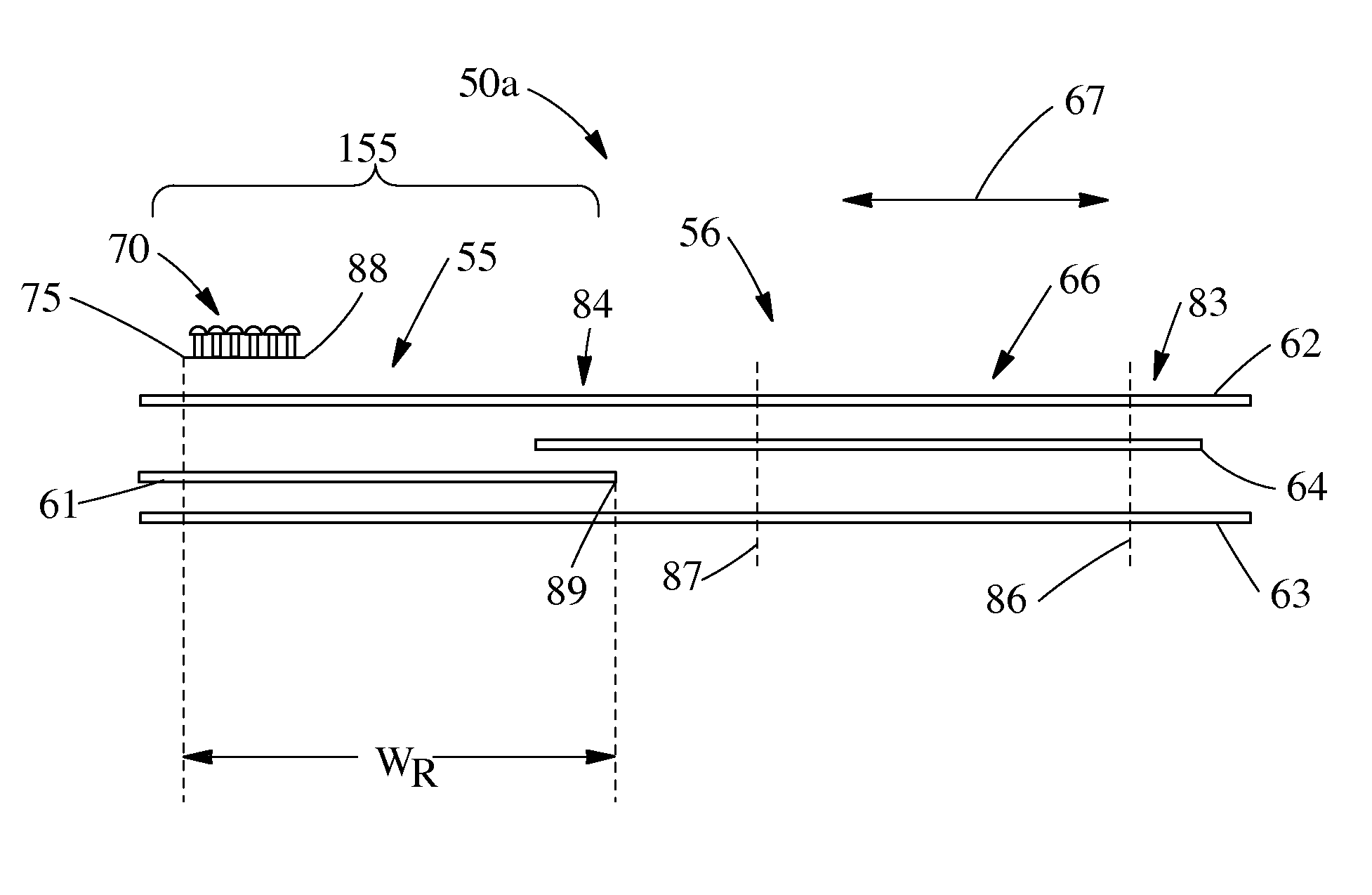
This problem may be more likely to manifest itself in “tape” type fastening members, in which a comparatively short tab member, bearing a fastener and forming the end region of the fastening member, joins a relatively longer side panel region, such that a step-wise decrease in length of the fastening member exists where the panel region ends and the tab member extends therefrom.
When the panel region and / or an extensible zone thereof is highly extensible (and relatively pliable), it may tend to buckle and flip about the relatively short tab member.
As a result, however, such longitudinal force components may act at or about the lateral edges of the fastener and contribute to causing the fastener to bend or “dish”, i.e., contribute to causing its lateral edges to be urged to turn up and away from the surface to which it is attached.
Upon being tugged laterally by an applier during application, and / or with lateral tension resulting from application and / or the wearer's movements, longitudinal force components of tension forces in the fastening member, acting at the edges of the fastener patch, can urge its longitudinally outer edges up and away from the
landing zone, thereby causing a sub-optimal fastener attachment to the landing zone, or weakening the fastener's hold at the landing zone, or even causing the fastener's hold to fail—which may allow the diaper to come loose or fall free of the wearer.
As a result, the likelihood of a tear beginning at the location of
stress concentration is increased.
The above-described events, i.e., panel region buckling / flipping, fastener dishing, and tearing, may be deemed problematic because they may result in less than optimum performance and / or appearance, failure of the product, and
consumer dissatisfaction.
Similarly, increasing the
bending stiffness of a fastener patch by selection of a thicker and / or denser
patch material may make it more resistive to dishing.
These approaches, however, also may have undesirable consequences.
If a fastener patch is too stiff and unyielding, when fastened at the wearer's
waist it may feel like an unyielding object and be a source of discomfort for the wearer under certain circumstances.
Increasing the strength of a stretch laminate may increase its stiffness, but decrease its
extensibility and
pliability, as well.
Increasing the stiffness of a material that is against the wearer's
skin in a region of the body subject to movement and bending may increase likelihood of discomfort for the wearer, and promote marking,
irritation and chafing of the wearer's
skin.
For the manufacturer of disposable diapers, acceptable but relatively more robust materials may be relatively more expensive.



 Login to View More
  Login to View More