
Display device
a display device and display screen technology, applied in the field of display devices, can solve the problems of emi generation, adverse effects on the operation of other electronic devices inside and outside the display device, and emi generation in the display screen, so as to save the power of the liquid crystal display device and prevent a malfunction
- Summary
- Abstract
- Description
- Claims
- Application Information
AI Technical Summary
Benefits of technology
Problems solved by technology
Method used
Image

Examples
first embodiment
[0035]Now, a brief summary of charge sharing driving of the present invention and the present invention are described with reference to FIGS. 1 to 11.
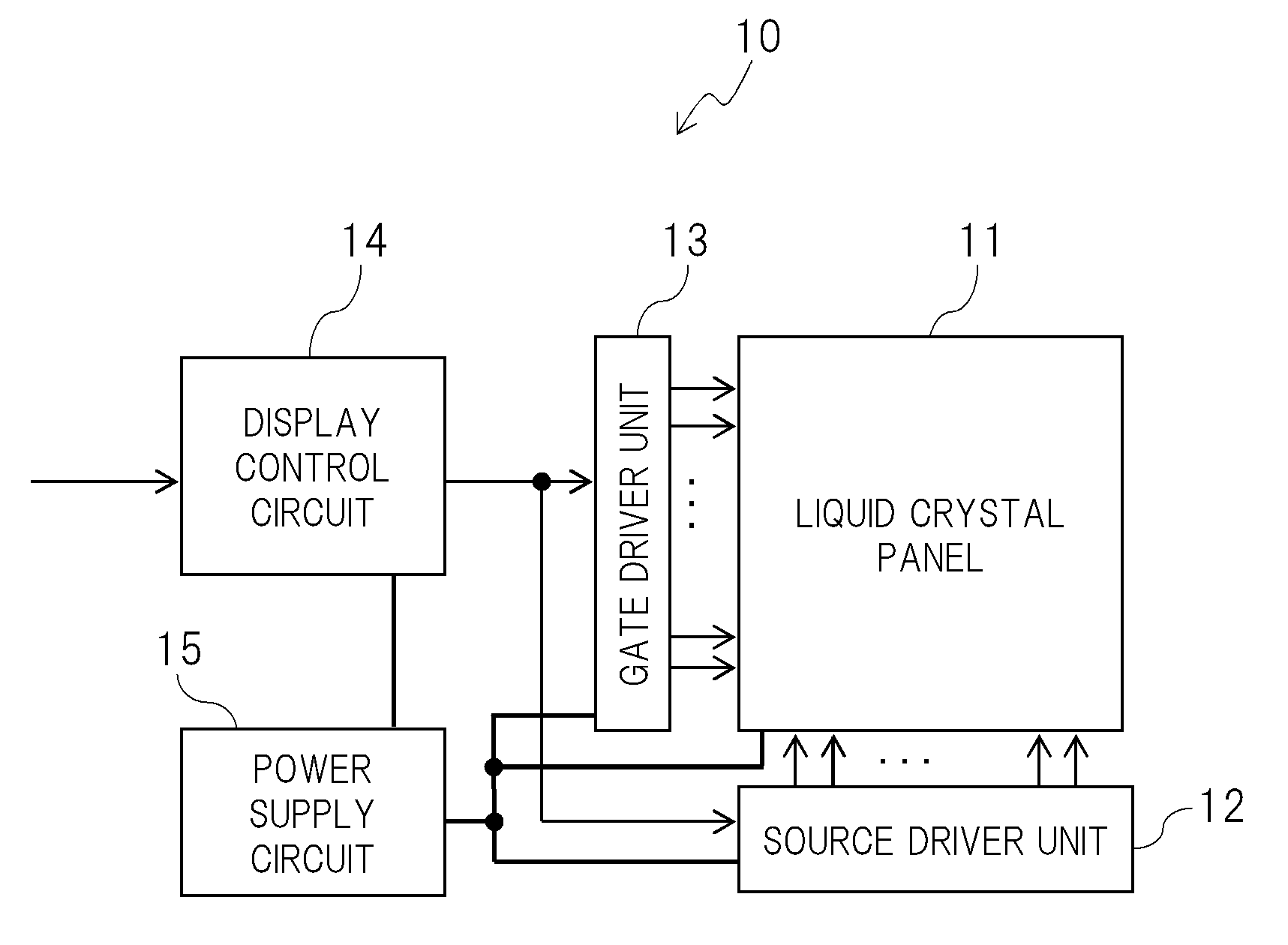
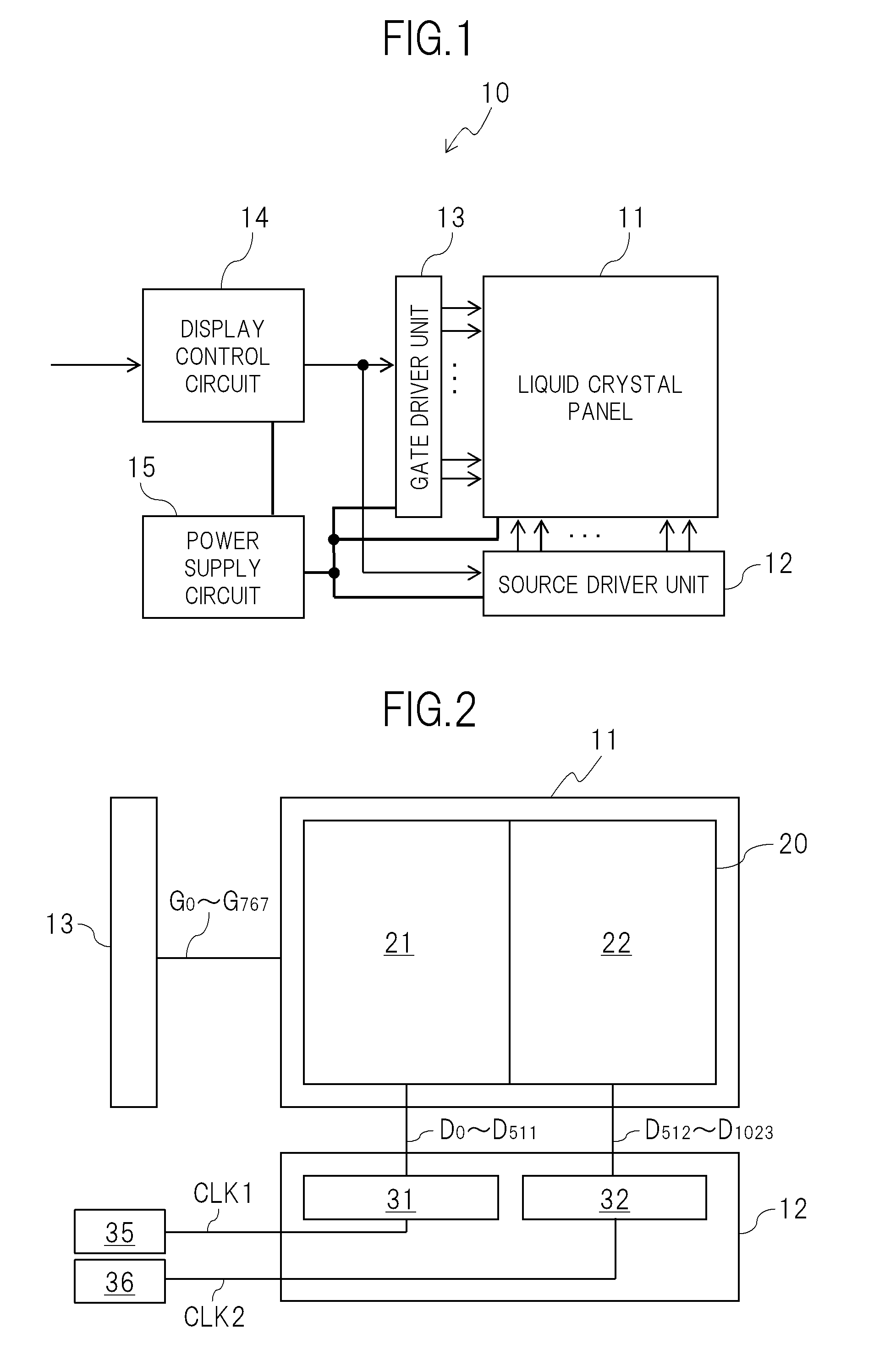
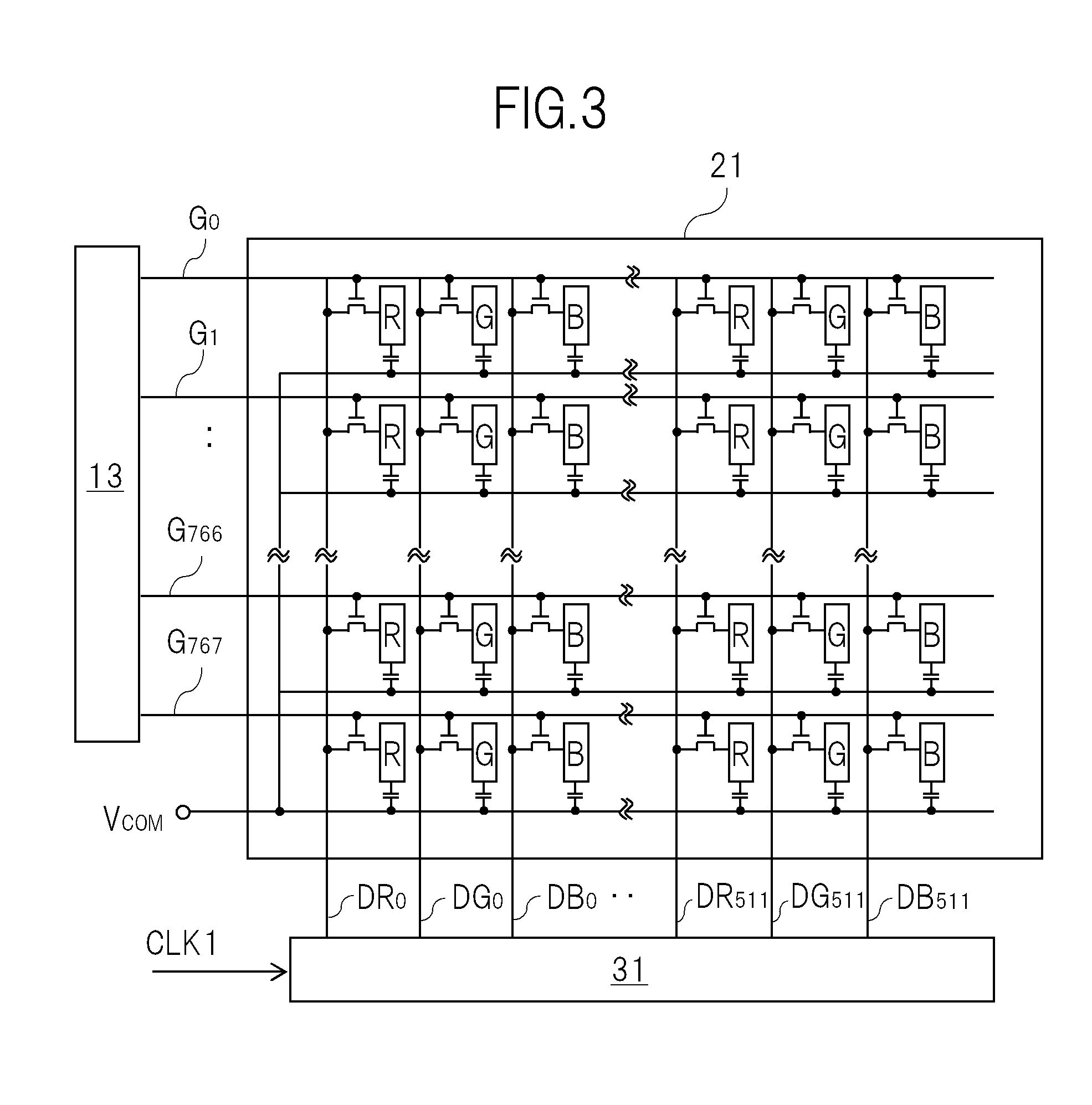
[0036]FIG. 1 schematically illustrates a configuration of a thin film transistor (TFT) liquid crystal display device 10 including a driver circuit according to a first embodiment of the present invention. The liquid crystal display device 10 includes: (a) a liquid crystal panel 11 including TFTs, for operating the TFTs to display an image visually; (b) a source driver unit 12 for controlling a voltage to be applied to a drain terminal of the TFT included in the liquid crystal panel 11; (c) a gate driver unit 13 for controlling a voltage to be applied to a gate terminal of the TFT included in the liquid crystal panel 11; (d) a display control circuit 14 for receiving image data to be displayed and instructing operations of the source driver unit 12 and the gate driver unit 13; and (e) a power supply circuit 15 for supplying power to the...
second embodiment
[0051]Hereinafter, the present invention is described with reference to FIG. 13.
[0052]A liquid crystal display device according to the second embodiment has the same configuration as that of the liquid crystal display device of the first embodiment except that the internal configuration of the driving section 231 of FIG. 11 is different, and hence description thereof is omitted. FIG. 13 is a diagram schematically illustrating an internal configuration of a driving section 331 corresponding to the driving section 231 of the first embodiment. Referring to FIG. 13, drain signals DR0, DG0, DB0, DR1, and DG1 are connected to a DR0 circuit 311, a DG0 circuit 312, a DB0 circuit 313, a DR1 circuit 314, and a DG1 circuit 315, and also connected to a common line CL via a switch SW321, a switch SW322, a switch SW323, a switch SW324, and a switch SW325, respectively. In other words, in FIG. 12 of the first embodiment, the switches SW221 to SW223 for setting the pair of two adjacent lines to the...
third embodiment
[0056]Hereinafter, the present invention is described with reference to FIG. 14.
[0057]A liquid crystal display device according to the third embodiment has the same configuration as that of the liquid crystal display device of the first embodiment except that the internal configuration of the driving section 231 of FIG. 11 is different, and hence description thereof is omitted. FIG. 14 is a diagram schematically illustrating an internal configuration of a driving section 431 corresponding to the driving section 231 of the first embodiment. Referring to FIG. 14, drain signals DR0, DG0, DB0, and DR1 are connected to a DR0 circuit 411, a DG0 circuit 412, a DB0 circuit 413, and a DR1 circuit 414, and also connected to a common line CL via a switch SW421, a switch SW422, a switch SW423, and a switch SW424, respectively. Further, the driving section 431 is divided into a plurality of unit driving sections, each of which is formed for each line (e.g., a unit driving section constituted by ...
PUM
 Login to View More
 Abstract
Description
Claims
Application Information
 Login to View More