
Multi-configuration adaptive layered steered space-time coded system and method
a wireless transmission system and multi-configuration technology, applied in the field of data transmission methods, can solve the problems of poor energy performance of v-blast, inability to fully exploit the diversity of available diversity, and difficulty in implementing antenna arrays on handheld terminals, etc., to achieve high signal-to-noise ratio (snr) range, improve performance, and optimize error performance
- Summary
- Abstract
- Description
- Claims
- Application Information
AI Technical Summary
Benefits of technology
Problems solved by technology
Method used
Image

Examples
Embodiment Construction
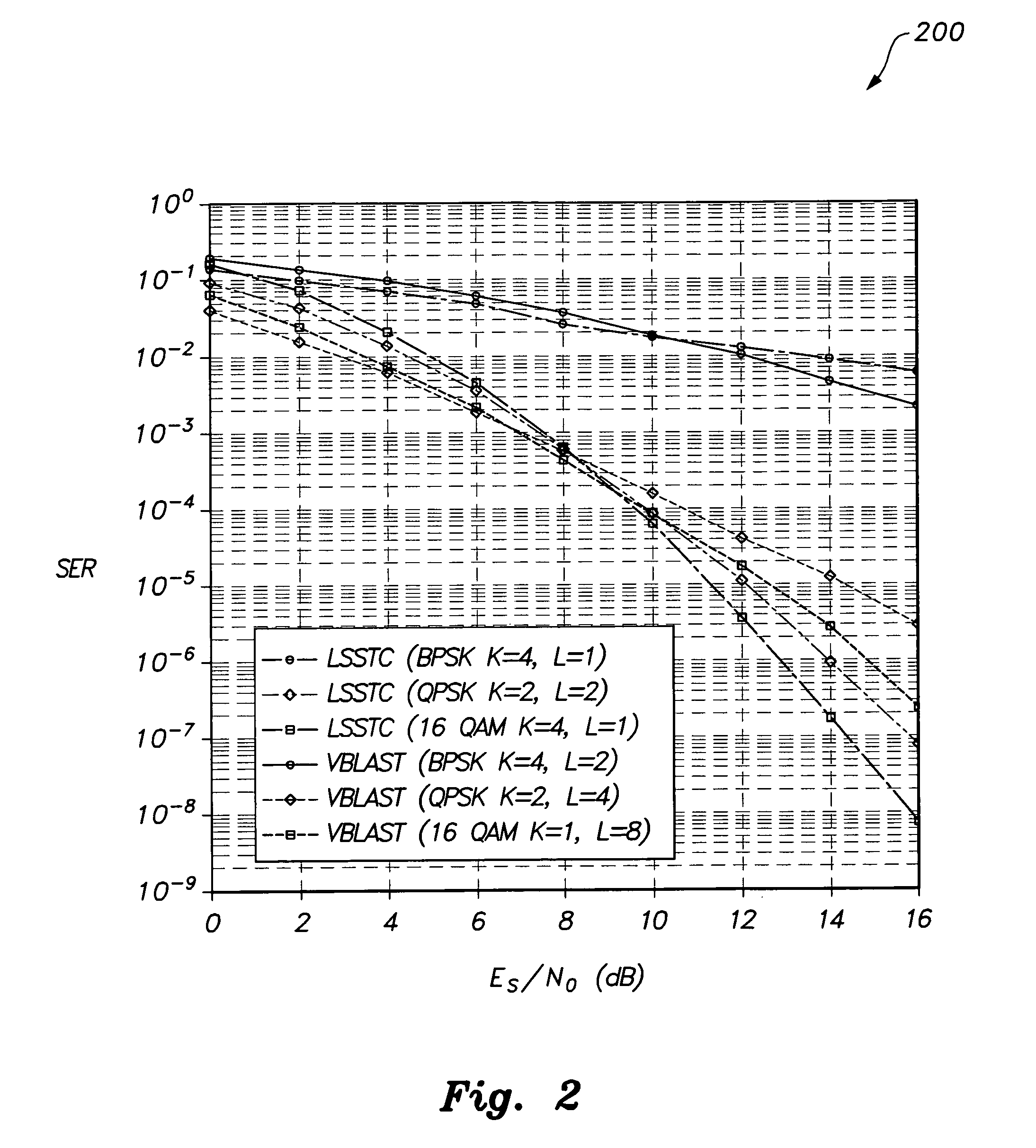
[0013]The multi-configuration adaptive layered steered space-time coded system utilizes Layered Steered Space-Time Codes (LSSTC), a recently proposed multiple-input multiple-output (MIMO) system that combines the benefits of vertical Bell Labs space-time (V-BLAST) scheme, space-time block codes (STBC) and beamforming. The multi-configuration transmission scheme based on LSSTC and V-BLAST systems uses threshold-based decision making to change the modulation type and the MIMO transmission scheme in order to optimize error performance. Numerical results are presented showing that combining beamforming, STBC, and V-BLAST has better performance than V-BLAST alone at high signal-to-noise ratio (SNR) range.
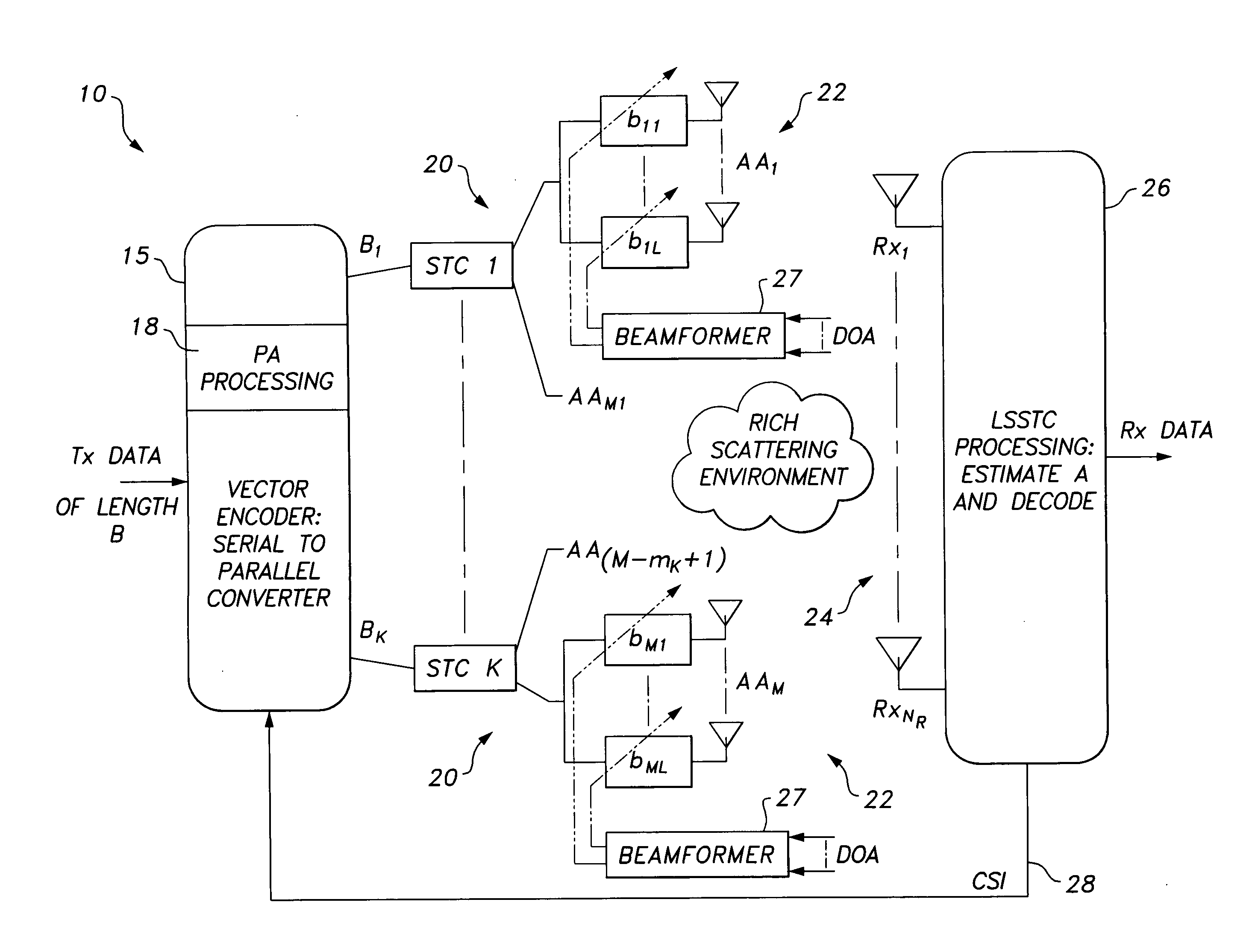
[0014]FIG. 1 shows a block diagram of LSSTC system 10, which has NT total transmitting antennas 22 and NR receiving antennas 24 and is denoted by an NT×NR system. The antenna architecture shown has M transmit adaptive antenna arrays (AA1-AAM) spaced sufficiently far apart in order to exp...
PUM
 Login to View More
 Abstract
Description
Claims
Application Information
 Login to View More