Unlock instant, AI-driven research and patent intelligence for your innovation.

Wastewater treatment comprising electrodissolution, flocculation and oxidation

Inactive Publication Date: 2013-06-20
UNIV DEL VALLE
View PDF6 Cites 8 Cited by
  • Summary
  • Abstract
  • Description
  • Claims
  • Application Information

AI Technical Summary

Benefits of technology

The patent describes a new process that combines three techniques to remove a high amount of solid waste from water. This process can be used for leachate from sanitary landfills or industrial wastewaters from factories. It does not require any pretreatments and can effectively remove up to 98% of the total solid waste present in the effluent.

Problems solved by technology

These treatments result troublesome when they are conducted in warm and humid climatic zones due to the generation of waste liquids produced by the slow passage of water through the permeable material present in sanitary landfills.
Said leachate is toxic due to the degradation of the organic material deposited on the landfills and the increase of their corrosive character by the effect of the dissolution of atmospheric CO2 in water.
Numerous limitations exist to treat leachate derived from the difficulty to guide them to a landfill in controlled manner, given that anaerobic fermentation processes generate malodorous gases and effluents with repugnant aspect.
However, these treatments do not reduce the contaminating capacity of the leachate and do not solve the problem of the contamination they generate through a practical and economic process.
This situation generates highly toxic leachate that cannot be re-circulated.
Because of its composition, it would be detrimental to discharge raw vinasse directly onto water sources: the high organic load would consume their oxygen, depleting flora and fauna; additionally, the high mineral content would cause eutrophication of waters.
The concentration of solids is an operation with high energy demand that is developed in the alcohol production plant and which, as a result, affects the process in economic terms.
Said situation forces recurrent interruptions and increased costs of the process, besides restrictions in maximum solid concentration levels during the same process (maximum 55% p / p).
However, it has been noted that these treatments do not degrade melanoidin, a substance that causes the Brown color of vinasse, which constitutes a refractory contaminant because it comes from industrial wastes and which because of its characteristics tends to be resistant to conventional treatments, and because of its characteristics the effluent cannot be reused to irrigate crops, nor can it be discharged into bodies of water.
These substances have antioxidant properties and are frequently toxic to microorganisms used in biological treatments of effluents, which has interfered in the development of conventional methods to treat distillery vinasse and has provoked the search for alternatives to accomplish discoloration and elimination of the high organic load of these types of effluents.
This situation has motivated researchers to combine the anaerobic treatment with prior advanced oxidation treatments or with subsequent aerobic treatments recurring to the capacity fungus and bacteria to degrade them, but high loads of additional nutrients are required.
Thereby, vinasse clarification has always resulted in a costly or difficult process and, in the best of cases; vinasse pretreated with known methods turns out unstable and precipitates after the treatment.
However, this treatment presents certain limitations derived from high consumption in chemical inputs.
Physical-chemical treatments also exist that recur to the use of absorbent and coagulant agents, as well as processes like electrochemical oxidation or even the use of membranes for filtration, but no method exists that can conduct a complete treatment and which additionally guarantees the use of the vinasse.
However, this process is not as convenient inasmuch as it does not recover the salts present in the effluent, given that once vinasse demineralization takes place, substances are eliminated with the application technique in the manufacture of agricultural sub-products, such is the case of the potassium salts in the form of titrate, nitrate, or phosphate and in other cases, as in the use of vinasse as animal food, the potassium level needs to diminish below 2 g / 100 g of dry matter, without eliminating it completely from the liquid fraction.
Nevertheless, the decontamination process mentioned presents high consumption of oxidizing agent and comprises the following stages:a) Separate the purified water from the sludge in a container zone that permit its circulation;b) Feed said waters containing iron III within a mixer; andc) Recover the purified water
Nevertheless, the high cost of generating ozone becomes one of its limitations.
And given that previously treated vinasse presents low electric conductivity due to the reduction of the ion content, this situation is not recommendable because the consumption of electricity increases during the electrochemical treatment.
Other requirements for the electrochemical treatment are derived from using semi-impermeable membranes capable of separating the anodic zones from the cathodic zones to facilitate the separation process through ion exchange, membranes that also present coating films with sulfonic acid radicals substituted by perfluorinated groups that increase operating costs.
However, these applications have disadvantages due to elevated periods of time they have to remain in storage, high cost of the investments, and operation difficulties in the processes.

Method used

the structure of the environmentally friendly knitted fabric provided by the present invention; figure 2 Flow chart of the yarn wrapping machine for environmentally friendly knitted fabrics and storage devices; image 3 Is the parameter map of the yarn covering machine
View more

Image

Smart Image Click on the blue labels to locate them in the text.
Viewing Examples
Smart Image
  • Wastewater treatment comprising electrodissolution, flocculation and oxidation
  • Wastewater treatment comprising electrodissolution, flocculation and oxidation
  • Wastewater treatment comprising electrodissolution, flocculation and oxidation

Examples

Experimental program
Comparison scheme
Effect test

example 1

Trials on Vinasse from Distilleries

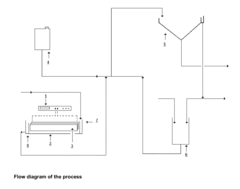
[0080]Electrodissolution trials were carried out in a discontinuous electrolytic reactor with upstream flow and with permanent recirculation. A monopolar arrangement was available in the electrodes and five stainless steel cathodes were used and six steel to carbon anodes. A 3-mm distance was set between electrodes and a total anodic area of 900 cm2 was established.

[0081]For the flocculation trials, 100-ml volumes of vinasse previously treated with electrodissolution were taken and diluted at different concentrations of solids: 1%, 2%, 3%, and 4% (p / p). Each sample was brought to pH 11.5 by adding Ca(OH)2 and was subjected to rapid agitation (700 rpm) for one minute; thereafter, it was subjected to slow agitation (60 rpm) for 10 minutes.

[0082]The samples were left to decant for 10 minutes and turbidity measurements were taken of the supernatant liquid. This liquid was separated and hydrogen peroxide was added to it.

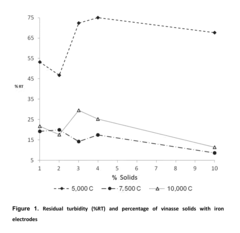
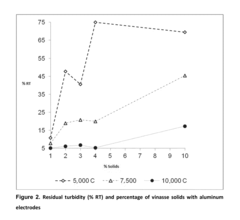
[0083]The influence of the electr...

example 2

Trials on Leachate from Sanitary Landfill

[0090]The leachate treatment was carried out from a sanitary landfill; results at different operating conditions are shown in FIG. 3. The same equipment as for example 1 was used.

[0091]The conditions for the electrochemical reactor were: operating pH between 4 and 5 and load in the reactor between 5,000-10,000 Coulombs per liter through direct current and iron electrodes.

[0092]The flocculation stage required a pH up to 11.5 using slaked lime, and for the oxidation process the amount of peroxide used ranged between 200 and 5,000 ppm.

Results

[0093]The leachate presented initial turbidity of 645 NTU (Nephelometric turbidity units) and after using the same process as in example 1, a liquid was obtained with a final turbidity of 7.25, that is, 98.9% reduction of solids content was produced.

NTU Original turbidity=645

NTU final turbidity=7.25

Percentage of turbidity reduction=98.9%

example 3

Trials on Biologically Pretreated Vinasse

[0094]Treatment was conducted on pretreated vinasse from the yeast farming industry. The effluent from an activated sludge anaerobic reactor (UASB) presented the following initial characteristics:

Sample A. COD (ppm)=7,758

[0095]After the treatment, the sample presented the following characteristic:

Sample A. COD (ppm)=558

[0096]The percentage of reduction of COD content after treatment was 93%. The same procedure from example 1 was used.

the structure of the environmentally friendly knitted fabric provided by the present invention; figure 2 Flow chart of the yarn wrapping machine for environmentally friendly knitted fabrics and storage devices; image 3 Is the parameter map of the yarn covering machine
Login to View More

PUM

PropertyMeasurementUnit
Fractionaaaaaaaaaa
Current densityaaaaaaaaaa
Login to View More

Abstract

The present invention claims a process to reduce COD, TOC, and total solids from a contaminated liquid medium, which comprises of the following stages: feed an electrolytic cell provided with electrodes with the contaminated liquid medium; apply a constant direct current through said electrodes; flocculate the solids present in said contaminated liquid medium by adding coadjuvant agents, remove sludge and supernatant obtained; and oxidize the supernatant through oxidizing agents.

Description

FIELD OF THE INVENTION[0001]The present invention is related to a novel process for the reduction of chemical oxygen demand (COD), total organic carbon (TOC), and the content of total solids present in industrial waste waters or wastewaters among which are included, but not limited to: a) leachate from landfills of urban solid wastes; b) vinasse produced in ethanol distilleries: c) vinasse produced in yeast producing plants; d) production waters from petroleum wells; e) waters contaminated with flexographic inks or textile dyes; and f) acid drainage from coal mines. The treatment comprises coupling three processes: iron (or aluminum) electrodissolution, chemical flocculation, and advanced oxidation.[0002]The process proposed consumes little electrical energy en la metal electrodissolution (less than 1.5 kWh / m3) due to the management of low current densities, which places it at advantage against conventional electrocoagulation. Likewise, it avails of the fact that coagulant dosing (i...

Claims

the structure of the environmentally friendly knitted fabric provided by the present invention; figure 2 Flow chart of the yarn wrapping machine for environmentally friendly knitted fabrics and storage devices; image 3 Is the parameter map of the yarn covering machine
Login to View More

Application Information

Patent Timeline
no application Login to View More
IPC IPC(8): C02F9/00
CPCC02F1/463C02F1/5245C02F1/66C02F9/00C02F2103/325C02F2201/4617C02F1/722
Inventor MACHUCA MARTINEZ, FIDERMANMARRIAGA CABRALES, NILSON DE JESUSCARDONA PALOMINO, CHARLES EDUARDO
Owner UNIV DEL VALLE