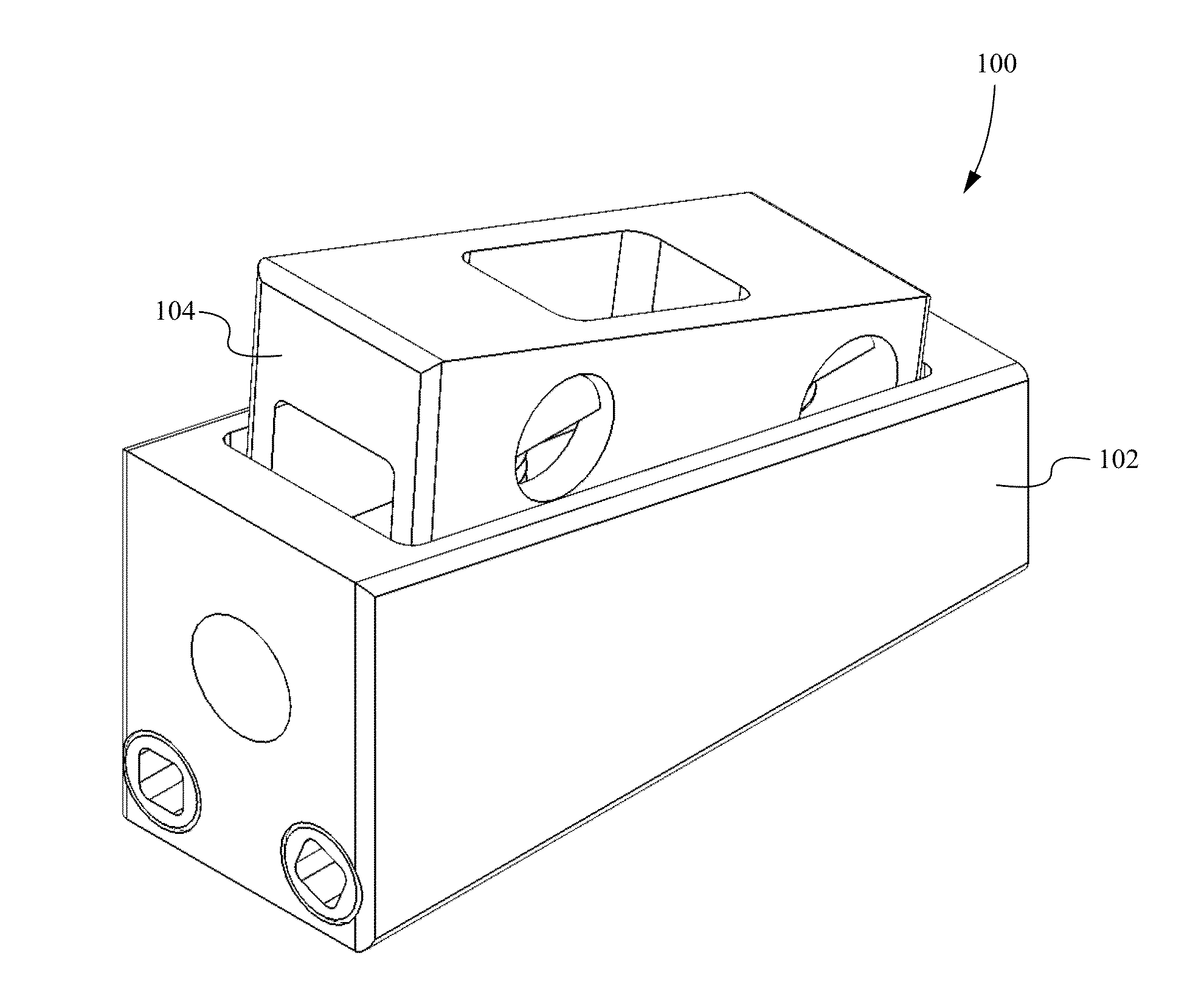
Bone fusion device

a bone fusion and bone technology, applied in the field of bone fusion devices, can solve the problems of degenerative disc disease, pain that radiates into other parts of the body, and may cause instability of the vertebrae, and achieve the effect of increasing the surface area

US20130274883A1Active Publication Date: 2013-10-17NEUROPRO TECH
65 Cites 160 Cited by

Patent Information

Authority / Receiving Office
US · United States
Patent Type
Applications(United States)
Current Assignee / Owner
Publication Date
2013-10-17

Smart Images

  • Figure 1
    Figure 1
  • Figure 2
    Figure 2
  • Figure 3
    Figure 3
Patent Text Reader

Abstract

A bone fusion device for insertion between bones that are to be fused together, such as, for example, the vertebrae of a spinal column. The bone fusion device comprises at least one extendable tab and one or more tab extension assemblies. Each tab extension assembly is able to be adjusted in order to individually control the extension or contraction of a side of the tab thereby enabling adjustment of the height and / or angle of the tab with respect to the body of the bone fusion device. Each tab extension assembly is able to be individually adjusted such that the side controlled by each assembly is raised or lowered until the desired tab angle is achieved. The tab is advantageously positioned and angled to correspond to the vertebrae to help brace the device until the bone has fused.
Need to check novelty before this filing date? Find Prior Art

Description

RELATED APPLICATIONS

[0001] This application claims priority under 35 U.S.C. §119(e) of U.S. Provisional Patent Application Ser. No. 61 / 624,155, filed Apr. 13, 2012, and entitled “BONE FUSION DEVICE,” which is hereby incorporated by reference.FIELD OF THE INVENTION

[0002] This invention relates generally to bone fusion devices. More specifically, the present invention relates to devices for fusing vertebrae of the spine that can be inserted arthroscopically.BACKGROUND OF THE INVENTION

[0003] The spinal column is made up of vertebrae stacked on top of one another. Between the vertebrae are discs which are gel-like cushions that act as shock-absorbers and keep the spine flexible. Injury, disease, or excessive pressure on the discs can cause degenerative disc disease or other disorders where the disc becomes thinner and allows the vertebrae to move closer together or become misaligned. As a result, nerves may become pinched, causing pain that radiates into other parts of the body, or instabi...

Examples

Embodiment Construction

[0059]In the following description, numerous details and alternatives are set forth for purpose of explanation. However, one of ordinary skill in the art will realize that the invention can be practiced without the use of these specific details. For instance, the figures and description below often refer to the vertebral bones of a spinal column. However, one of ordinary skill in the art will recognize that some embodiments of the invention are practiced for the fusion of other bones, including broken bones and / or joints. In other instances, well-known structures and devices are shown in block diagram form in order not to obscure the description of the invention with unnecessary detail. Further, although the figures and description below refer to a bone fusion device having a single tab and a pair of tab extension assemblies, it is understood that the bone fusion device is able to comprise multiple tabs each having any number of tab extension assemblies.

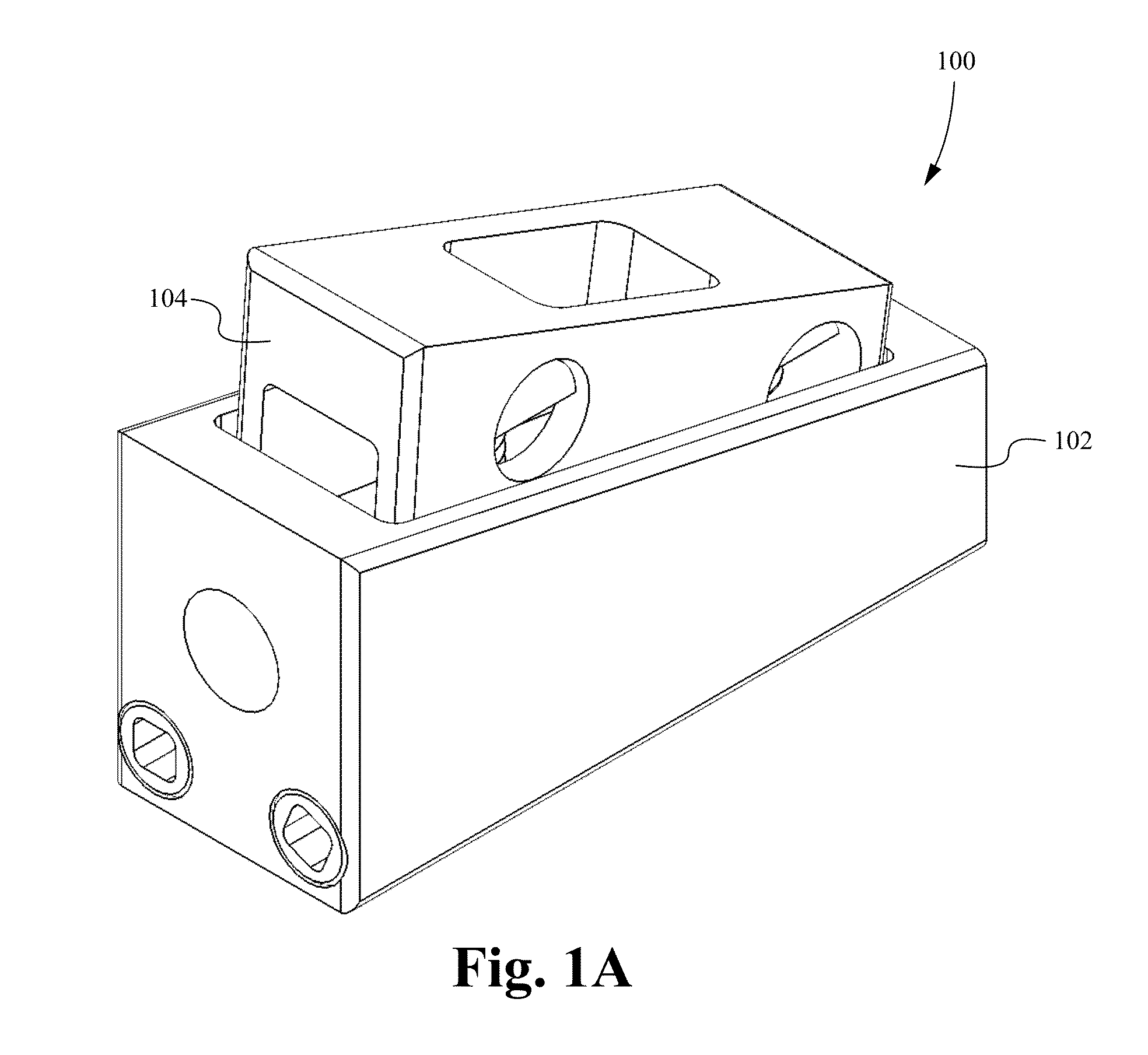
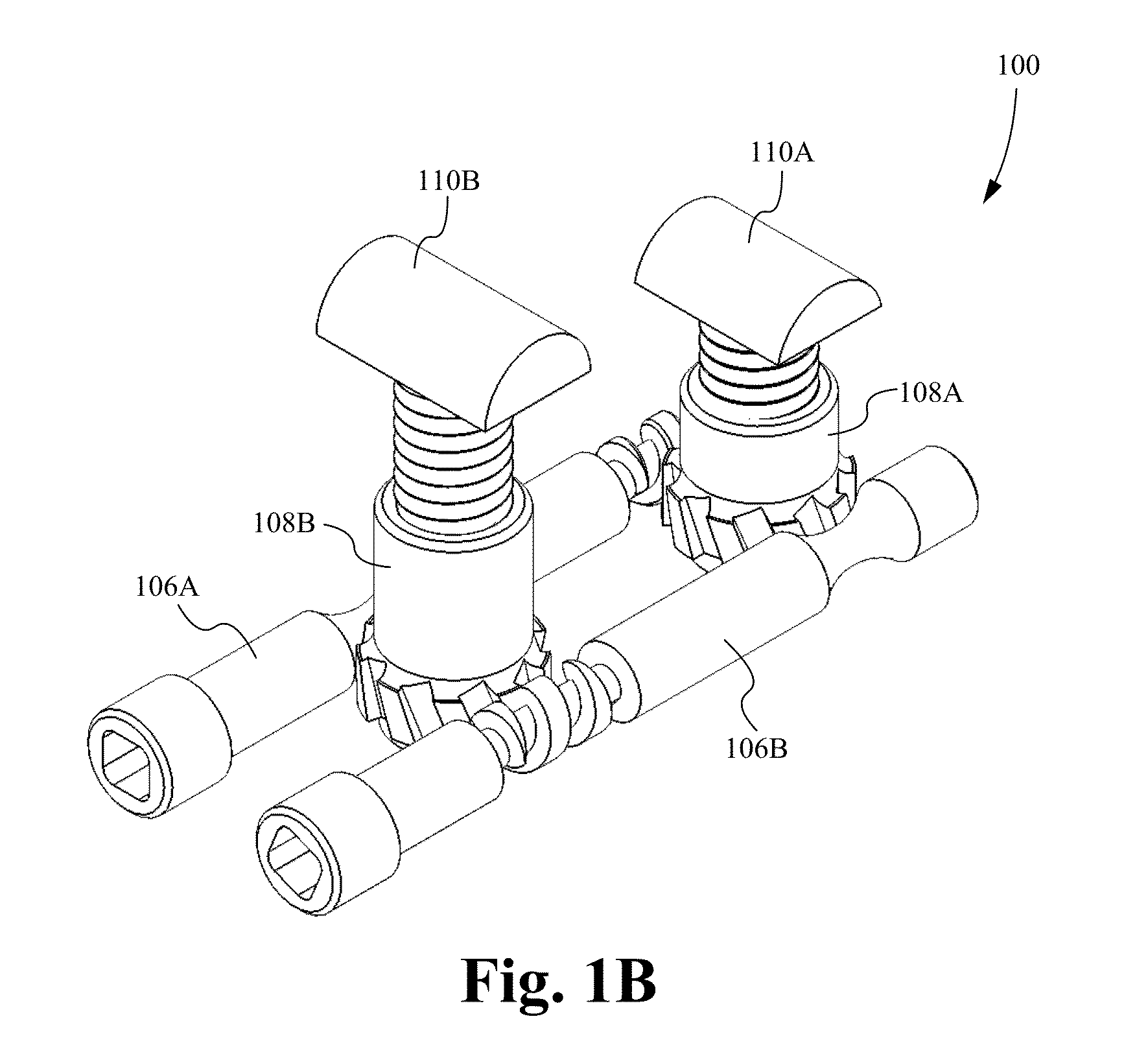
[0060]FIGS. 1A and 1B illustr...