
Phase interpolating apparatus and method
a phase interpolation and phase technology, applied in pulse generators, pulse manipulation, pulse techniques, etc., can solve problems such as unrecoverable errors, waveform becomes incorrect, interpolated clock signal display un-normal surge or decay, etc., to achieve the effect of maintaining processing speed
- Summary
- Abstract
- Description
- Claims
- Application Information
AI Technical Summary
Benefits of technology
Problems solved by technology
Method used
Image

Examples
Embodiment Construction
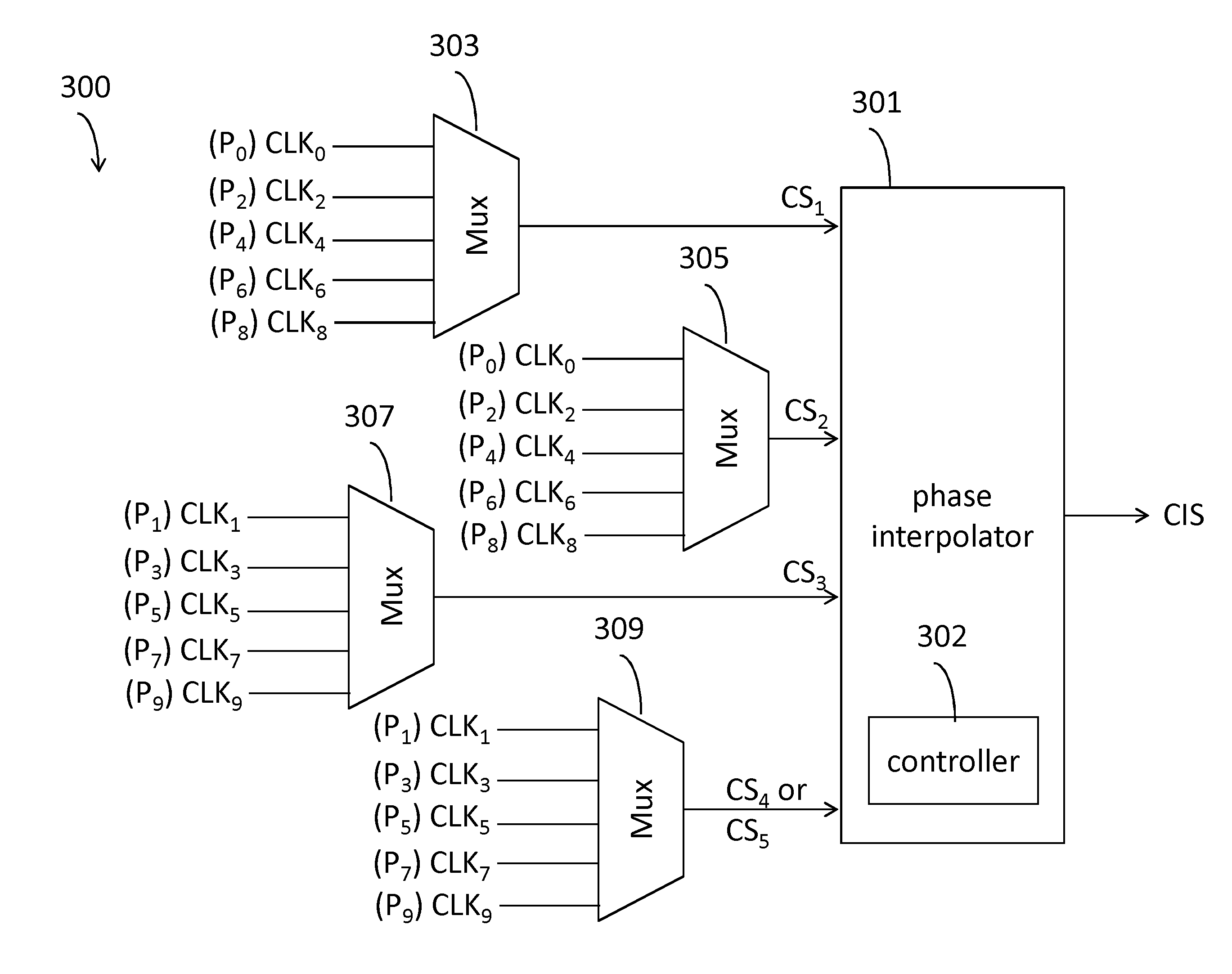
[0022]Please refer to FIG. 3, which shows a block diagram of a phase interpolating apparatus 300 in accordance with an embodiment of the present invention. As shown in FIG. 3, clock signals CLK0, CLK2, CLK4, CLK6, and CLK8 have even phases P0, P2, P4, P6, and P8, respectively. Similarly, clock signals CLK1, CLK3, CLK5, CLK7, and CLK9 have odd phases P1, P3, P5, P7, and P9, respectively. The phase interpolating apparatus 300 comprises a phase interpolator 301 and multiplexers 303, 305, 307, and 309. The multiplexers 303 and 305 receive clock signals CLK0, CLK2, CLK4, CLK6, and CLK8 and output a first clock signal CS1 and a second clock signal CS2 to the phase interpolator 301, respectively. The multiplexer 307 receives clock signals CLK1, CLK3, CLK5, CLK7, and CLK9 and outputs a third clock signal CS3 to the phase interpolator 301. The multiplexer 309 receives clock signals CLK1, CLK3, CLK5, CLK7, and CLK9 and outputs a fourth clock signal CS4 or a fifth clock signal CS5 to the phase...
PUM
 Login to View More
 Abstract
Description
Claims
Application Information
 Login to View More