Realtime color vision deficiency correction

a color vision and deficiency correction technology, applied in the field of video games, can solve the problems of reducing the appreciation of visually rich displays, not all may be able to enjoy the colorful, vibrant displays provided, and affecting the enjoyment of video game play

US20140066196A1Inactive Publication Date: 2014-03-06ACTIVISION PUBLISHING
8 Cites 14 Cited by

Patent Information

Authority / Receiving Office
US · United States
Patent Type
Applications(United States)
Current Assignee / Owner
Publication Date
2014-03-06
Estimated Expiration
Not applicable · inactive patent

Smart Images

  • Figure 1
    Figure 1
  • Figure 2
    Figure 2
  • Figure 3
    Figure 3
Patent Text Reader

Abstract

Real-time modification of pixel colors for displays, such as video game displays, may be performed to account for color vision deficiency. The modifications can be performed using operations utilizing constant matrices, with operations performed in the LMS color space. For example, a pixel may be transformed from an RGB color space to the LMS color space, a difference between a simulated color-vision deficient response and the pixel may be determined, and the difference may be distributed in the pixel such that the response is effectively taken from defective cones and distributed to functioning cones, with the resulting pixel transformed back to the RGB color space for display.
Need to check novelty before this filing date? Find Prior Art

Description

BACKGROUND OF THE INVENTION

[0001] The present invention relates to video games, and more particularly to video game display processing to account for color-vision deficiencies.

[0002] Video games are enjoyed by many, and often allow video game players to immerse themselves in a virtual world, virtually participating in possibly otherwise unavailable activities. With high resolution displays readily available, the virtual world may authentically be displayed in a colorful, vibrant, dynamic manner.

[0003] Unfortunately, not all may be able to enjoy the colorful, vibrant displays provided by video games. Color vision deficiency, commonly known as color blindness, affects a significant percentage of the population. Those with color blindness may have a reduced ability, or even inability, to see certain colors or distinguish certain colors among similar wavelengths. Such a condition may detract from enjoyment of video game play, not only in terms of reduced appreciation of visually rich displ...

Examples

Embodiment Construction

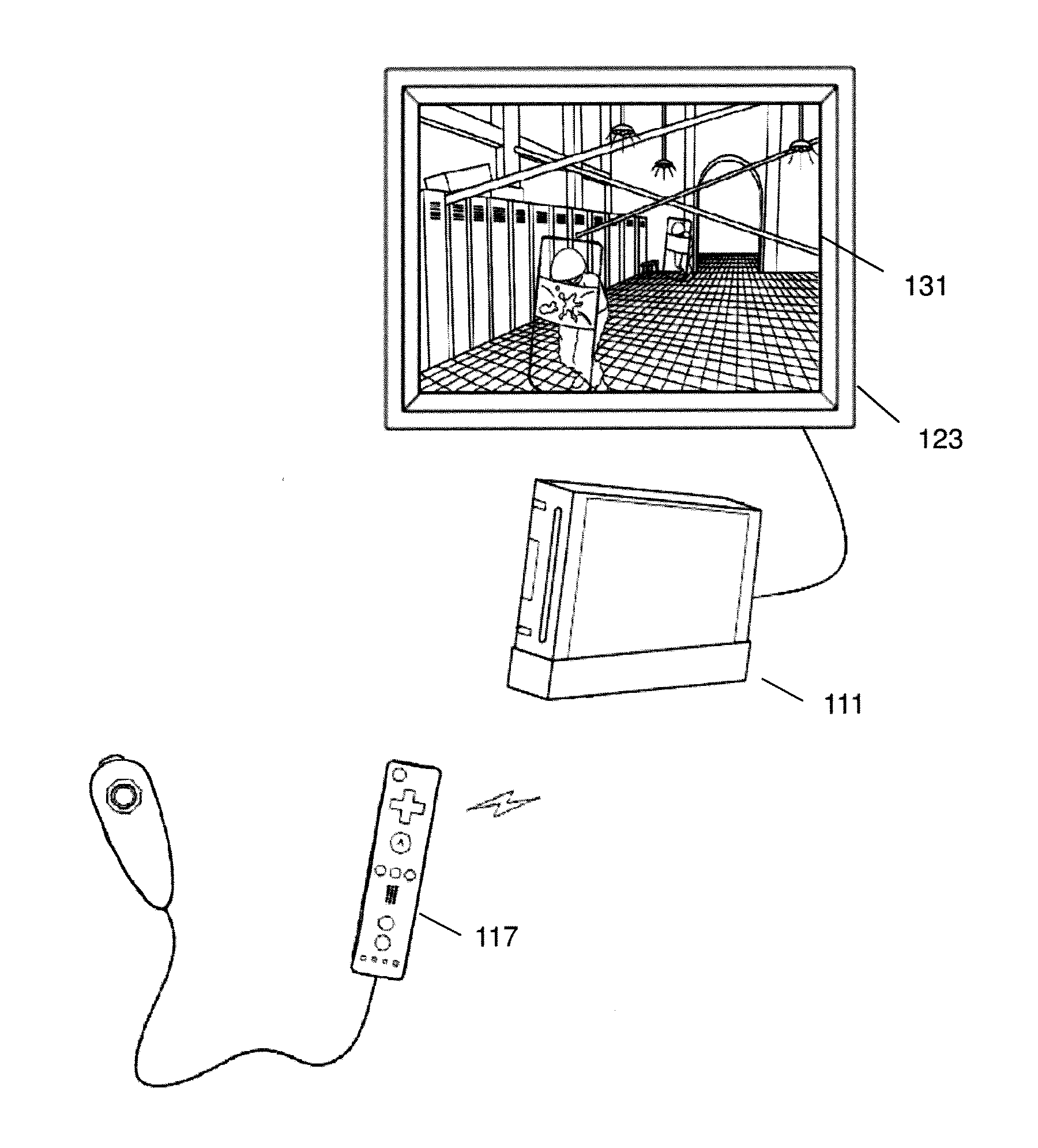
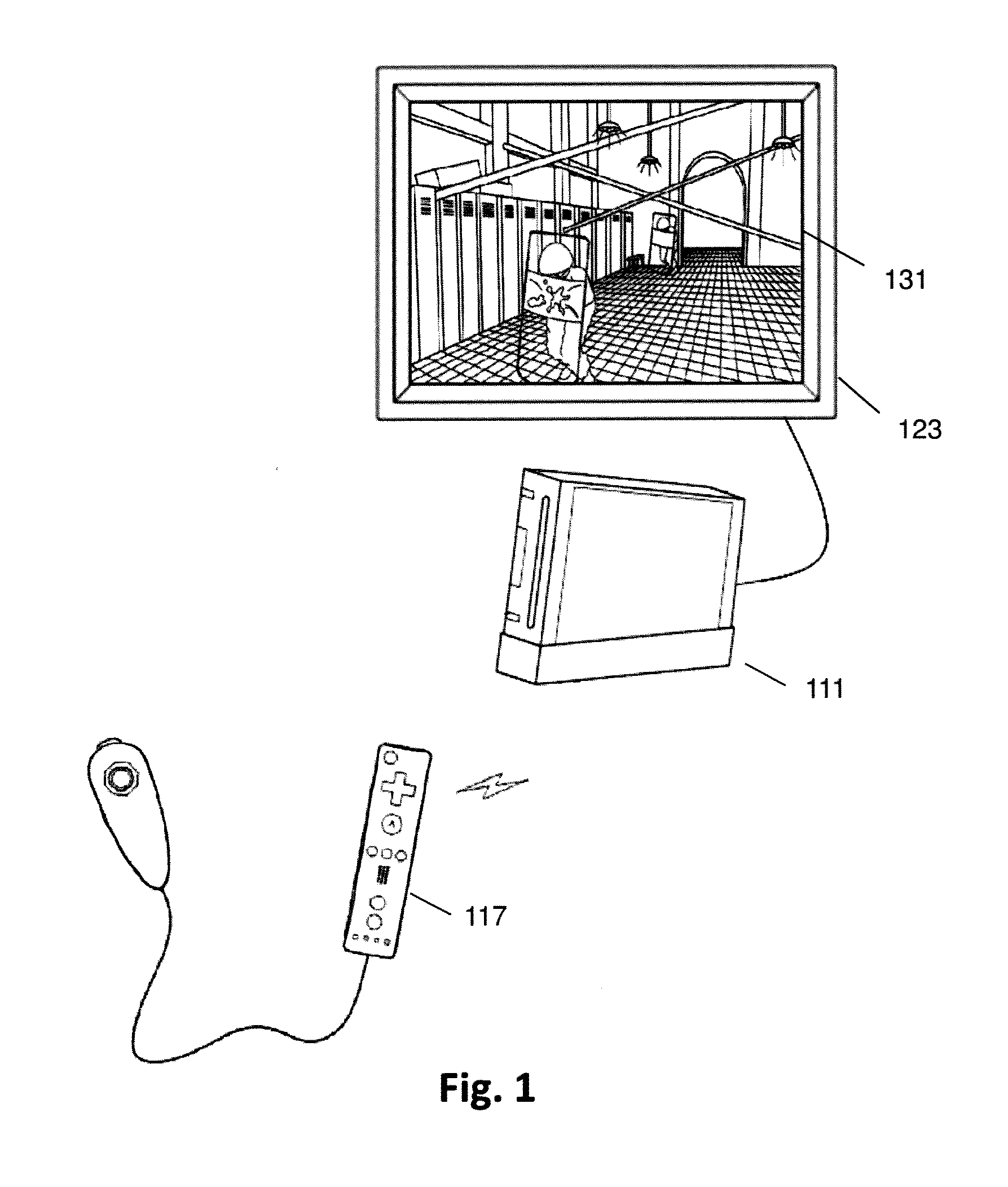
[0019]FIG. 1 illustrates an example of a video game system for play of a video game. In various embodiments, the video game may be an action game, for example a fighting game of a first-person shooter game, a role playing game, or a vehicle simulator game, or some other game. The video game system includes a game console 111 with at least one processor for executing program instructions providing for game play and associated circuitry, user input devices such as a game controller 117, and a display device 123 having a display screen 131. The processor, responsive to inputs from the user input devices, executes program instructions to provide for game play of the video game, generally including commanding display of game characters in and interacting with a virtual world of game play and possibly each other.

[0020]In the embodiment of FIG. 1, the display device shows a screen shot of video game play. The screen shot shown in FIG. 1 and other screen shots, generally show displays comma...