In the last couple of years it has become evident that static passwords are not sufficient and that more advanced security technology is required.
Notwithstanding the foregoing advantages, this architecture has however a number of security related disadvantages that are not readily apparent.
However, the downside of this flexibility is that such an
open architecture inherently makes the computing device vulnerable to attacks whereby an attacker may install malicious
software.
In practice it may turn out very difficult to ensure that the user's computing device has not been compromised by malicious
software such as viruses, Trojans, root kits, etc.
For example, in cases where a pure
software solution is being used to implement the cryptographic
library, it is very difficult to rule out with sufficient certainty that there has not been any malicious software on the user's personal computing device that has been able to get a copy of the private key which is being stored on the user's computing device in a file.
After all,
copying a file and stealthily
logging any passwords that the user enters to unlock such a file are known to be in reach of many malicious software applications.
While this already solves a part of the problem, it does not solve all problems.
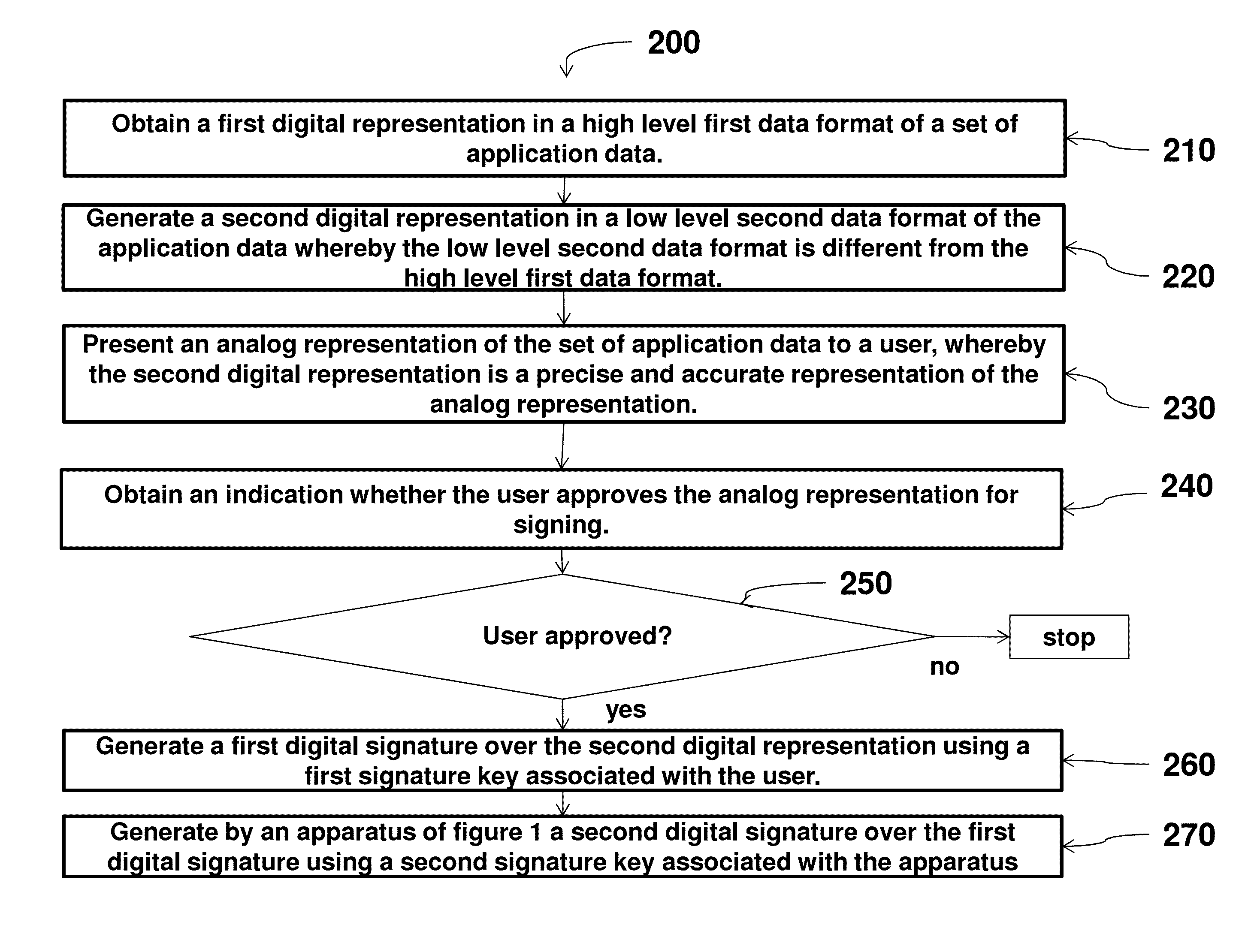
Since the presentation to the user and the review and approval by the user of the data to be signed happens before the actual signing on the computing device in a way that is independent of the actual signing process, it is very difficult to prove that the data that the user actually reviewed and approved are also the same data that subsequently have been passed to the cryptographic
library.
Indeed, it is very well conceivable that some malicious software manipulated the software stack and supplanted the data that the user reviewed and approved by
fraudulent data before the data is signed.
Also, a more subtle issue may cast doubt on what was exactly presented to the user and hence what exactly was approved by the user.
This may cause the user to actually see a different text than was intended.
For example, the document may contain images in a format that on some computing devices may not by supported and in some cases these computing devices may not represent these images and the omission of these images may not always be apparent to the user.
In some cases this may alter the meaning of the document that the user actually gets to see on the display for review and approval.
Another problem is that the number of screen views that are needed to let the user see the full contents of a specific document may vary from one
system to another or simply may vary on the same
system depending on certain preferences of the user.
All these problems have in common that a discrepancy may occur between on the one hand what the user observed (for example what the user in reality saw on the display of a computer) and therefore thinks to have reviewed and approved, and on the other hand what another party claims or may claim has been presented to the user (for example on the display of the computer) and therefore has been reviewed and approved by that user.
However, if uncertainty exists about what precisely the user observed when reviewing and approving an analog representation of the data to be signed, then the signature can, despite the mathematically guaranteed link between the signature and the high level representation of the data to be signed, not be considered to offer true non-repudiation.
This goal is difficult to achieve and it is even more difficult to prove that it has effectively been achieved for a given security device implementation in a given configuration.
However it is not sufficient that it can be demonstrated that for a given security device with a given configuration that there is no
ambiguity with respect to the end result of the transformation to an analog representation for any possible
data set in any high level abstract
digital data format supported by the security device.
This in turn means that adding, removing, replacing, changing or upgrading these components (e.g., to support new high level abstract data formats) must remain under strict control and must be subjected to severe limitations or must be even impossible.



 Login to View More
  Login to View More