

Industrial two-layer fabric
a two-layer fabric and fabric technology, applied in the field of industrial two-layer fabrics, can solve the problems of internal abrasion more frequently, abrasion at the position of the upper side, and the need for papermaking fabrics become more severe, so as to reduce dehydration marks, improve surface smoothness and drainage, and suppress internal abrasion
- Summary
- Abstract
- Description
- Claims
- Application Information
AI Technical Summary
Benefits of technology
Problems solved by technology
Method used
Image

Examples
embodiment 1
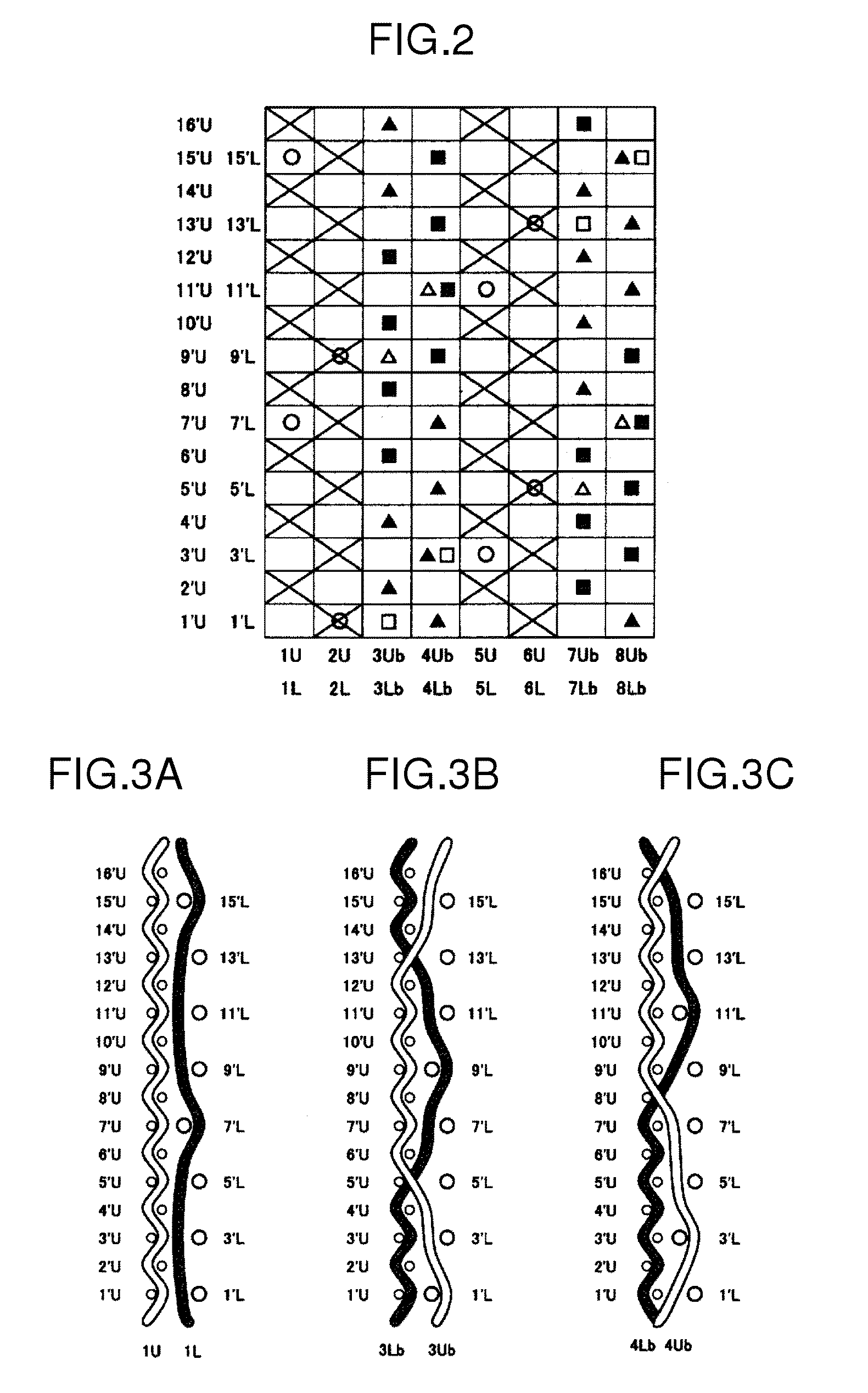
[0053]FIG. 2 is a design diagram showing a complete design or a repeating unit of Embodiment 1 according to the industrial two-layer fabric of the invention. The complete design has second warp pairs having no warp binding yarn and made of upper side warps (1U, 2U, 5U, and 6U) and lower side warps (1L, 2L, 5L, and 6L). Each of the upper side warps and each of the lower side warps of the second warp pairs having the same number are vertically arranged adjacent to each other and form the second warp pairs (1U, 1L), (2U, 2L), (5U, 5L) and (6U, 6L).
[0054]The complete design also has first warp pairs that consist of upper side warp binding yarns (3Ub, 4Ub, 7Ub, and 8Ub) and lower side warp binding yarns (3Lb, 4Lb, 7Lb, and 8Lb) each having a binding function. Each of the upper side warp binding yarns and each of the lower side warp binding yarns of the first warp pairs having the same number, are arranged adjacent to each other and form the first warp pairs (3Ub, 3Lb), (4Ub, 4Lb), (7Ub, ...
embodiment 2
[0064]FIG. 4 is a design diagram showing a complete design or a repeating unit of Embodiment 2 according to the industrial two-layer fabric of the invention. The complete design has second warp pairs having no warp binding yarn and made of upper side warps (1U, 2U, 5U, and 6U) and lower side warps (1L, 2L, 5L, and 6L) and first warp pairs made of upper side warp binding yarns (3Ub, 4Ub, 7Ub, and 8Ub) and lower side warp binding yarns (3Lb, 4Lb, 7Lb, and 8Lb) each having a binding function. In the first warp pairs shown in FIG. 4, two pairs, that is, a pair of 3Ub and 3Lb and a pair of 4Ub and 4Lb are adjacent to each other and two pairs, that is, a pair of 7Ub and 7Lb and a pair of 8Ub and 8Lb are adjacent to each other. Thus, the complete design has four first warp pairs. In the second warp pairs, two pairs, that is, a pair of 1U and 1L and a pair of 2U and 2L are adjacent to each other and two pairs, that is, a pair of 5U and 5L and a pair of 6U and 6L are adjacent to each other. ...
embodiment 3
[0076]FIG. 6 is a design diagram showing a complete design or a repeating unit of Embodiment 3 according to the industrial two-layer fabric of the invention. The complete design has second warp pairs having no warp binding yarn and made of upper side warps (1U, 2U, 5U, and 6U) and lower side warps (1L, 2L, 5L, and 6L) and first warp pairs made of upper side warp binding yarns (3Ub, 4Ub, 7Ub, and 8Ub) and lower side warp binding yarns (3Lb, 4Lb, 7Lb, and 8Lb) each having a binding function. In the first warp pairs, two pairs, that is, a pair of 3Ub and 3Lb and a pair of 4Ub and 4Lb are adjacent to each other and two pairs, that is, a pair of 7Ub and 7Lb and a pair of 8Ub and 8Lb are adjacent to each other. Thus, the complete design has four first warp pairs. In the second warp pairs, two pairs, that is, a pair of 1U and 1L and a pair of 2U and 2L are adjacent to each other and two pairs, that is, a pair of 5U and 5L and a pair of 6U and 6L are adjacent to each other. Thus, the comple...
PUM
 Login to View More
 Abstract
Description
Claims
Application Information
 Login to View More