Unlock instant, AI-driven research and patent intelligence for your innovation.

Inter-instance communication in a containered clustered server environment

Active Publication Date: 2016-11-24
MORGAN STANLEY
View PDF0 Cites 6 Cited by
  • Summary
  • Abstract
  • Description
  • Claims
  • Application Information

AI Technical Summary

Benefits of technology

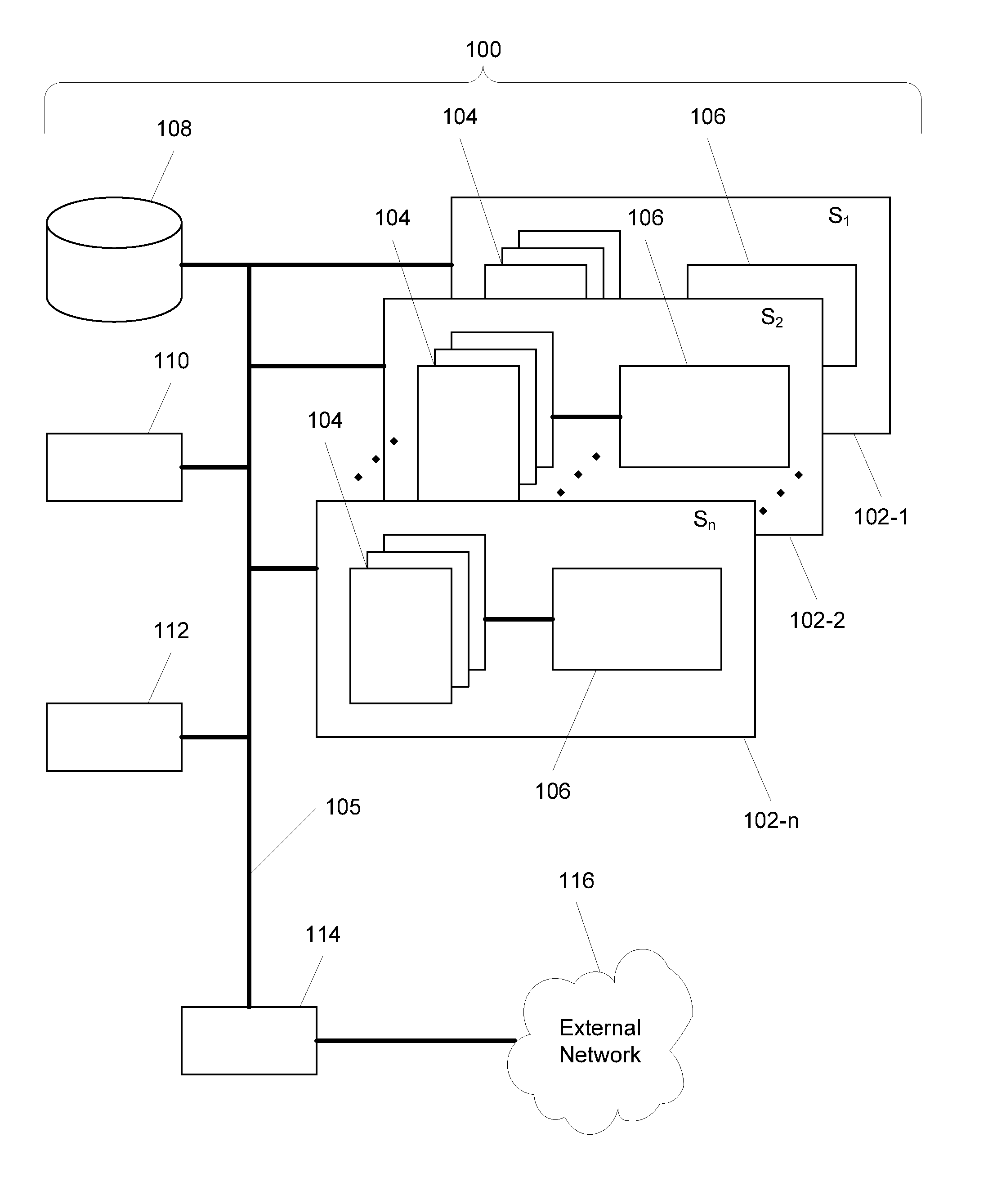
This patent describes a method for installing an ensemble application in a cluster of servers that allows for inter-instance communication. The method involves identifying a server with excess capacity, receiving a manifest file with the expected communication port, creating a container for the ensemble application, installing the application within the container, assigning the actual port to the application, and creating IP Tables rules to modify network connections. The method allows for dynamic discovery and communication between applications in a dynamic environment with different port addresses. Additionally, the patent describes a server system with multiple servers interconnected in a cluster, where instances of the ensemble application are installed and a framework agent causes the installation. The system also includes a custom shared library with IP Tables rules for redirecting communications. The technical effect of the patent is to enable effective communication and interaction between applications in a dynamic and secure environment.

Problems solved by technology

However, it is well known that applications / programs rarely use the full capabilities of existing servers on which they run, particularly for typical server deployments in a clustering environment, e.g., data center servers, leaving many servers with underutilized, excess capacity.
Such server capacity may be underutilized for various reasons, for example, to allow for performance spikes or due to the possibility of interference between applications / programs.
Because of the way some programs are written so as to be able to communicate with the “outside world” (i.e., other computers on the network, be it a small network within the company or the internet) while not knowing where they will be installed, if one needs to add an application / program in a clustering environment it is extremely difficult to use that underutilized, excess server capacity along side the existing (i.e., “legacy”) applications / programs because, since the applications do not know where they will be installed, port assignment is done dynamically at installation using a technique called “dynamic discovery” that allows the new application to identify its location and advertise its presence on a network.
Unfortunately, a current trend is to use “lightweight containers” for applications in clustered server environments.
This creates a technological impediment that prevents, or makes very difficult, the use of any existing excess server capacity for applications of this class.
However, adding a new hostname requires significant additional detailed work, additional IP addresses, it requires new security for that Host, and additional complexity that must be supported, etc.
Moreover, adding an ensemble application into such a container adds an additional layer of problems due to the need to have all instances use the same ports as noted above.
Dynamic discovery is antithetical to that requirement because (i) it cannot guarantee the same port assignments to all instances, and (ii) the required ports for the instances may already be allocated to other legacy applications.
Thus, there is presently a significant technological problem inhibiting the ability to make use of excess server capacity by adding ensemble applications that run in lightweight containers onto one or more servers that already contain legacy components.

Method used

the structure of the environmentally friendly knitted fabric provided by the present invention; figure 2 Flow chart of the yarn wrapping machine for environmentally friendly knitted fabrics and storage devices; image 3 Is the parameter map of the yarn covering machine
View more

Image

Smart Image Click on the blue labels to locate them in the text.
Viewing Examples
Smart Image
  • Inter-instance communication in a containered clustered server environment
  • Inter-instance communication in a containered clustered server environment
  • Inter-instance communication in a containered clustered server environment

Examples

Experimental program
Comparison scheme
Effect test

Embodiment Construction

[0027]We have devised a technological solution to the above problems, that allows for use of excess capacity of an existing Host server for a new network-discoverable (from a client perspective) ensemble application alongside a legacy application having a hostname on that existing Host server inside a new container having its own namespace while the new container in which the ensemble application will be installed shares its hostname with the Host.

[0028]Our solution is a technological advance in this important area because it does not require a new Host name, IP address, or changes to the ensemble application / program (i.e., the application / program is “container unaware”) and, despite the ensemble application requirement regarding using the same ports among all instances, allows for dynamic discovery to be used as part of the installation process.

[0029]In simplified overview, one variant of our approach uses a framework that takes advantage of the shared libraries capability of the L...

the structure of the environmentally friendly knitted fabric provided by the present invention; figure 2 Flow chart of the yarn wrapping machine for environmentally friendly knitted fabrics and storage devices; image 3 Is the parameter map of the yarn covering machine
Login to View More

PUM

No PUM Login to View More

Abstract

A method and a system environment are disclosed that allow for installation of an instance of an ensemble application into a container in excess capacity of an existing server and that allows the instance to coexist with a legacy application on the server and communicate with other instances of the ensemble application on other servers.

Description

BACKGROUND[0001]1. Field[0002]This disclosure relates generally to computers, and, more particularly, to clustered client-server architecture infrastructure.[0003]2. Background[0004]Most businesses use multiple networked servers, in some cases, many, many servers networked into clusters to handle their IT infrastructure needs. However, it is well known that applications / programs rarely use the full capabilities of existing servers on which they run, particularly for typical server deployments in a clustering environment, e.g., data center servers, leaving many servers with underutilized, excess capacity. Such server capacity may be underutilized for various reasons, for example, to allow for performance spikes or due to the possibility of interference between applications / programs.[0005]Because of the way some programs are written so as to be able to communicate with the “outside world” (i.e., other computers on the network, be it a small network within the company or the internet) ...

Claims

the structure of the environmentally friendly knitted fabric provided by the present invention; figure 2 Flow chart of the yarn wrapping machine for environmentally friendly knitted fabrics and storage devices; image 3 Is the parameter map of the yarn covering machine
Login to View More

Application Information

Patent Timeline
no application Login to View More
IPC IPC(8): G06F9/445H04L29/06H04L29/08
CPCG06F8/61H04L67/42H04L67/06H04L67/34H04L67/01
Inventor KEIS, ANDREIVIANA, RICHARD
Owner MORGAN STANLEY
Features
  • R&D
  • Intellectual Property
  • Life Sciences
  • Materials
  • Tech Scout
Why Patsnap Eureka
  • Unparalleled Data Quality
  • Higher Quality Content
  • 60% Fewer Hallucinations
Social media
Patsnap Eureka Blog
Learn More