
Liquid ejection apparatus
a technology of liquid ejection and ejection chamber, which is applied in the field of liquid ejection apparatus, can solve the problems of undesirably increasing the discharge amount of ink, undesirably etc., and achieves the effect of suppressing the evaporation rate of water, lowering the effect of suppressing an increase in and increasing the viscosity of ink
- Summary
- Abstract
- Description
- Claims
- Application Information
AI Technical Summary
Benefits of technology
Problems solved by technology
Method used
Image

Examples
second embodiment
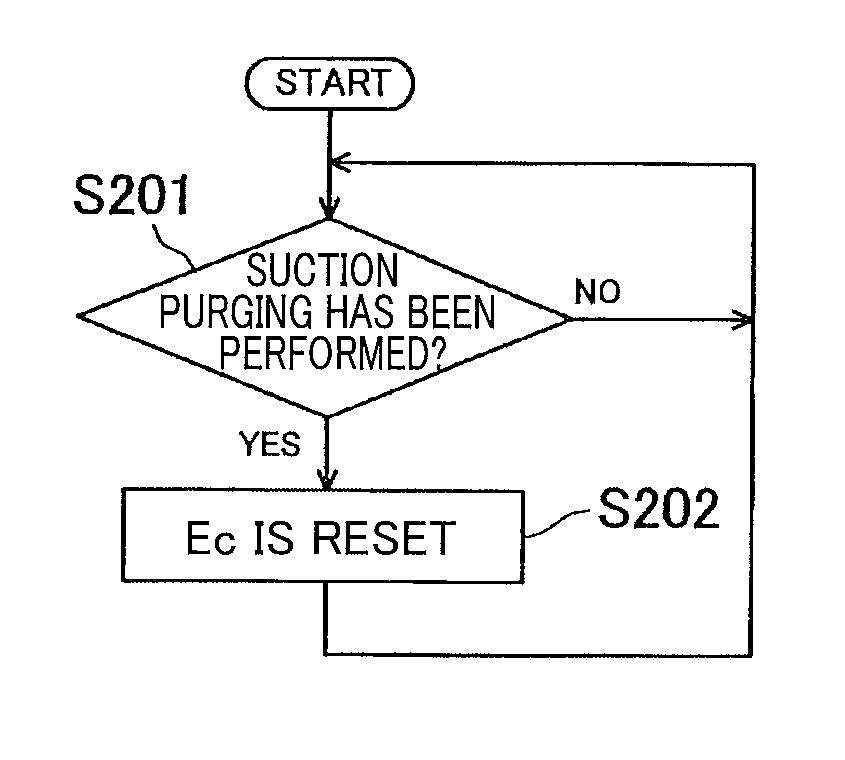
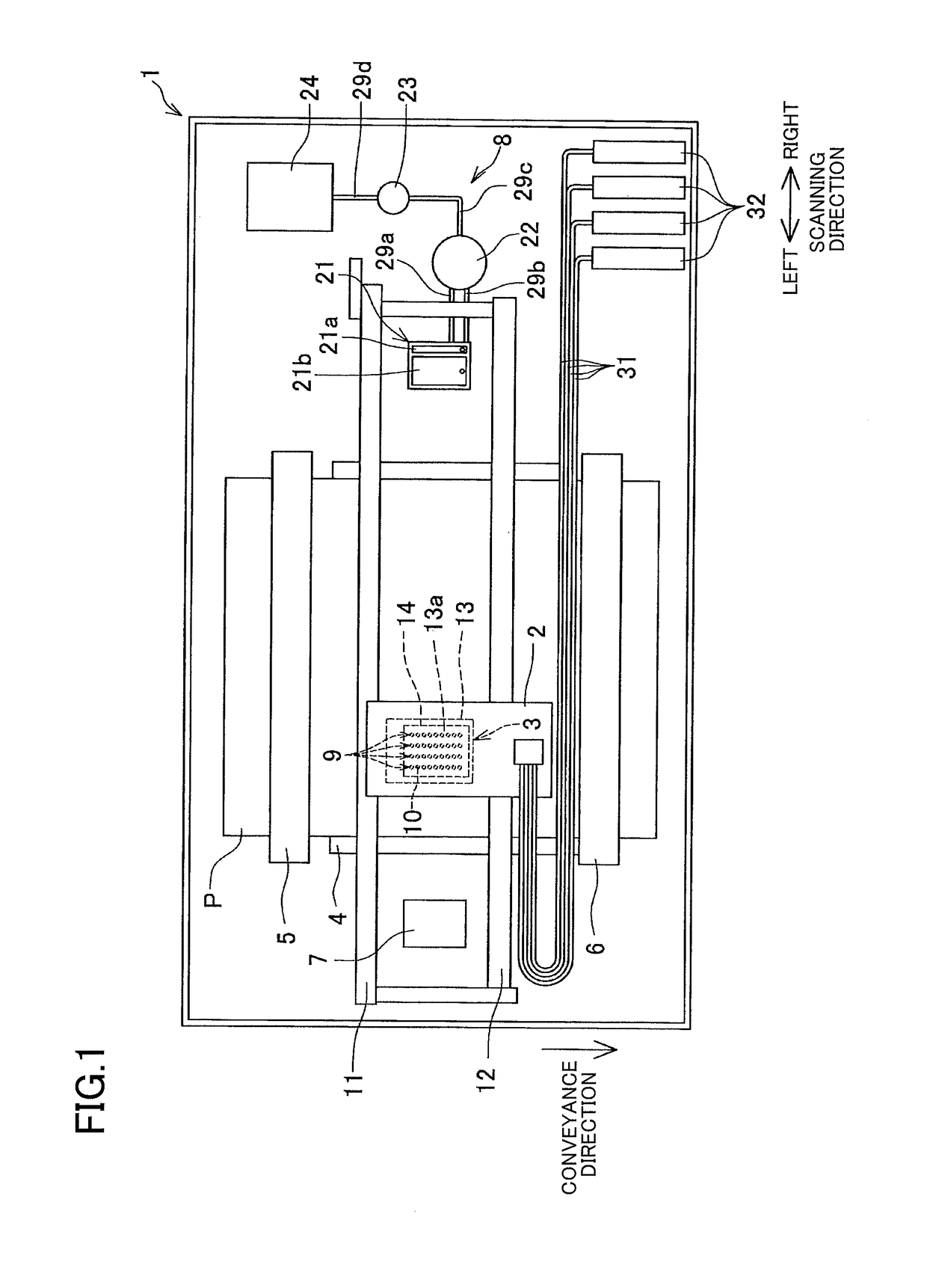
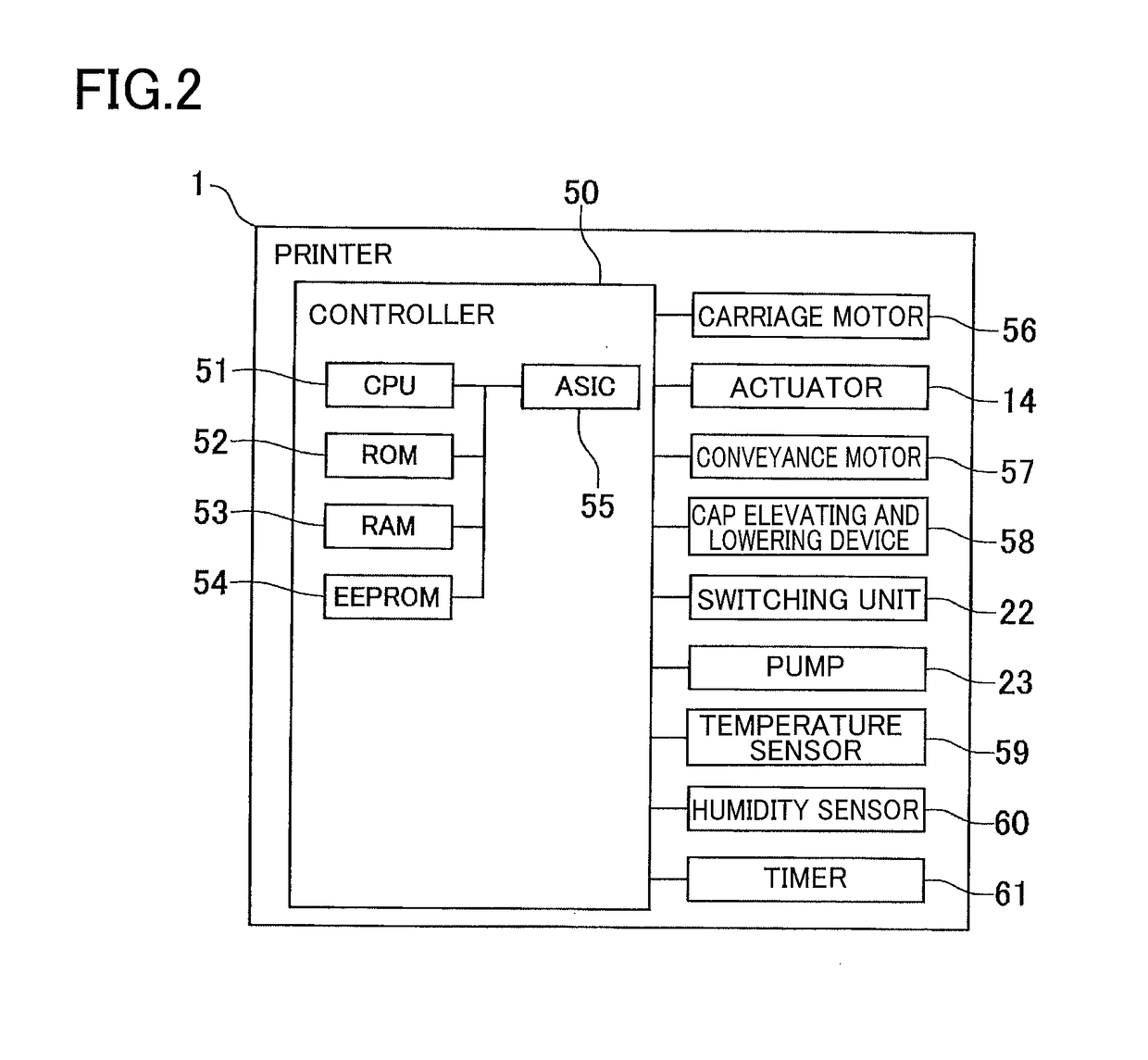
[0063]Next, there will be explained a second embodiment. While the second embodiment relates to the printer 1 according to the first embodiment, the second embodiment differs from the first embodiment in the control by the controller 50. Hereinafter, the control of the controller 50 will be mainly explained.
[0064]As explained in the first embodiment, in the uncapping state, water included in the ink in the cap portions 21a, 21b evaporates, and the cap evaporation rate is accordingly increased. Further, with an increase in the length of time of the uncapping state, evaporation of water included in the ink in the cap portions 21a, 21b proceeds, namely, an increase in the cap evaporation rate is accelerated. In the capping state, water included in the ink in the nozzles 10 moves to the ink in the cap portions 21a, 21b, so that the cap evaporation rate is decreased while the nozzle evaporation rate is increased, namely, the ink in the nozzles 10 becomes thickened. With an increase in th...
third embodiment
[0093]There will be next explained a third embodiment. The third embodiment differs from the second embodiment in the processing for calculating the nozzle evaporation rate Cn[t] and the cap evaporation rate Cc[t].
[0094]In the third embodiment, an inside of the nozzle 10 and an inside of the cap portion 21a, 21b are divided into a plurality of regions arranged in the up-down direction, as shown in FIG. 9. The nozzle evaporation rate Cn[t] and the cap evaporation rate Cc[t] are calculated as explained below in consideration of a movement of water among the regions. The following explanation is made based on an example in which the inside of the nozzle 10 is divided into the number I of nozzle regions Rn[i] (i=1, 2, 3, . . . , I), and the inside of the cap portion 21a, 21b is divided into the number J of cap regions Rc[j] (j=1, 2, 3, . . . , J). In the example below, the ink is present in the cap regions Rc[j] in which j is equal to or larger than J1 (J11 (J1<J), among the number J of...
PUM
 Login to View More
 Abstract
Description
Claims
Application Information
 Login to View More