Unlock instant, AI-driven research and patent intelligence for your innovation.

System and Method for Single-Loop Vehicle Speed Estimation Using Inductive Loop Signature Data

Active Publication Date: 2019-07-04
CLR ANALYTICS INC
View PDF0 Cites 0 Cited by
  • Summary
  • Abstract
  • Description
  • Claims
  • Application Information

AI Technical Summary

Benefits of technology

The patent describes a system and method that uses an inductive loop sensor to estimate the speed of a vehicle by analyzing the vehicle's signature. This method involves calculating two regression models, one for the duration of the signature and another for the rate at which it changes. By finding the point where the signature is normalized and determining the earliest point to cross a set threshold, the speed of the vehicle can be estimated. These regression models have been tested in real-world environments and have been found to be reliable, eliminating the need for calibration or estimation at specific locations.

Problems solved by technology

However, such approach does not perform well to yield reliable estimates under congestion or under heavy truck traffic (Coifman and Neelisetty, 2014).

Method used

the structure of the environmentally friendly knitted fabric provided by the present invention; figure 2 Flow chart of the yarn wrapping machine for environmentally friendly knitted fabrics and storage devices; image 3 Is the parameter map of the yarn covering machine
View more

Image

Smart Image Click on the blue labels to locate them in the text.
Viewing Examples
Smart Image
  • System and Method for Single-Loop Vehicle Speed Estimation Using Inductive Loop Signature Data
  • System and Method for Single-Loop Vehicle Speed Estimation Using Inductive Loop Signature Data
  • System and Method for Single-Loop Vehicle Speed Estimation Using Inductive Loop Signature Data

Examples

Experimental program
Comparison scheme
Effect test

Embodiment Construction

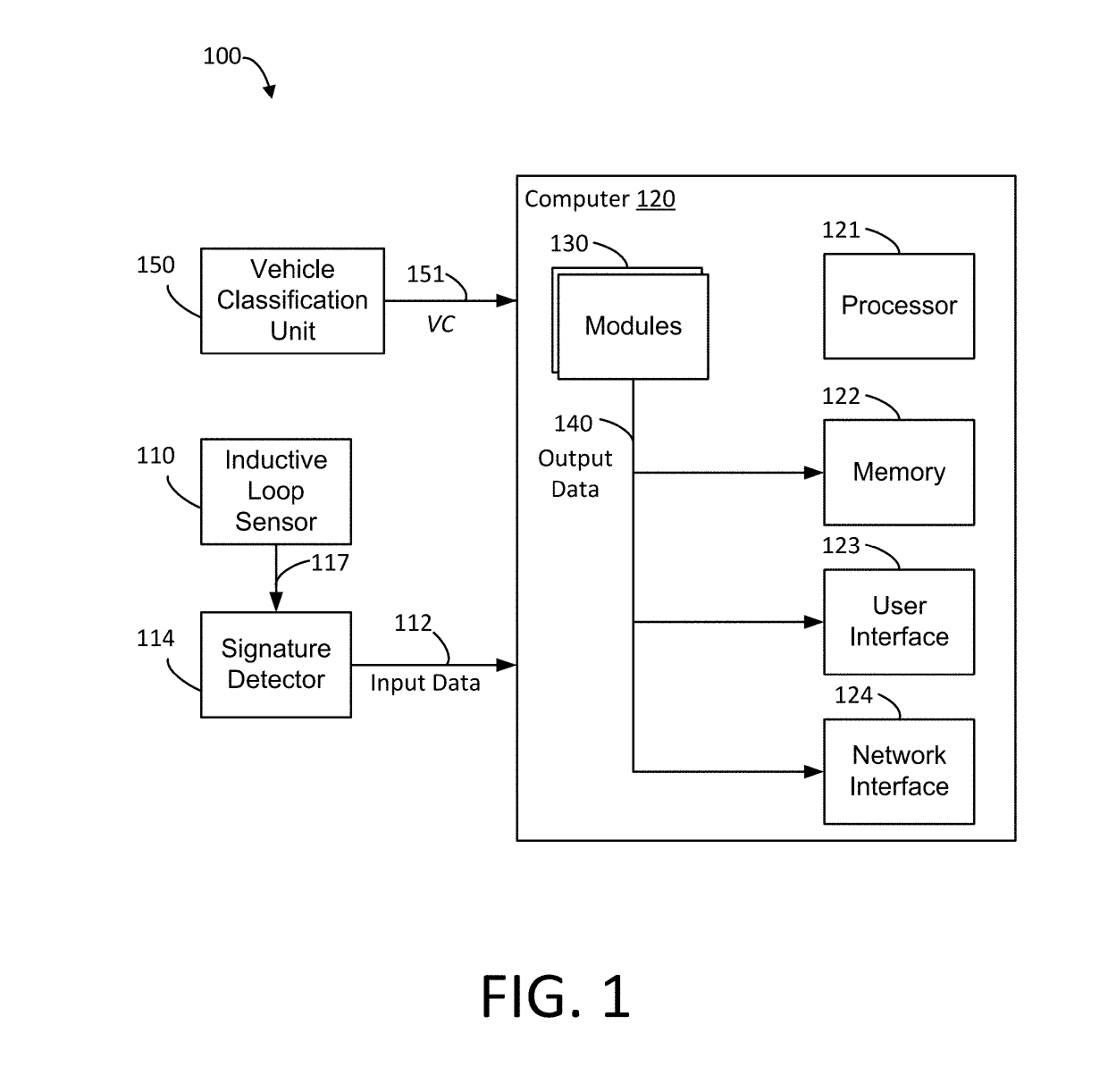
[0037]Prior art systems using single-loop inductive loop sensor (ILS) data to estimate vehicle speed are usually calibrated to the particular traffic detection station. Re-calibration and re-estimation are required when transferring these systems to traffic detection stations where conditions differ. Re-calibration and re-estimation are necessary because the vehicle grouping modules used in prior art systems are trained using data collected from only one or two stations and each of the derived vehicle groups contain similar vehicles attributes that are arbitrarily selected by the developers. The regression models are then constructed and estimated for each vehicle group.

[0038]Since vehicle attributes are investigated, evaluated, and selected to meet modeling and training needs during the development of vehicle grouping modules, significant changes in vehicle types and vehicle composition may require a new vehicle attribute set to replace the original one. If a new vehicle attribute ...

the structure of the environmentally friendly knitted fabric provided by the present invention; figure 2 Flow chart of the yarn wrapping machine for environmentally friendly knitted fabrics and storage devices; image 3 Is the parameter map of the yarn covering machine
Login to View More

PUM

No PUM Login to View More

Abstract

A system and method are disclosed for using vehicle signature data from a single inductive loop sensor to estimate vehicle speed. Two regressors are calculated from the vehicle signature: the “inverse of the duration” and the “slew rate”. A point is found by normalizing the vehicle signature in amplitude and determining the earliest point in the normalized signature to cross a set threshold. The slew rate is the slope of the normalized vehicle signature at this point. Regression models are generated from empirical data for several vehicle categories. Using the regression model for the category of vehicle and the two regressors vehicle speed is estimated. The regression models have been demonstrated to be robust eliminating the need for site-specific calibration or estimation.

Description

GOVERNMENT SUPPORT[0001]This invention was made with government support under contract number DTRT57-14-C-10025 awarded by the Department of Transportation. The government has certain rights in the invention.BACKGROUND[0002]Inductive loop sensors are currently the most invested and widely deployed traffic detection infrastructure for traffic data collection from highways and traffic signal control in the United States. Inductive Loop Detection (ILD) technology is very reliable and provides accurate traffic count data. Properly installed loop sensors have a service life that is typically comparable to the road surface itself.[0003]When installed in a double loop speed trap configuration, an inductive loop can provide point speed and effective vehicle length information. The double loop sensors are widely applied in Continuous Vehicle Classification (CVC) and Weigh-In-Motion (WIM) sites. However, most of the traffic detection stations are Continuous Count Stations (CCS), which are com...

Claims

the structure of the environmentally friendly knitted fabric provided by the present invention; figure 2 Flow chart of the yarn wrapping machine for environmentally friendly knitted fabrics and storage devices; image 3 Is the parameter map of the yarn covering machine
Login to View More

Application Information

Patent Timeline
no application Login to View More
IPC IPC(8): G08G1/052G08G1/015G08G1/042G06F17/18
CPCG08G1/052G08G1/015G08G1/042G06F17/18
Inventor JENG, SHIN-TING
Owner CLR ANALYTICS INC