
Method and system for characterization and compression of ultrashort pulses
a technology of ultrashort pulses and compression methods, applied in the direction of instruments, basic electric elements, laser details, etc., can solve the problems of not calibrating, not being practicable to introduce enough dispersion of glass wedges of any angle and material to obtain an adequate d-scan trace,
- Summary
- Abstract
- Description
- Claims
- Application Information
AI Technical Summary
Benefits of technology
Problems solved by technology
Method used
Image

Examples
Embodiment Construction
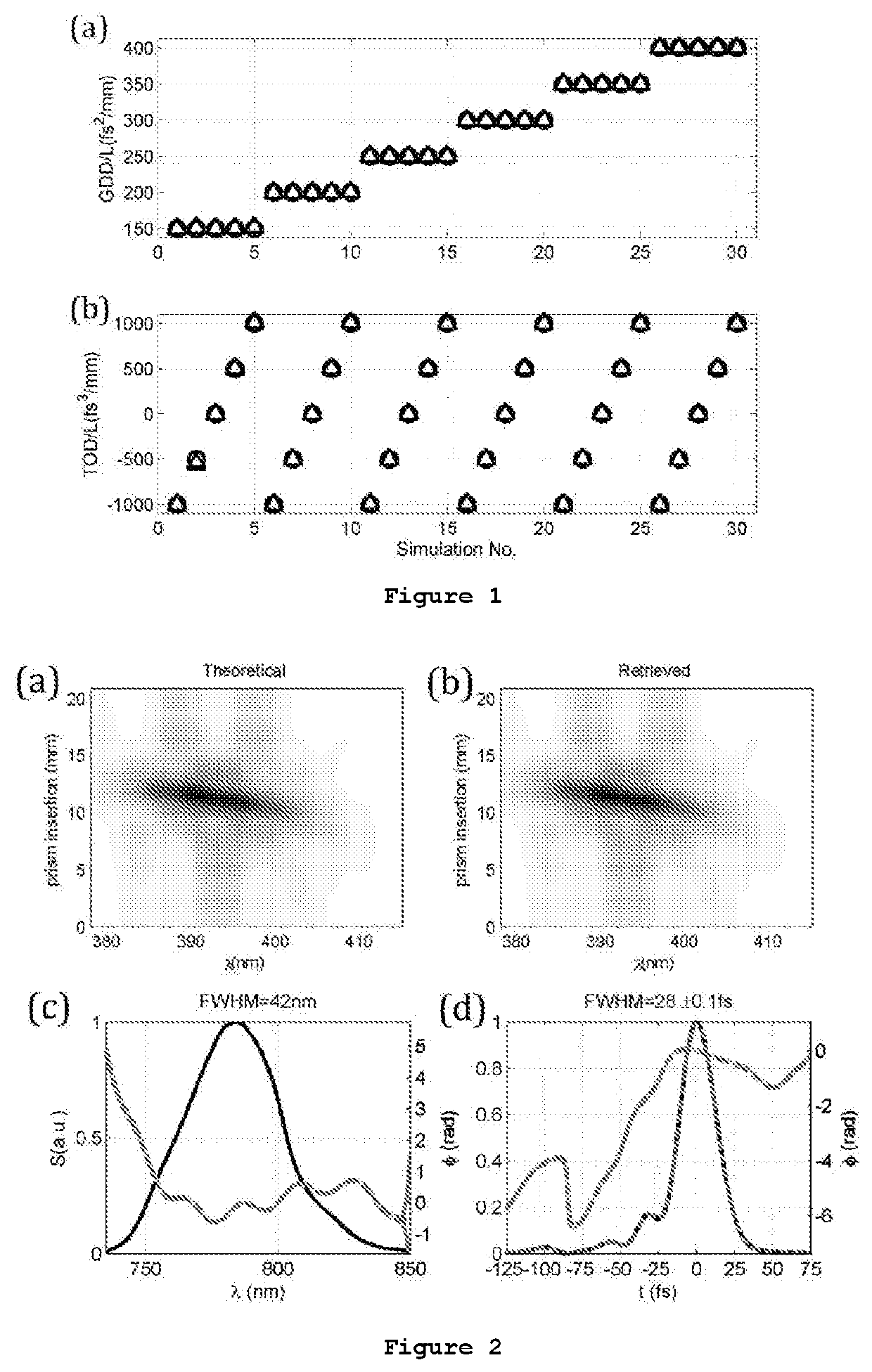
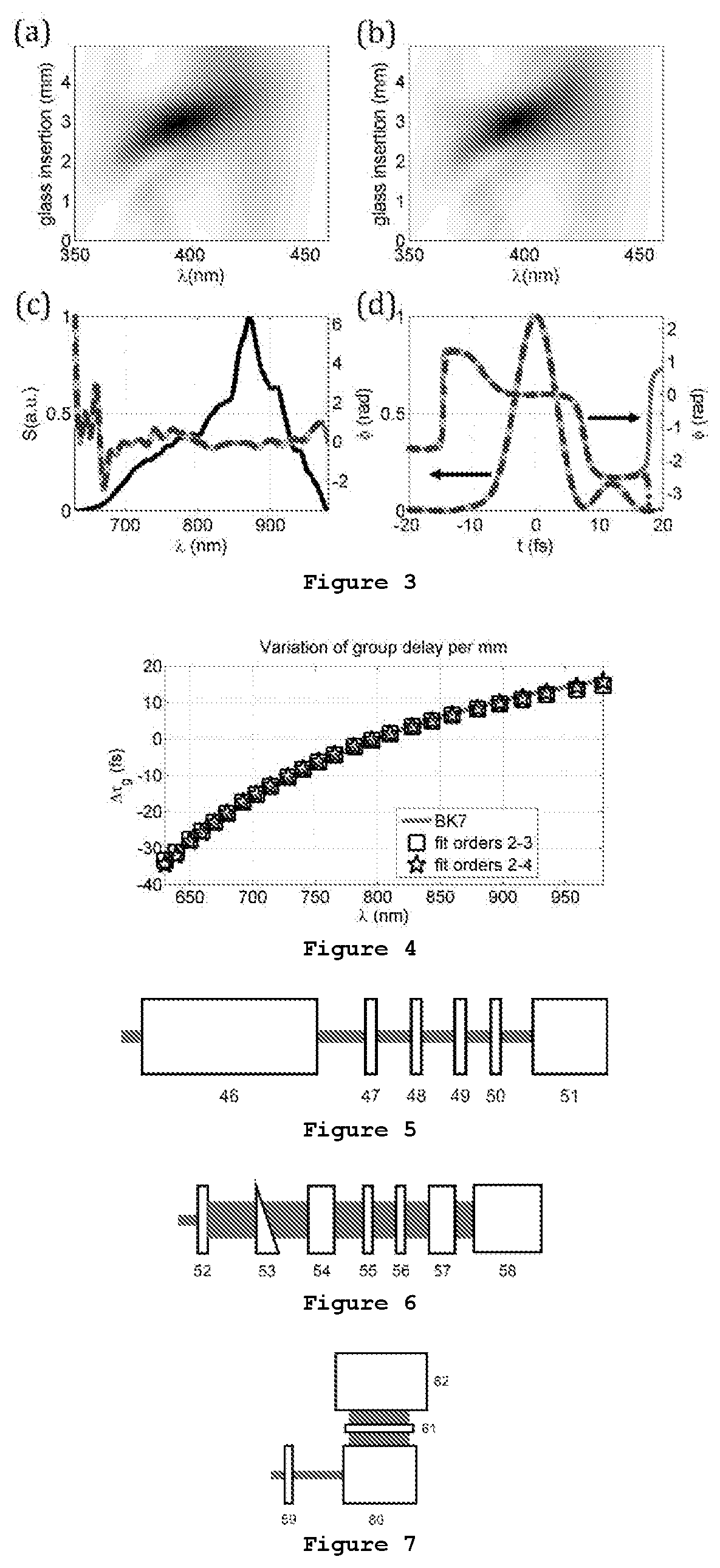
[0108]Now, preferred embodiments of the present application will be described in detail with reference to the annexed drawings. However, they are not intended to limit the scope of this application. The present disclosure relates to a method and device for the simultaneous compression and characterization of ultrashort laser pulses, especially suited to measure ultrashort pulses with diverse bandwidths and durations. By frequency resolving the generated nonlinear signal for various amounts of dispersion one is able to determine the intensity and phase of the pulse as well as the dispersion of the compression or dispersive optical system through an adequate mathematical model and algorithm. This technique is related to the d-scan technique in the sense that the pulse to be measured suffers progressive dispersion and a nonlinear signal is measured as a function of this parameter. However, the present method distinguishes itself by providing several functionalities not present in the d...
PUM
| Property | Measurement | Unit |
|---|---|---|
| central wavelength | aaaaa | aaaaa |
| apex angle | aaaaa | aaaaa |
| dispersion | aaaaa | aaaaa |
Abstract
Description
Claims
Application Information
 Login to View More