Unlock instant, AI-driven research and patent intelligence for your innovation.

Neural Network Classifier Using Array Of Stacked Gate Non-volatile Memory Cells

a neural network and memory cell technology, applied in the field of neural networks, can solve the problems of cmos-implemented synapses being too bulky, lack of hardware technology for performance information processing, and mediocre energy efficiency

Active Publication Date: 2020-07-30
SILICON STORAGE TECHNOLOGY
View PDF0 Cites 0 Cited by
  • Summary
  • Abstract
  • Description
  • Claims
  • Application Information

AI Technical Summary

Benefits of technology

The patent describes a neural network device that includes a plurality of synapses that can receive inputs and generate outputs. The synapses are arranged in rows and columns and include a floating gate, a first gate, and a second line. The device can be used to solve problems and make decisions based on the input data it receives.

Problems solved by technology

One of the major challenges in the development of artificial neural networks for high-performance information processing is a lack of adequate hardware technology.
However, in addition to high cost, these approaches also suffer from mediocre energy efficiency as compared to biological networks, which consume much less energy primarily because they perform low-precision analog computation.
CMOS analog circuits have been used for artificial neural networks, but most CMOS-implemented synapses have been too bulky given the high number of neurons and synapses.

Method used

the structure of the environmentally friendly knitted fabric provided by the present invention; figure 2 Flow chart of the yarn wrapping machine for environmentally friendly knitted fabrics and storage devices; image 3 Is the parameter map of the yarn covering machine
View more

Image

Smart Image Click on the blue labels to locate them in the text.
Viewing Examples
Smart Image
  • Neural Network Classifier Using Array Of Stacked Gate Non-volatile Memory Cells
  • Neural Network Classifier Using Array Of Stacked Gate Non-volatile Memory Cells
  • Neural Network Classifier Using Array Of Stacked Gate Non-volatile Memory Cells

Examples

Experimental program
Comparison scheme
Effect test

Embodiment Construction

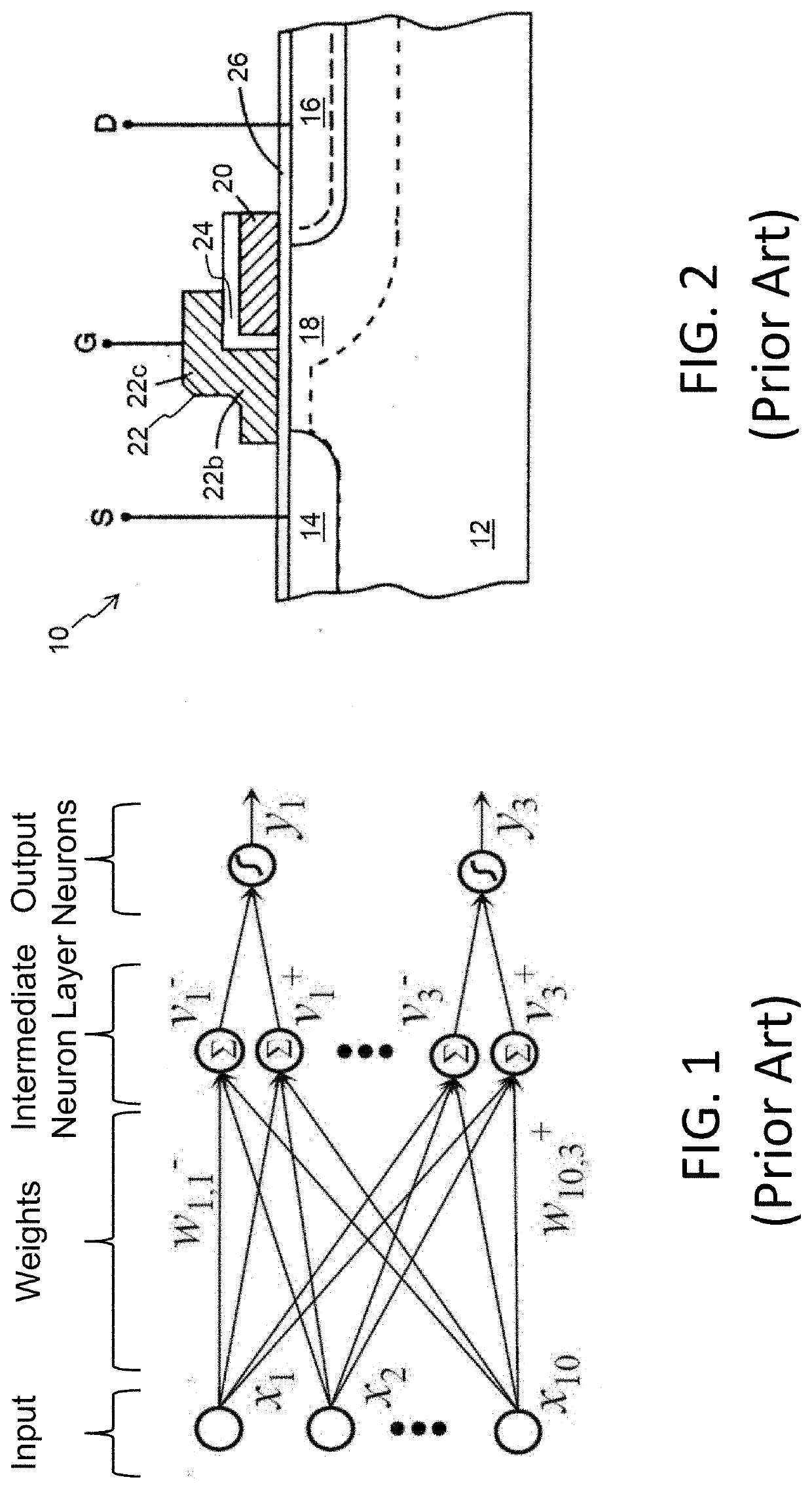
[0031]The artificial neural networks of the present invention utilize a combination of CMOS technology and non-volatile memory arrays. Digital non-volatile memories are well known. For example, U.S. Pat. No. 5,029,130 (“the '130 patent”) discloses an array of split gate non-volatile memory cells, and is incorporated herein by reference for all purposes. The memory cell disclosed in the '130 patent is shown in FIG. 2 as memory cell 10. Each memory cell 10 includes source and drain regions 14 / 16 formed in a semiconductor substrate 12, with a channel region 18 there between. A floating gate 20 is formed over and insulated from (and controls the conductivity of) a first portion of the channel region 18, and over a portion of the drain region 16. A control gate 22 (i.e., a second, channel controlling gate) has a first portion 22b that is disposed over and insulated from (and controls the conductivity of) a second portion of the channel region 18, and a second portion 22c that extends up ...

the structure of the environmentally friendly knitted fabric provided by the present invention; figure 2 Flow chart of the yarn wrapping machine for environmentally friendly knitted fabrics and storage devices; image 3 Is the parameter map of the yarn covering machine
Login to View More

PUM

No PUM Login to View More

Abstract

A neural network device with synapses having memory cells each having source and drain regions in a semiconductor substrate with a channel region extending there between, a floating gate over an entirety of the channel region, and a first gate over the floating gate. First lines each electrically connect together the first gates in one of the memory cell rows, second lines each electrically connect together the source regions in one of the memory cell rows, and third lines each electrically connect together the drain regions in one of the memory cell columns. The synapses are configured to receive a first plurality of inputs as electrical voltages on the first lines or on the second lines, and to provide a first plurality of outputs as electrical currents on the third lines.

Description

RELATED APPLICATIONS[0001]This application claims the benefit of U.S. Provisional Application No. 62 / 798,417, filed Jan. 29, 2019.FIELD OF THE INVENTION[0002]The present invention relates to neural networks.BACKGROUND OF THE INVENTION[0003]Artificial neural networks mimic biological neural networks (the central nervous systems of animals, in particular the brain) which are used to estimate or approximate functions that can depend on a large number of inputs and are generally known. Artificial neural networks generally include layers of interconnected “neurons” which exchange messages between each other. FIG. 1 illustrates an artificial neural network, where the circles represent the inputs or layers of neurons. The connections (called synapses) are represented by arrows, and have numeric weights that can be tuned based on experience. This makes neural nets adaptive to inputs and capable of learning. Typically, neural networks include a layer of multiple inputs. There are typically o...

Claims

the structure of the environmentally friendly knitted fabric provided by the present invention; figure 2 Flow chart of the yarn wrapping machine for environmentally friendly knitted fabrics and storage devices; image 3 Is the parameter map of the yarn covering machine
Login to View More

Application Information

Patent Timeline
no application Login to View More
Patent Type & Authority Applications(United States)
IPC IPC(8): G06N3/063H01L27/115H10B41/30H10B69/00
CPCH01L27/115G06N3/063G11C11/54G11C11/5628G11C11/5642G11C16/0425G11C16/10G11C16/28G11C16/349G11C16/3495H01L29/42328G06N3/065H10B41/30G06N3/0464G06N3/045G11C16/26G11C14/00H10B69/00
Inventor TRAN, HIEU VANLEMKE, STEVENTIWARI, VIPINDO, NHANREITEN, MARK
Owner SILICON STORAGE TECHNOLOGY