Discrete-time tuning of neural network controllers for nonlinear dynamical systems

US6064997AInactive Publication Date: 2000-05-16BOARD OF RGT THE UNIV OF TEXAS SYST
6 Cites 42 Cited by

Patent Information

Authority / Receiving Office
US · United States
Current Assignee / Owner
Publication Date
2000-05-16
Estimated Expiration
Not applicable · inactive patent

Smart Images

  • Figure 1
    Figure 1
  • Figure 2
    Figure 2
  • Figure 3
    Figure 3
Patent Text Reader

Abstract

A family of novel multi-layer discrete-time neural net controllers is presented for the control of an multi-input multi-output (MIMO) dynamical system. No learning phase is needed. The structure of the neural net (NN) controller is derived using a filtered error / passivity approach. For guaranteed stability, the upper bound on the constant learning rate parameter for the delta rule employed in standard back propagation is shown to decrease with the number of hidden-layer neurons so that learning must slow down. This major drawback is shown to be easily overcome by using a projection algorithm in each layer. The notion of persistency of excitation for multilayer NN is defined and explored. New on-line improved tuning algorithms for discrete-time systems are derived, which are similar to e-modification for the case of continuous-time systems, that include a modification to the learning rate parameter plus a correction term. These algorithms guarantee tracking as well as bounded NN weights. An extension of these novel weight tuning updates to NN with an arbitrary number of hidden layers is discussed. The notions of discrete-time passive NN, dissipative NN, and robust NN are introduced.
Need to check novelty before this filing date? Find Prior Art

Description

1. BACKGROUND OF THE INVENTIONThe following references, to the extent that they provide exemplary procedural or other details supplementary to those set forth herein, are specifically incorporated herein by reference. These references may provide certain background regarding the subject matter discussed herein.F. Chen, H. K. Khalil, "Adaptive control of nonlinear systems using neural networks," Int. J. Control, 55(6):1299-1317, 1992.G. C. Goodwin, K. S. Sin, "Adaptive Filtering, Prediction and Control," Prentice-Hall Inc., Englewood Cliffs, N.J., 1984.S. Jagannathan, F. L. Lewis, "Discrete-time neural net controller with guaranteed performance," IEEE Transaction on Neural Networks, January 1996.I. D. Landau, "Evolution of Adaptive control," ADME Journal of Dynamic systems, Measurements, and Control, 115:381-391, June 1993.I. D. Landau, "Adaptive Control: The Model Reference Approach," Marcel Dekker, Inc., 1979.A. U. Levine, K. S. Narendra, "Control of nonlinear dynamical systems usi...

Examples

Embodiment Construction

Let R denote the real numbers, R.sup.n denote the real n-vectors, R.sup.m.times.n the real m.times.n matrices. Let S be a compact simply-connected set of R.sup.n. With maps f:S.fwdarw.R.sup.k, define C.sup.k (S) as the space such that f is continuous. We denote by .parallel...parallel. any suitable vector norm. Given a matrix A=[a.sub.ij ], A.epsilon.R.sup.n.times.m the Frobenius norm is defined by ##EQU1## with tr () the tract operation. The Frobenius norm .parallel.A.parallel..sub.F, denoted by .parallel...parallel. throughout this application until unless specified explicitly, is nothing but the vector 2-norm over the space defined by stacking the matrix columns into a vector, so that it is compatible with the vector 2-norm, that is, .parallel.Ax.parallel..ltoreq..parallel.A.parallel...parallel.x.parallel..

2.1 Neural Networks

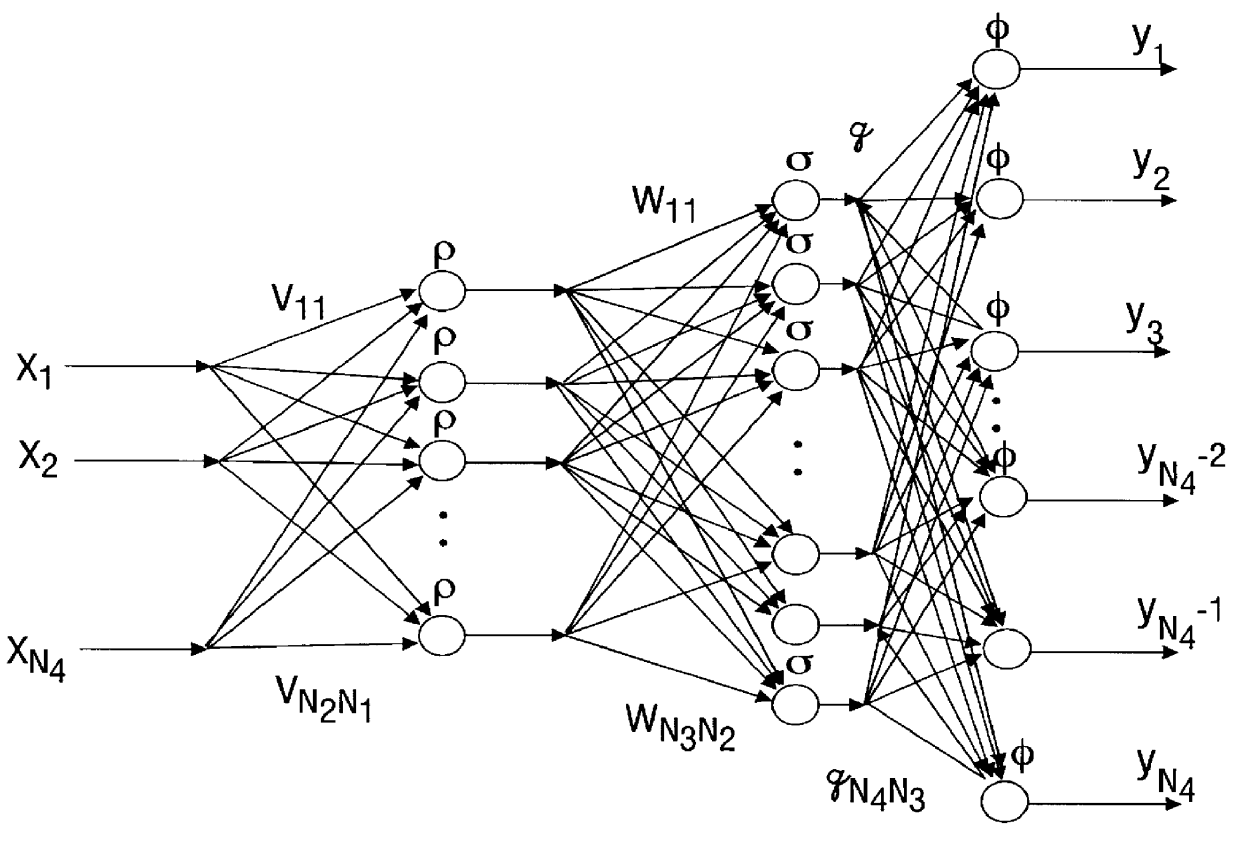
Given x.sub.k .epsilon.R, a three-layer neural network as shown in FIG. 1 has a net output ##EQU2## with .rho.(.), .sigma.(.) and .phi.(.) the activation fun...