

System for exchanging compressed data according to predetermined dictionary codes
a technology of compressed data and dictionary codes, applied in the field of communication systems, can solve the problems of slow downloading speed, computer users with access to the enterprise internet ("intranet"), and frustration with 28.8 kbps communication with another computer over a telephone lin
Inactive Publication Date: 2000-07-11
IBM CORP
View PDF14 Cites 70 Cited by
- Summary
- Abstract
- Description
- Claims
- Application Information
AI Technical Summary
Problems solved by technology
Although advances have been made, data exchange speed still remains a bottleneck in many cases.
Despite having purchased a speedy processor and large-capacity storage drive, for example, a computer user might still be frustrated with 28.8 Kbps communication with another computer over a telephone line.
In another example, a computer user with access to an enterprise internet ("Intranet") may experience slow downloading due to network loading by other computer users.
Accordingly, communications between two computers ("inter-computer" communications) can be one source of communications related frustration.
Another communication related delay concerns the electronic data exchange between components of one computing device ("intra-computer" communications).
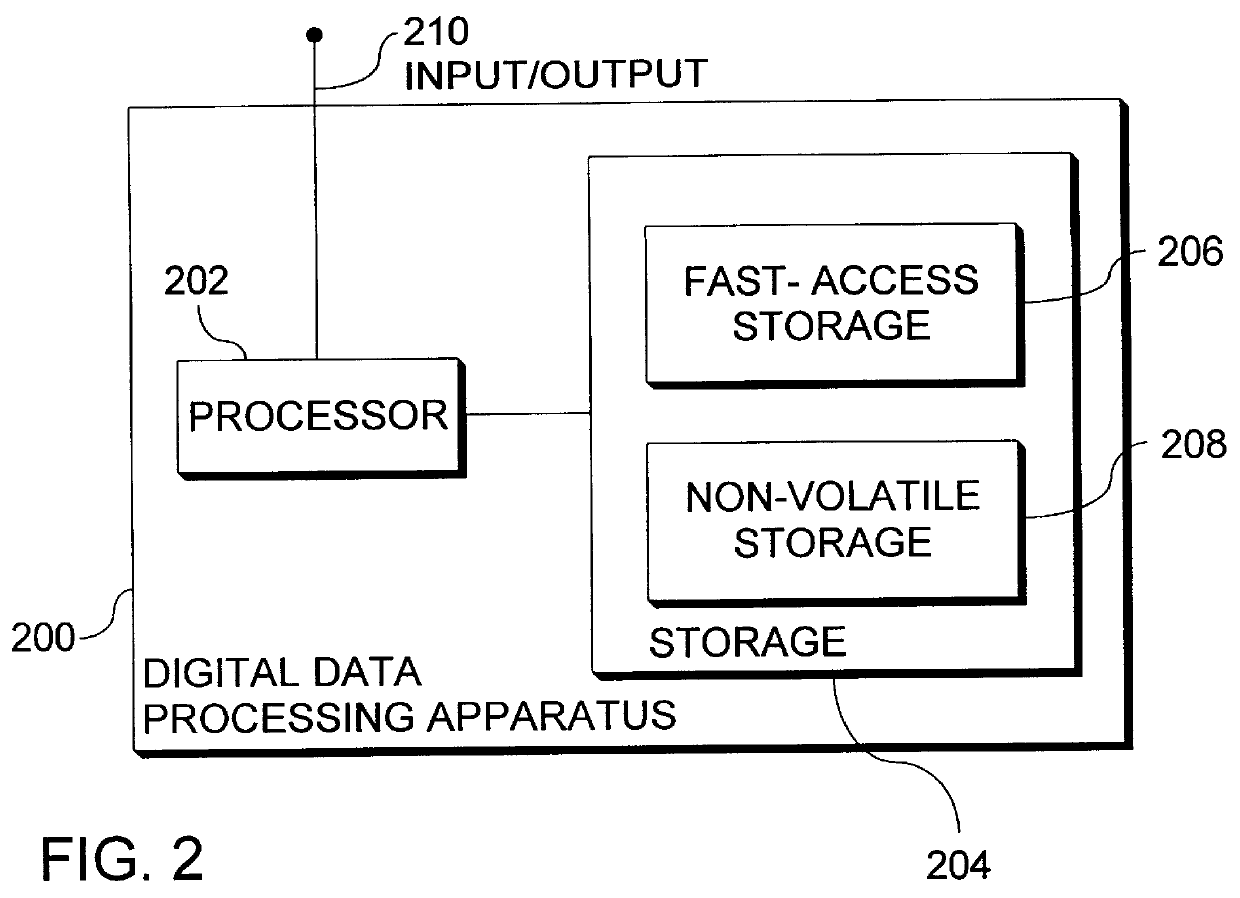
For example, it may be time consuming to read data from a relatively slow storage device such as a floppy diskette drive, or for a processor to retrieve data from nonvolatile storage such as tape.
Data exchange delays, then, can be a problem in both inter-computer and intra-computer communications.
The source of this problem may be the limitations of the communication link itself, such as the maximum baud rate of a telephone line.
In the intra-computer context, the source of data delays may be the data storage medium.
Caching recognizes that the exchange of data and program segments is frequently "redundant" because the same items are sent and received over and over again.
Although caching is beneficial for many applications, caching has several limitations.
First, there is a startup time penalty users pay to initially stage data from storage into the cache.
Moreover, this startup penalty is enhanced when the link between the cache and storage is noisy, busy, or otherwise slow.
Nonetheless, this technique is not well suited to the overall purpose of expediting communications, for several reasons.
First, although compressed data sets can be transmitted more quickly than their uncompressed counterparts, the compression process demands a considerable processing time and resources, thereby increasing the overall data exchange time.
Consequently, due to certain unsolved problems such as those described above, known electronic communication systems are not completely adequate for some applications.
Method used
the structure of the environmentally friendly knitted fabric provided by the present invention; figure 2 Flow chart of the yarn wrapping machine for environmentally friendly knitted fabrics and storage devices; image 3 Is the parameter map of the yarn covering machine
View moreImage
Smart Image Click on the blue labels to locate them in the text.
Smart ImageViewing Examples

Examples
Experimental program
Comparison scheme
Effect test
Embodiment Construction
While the foregoing disclosure shows a number of illustrative embodiments of the invention, it will be apparent to those skilled in the art that various changes and modifications can be made herein without departing from the scope of the invention as defined by the appended claims. Furthermore, although elements of the invention may be described or claimed in the singular, the plural is contemplated unless limitation to the singular is explicitly stated.
the structure of the environmentally friendly knitted fabric provided by the present invention; figure 2 Flow chart of the yarn wrapping machine for environmentally friendly knitted fabrics and storage devices; image 3 Is the parameter map of the yarn covering machine
Login to View More PUM
 Login to View More
 Abstract
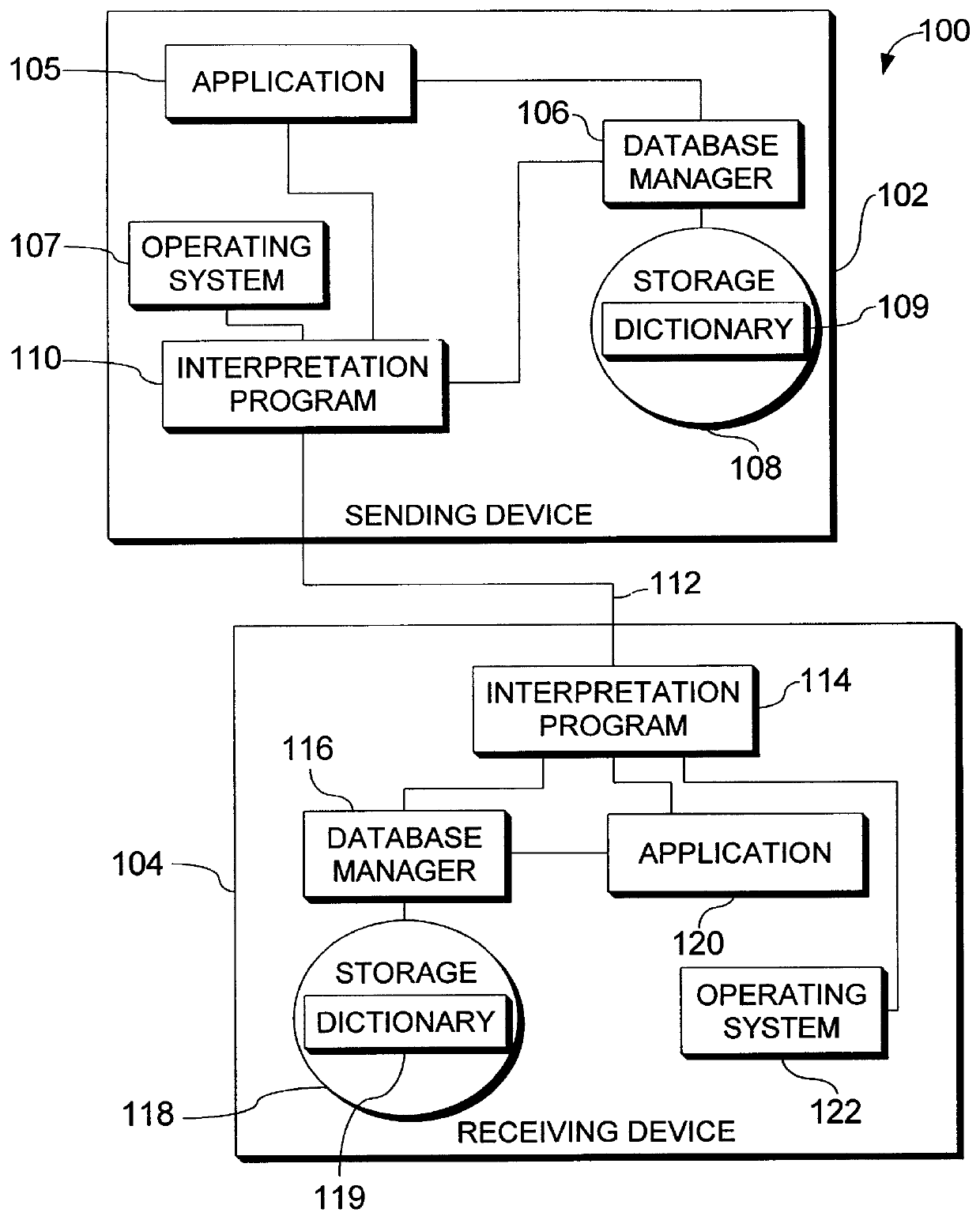
Messages containing non-dictionary and dictionary data objects are quickly exchanged between sending and receiving devices. Data stores of the devices contain a common dictionary cross-referencing each of multiple data objects with a different dictionary index code. Data objects in the dictionary are likely to be frequently exchanged. Prior to transmission of data objects, the sending device searches its dictionary for each data object. Each data object may include text, graphics, program segments, or another type of data object. If the data object appears in the dictionary, the sending device obtains its dictionary index code. Next, the sending device transmits a message representing the data objects to the receiving device. The message includes multiple subparts each corresponding to a different data object. If a data object is not present in the dictionary, its subpart comprises the content of the data object without any dictionary encoding. If a data object is represented in the dictionary, its subpart comprises the data object's index code from the dictionary. Flags included in the message distinguish between dictionary and non-dictionary subparts. The receiving device interprets received messages, reviewing flags in the message to determine which subparts comprise dictionary index codes. Each index code is cross-referenced in the receiving device's dictionary to obtain the unencoded data object, which is provided as an output. Each non-dictionary data object is provided as an output directly.
Description
1. Field of the InventionThe present invention relates to the exchange of electronically represented data between separate computers, or between subcomponents of one computer. More particularly, the invention concerns a communication system for exchanging data objects such as text, graphics, program segments, and the like according to a dictionary known in advance by both sending and receiving devices. After indexing the source data objects in the dictionary, the sending device transmits a message including dictionary index codes comprising encoded representations of objects found in the dictionary, along with non-dictionary data objects in unencoded form.2. Description of the Related ArtAlong with the rising capabilities of modern computers, there is a rising tide of electronic information to store, process, send, and receive. Engineers are squarely meeting the challenge of higher data storage requirements with magnetic hard drives, tape drives, and other data storage devices with ...
Claims
the structure of the environmentally friendly knitted fabric provided by the present invention; figure 2 Flow chart of the yarn wrapping machine for environmentally friendly knitted fabrics and storage devices; image 3 Is the parameter map of the yarn covering machine
Login to View More Application Information
Patent Timeline
 Login to View More
 IPC IPC(8): H03M7/30
CPCH03M7/30H03M7/3088Y10S707/99931Y10S707/99933
InventorGAMPPER, JAMES MICHAELWOLFE, DANIEL CHARLES
OwnerIBM CORP