Multi-sectional utility pole having slip-joint conical connections

a technology of conical connections and utility poles, applied in the field of sectional utility poles, can solve the problems of limited application of this technique, high manufacturing cost of this type of poles, and high labor cos

US6191355B1Inactive Publication Date: 2001-02-20EDELSTEIN HANS P
20 Cites 45 Cited by

Patent Information

Authority / Receiving Office
US · United States
Patent Type
Patents(United States)
Current Assignee / Owner
Publication Date
2001-02-20
Estimated Expiration
Not applicable · inactive patent

Smart Images

  • Figure 1
    Figure 1
  • Figure 2
    Figure 2
  • Figure 3
    Figure 3
Patent Text Reader

Abstract

A multi-sectional utility pole includes at least two sections of straight pipe, which are joined and connected by a slip joint connection. The slip joint preferably consists of two mating conical sections, with one attached to each section of the pole. The slip joint is compressed with the aid of rings, which are attached to the pipe, and a key and slot. The two conical sections are fastened together with bolts that pass through the female conical section and thread into the male conical section of the slip joint. The pole is easily assembled on the ground and the pole sections are fungible with other sections of the same diameter. The sections are also inexpensively manufactured. The conical sections can be swaged from the ends of the pipe, or can be fabricated separately and welded on to the ends of the pipe.
Need to check novelty before this filing date? Find Prior Art

Description

BACKGROUND OF THE INVENTION1. Field of the InventionThe invention broadly relates to the field of sectional utility poles, and more particularly relates to the field of inter-connections for securing the sections of such poles.2. Description of the Related ArtMulti-sectional utility poles are used for a variety of purposes such as highway luminaire supports and utility poles, e.g., telephone, cable and electrical. Poles of a given length are often designed in multiple sections to provide for an increased ease of transporting by truck, railroad, or even cargo plane. The length may also be restricted due to other field requirements. All such multi-section poles, however, must address the issues of joining each of the sections of pole to one another and appropriately securing the joints in the field during installation.One common method of making multi-section poles is to use tubular sections which are uniformly tapered along their entire length such that the top is narrower than the b...

Examples

Embodiment Construction

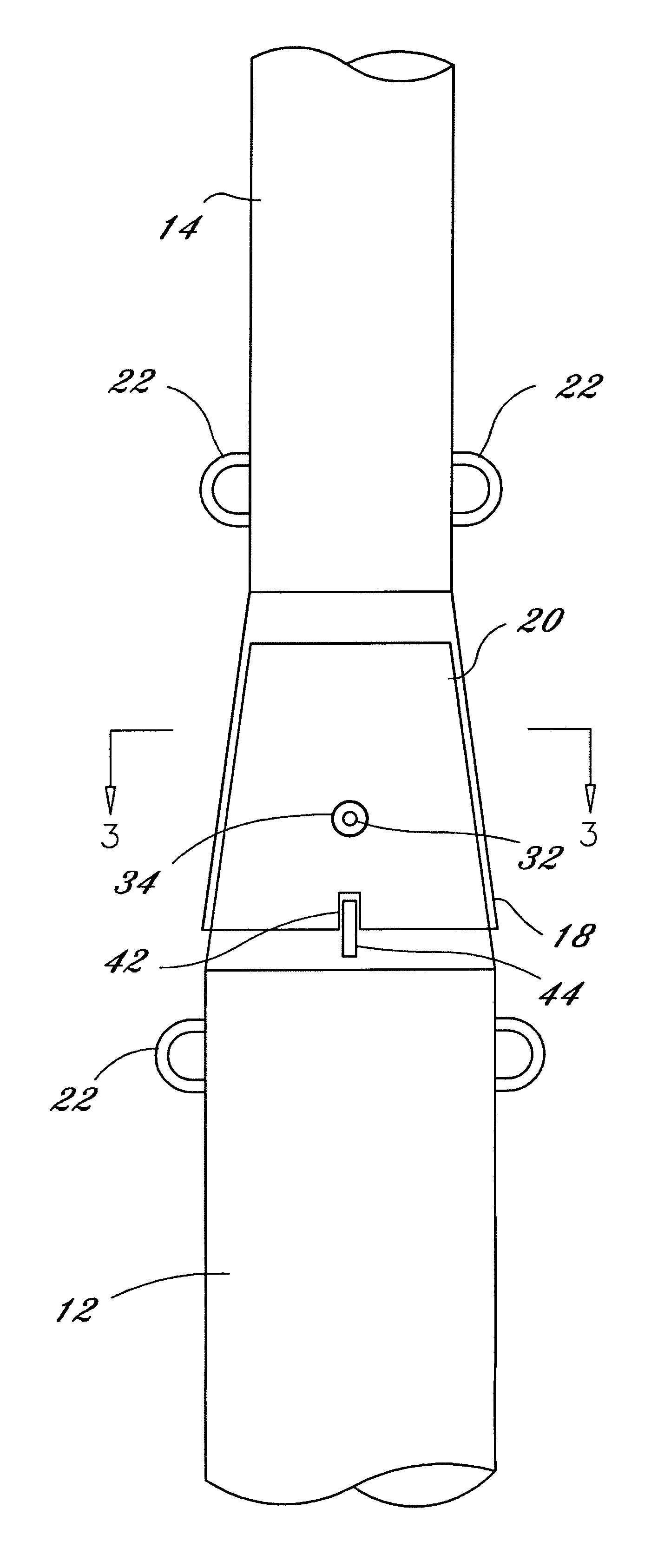
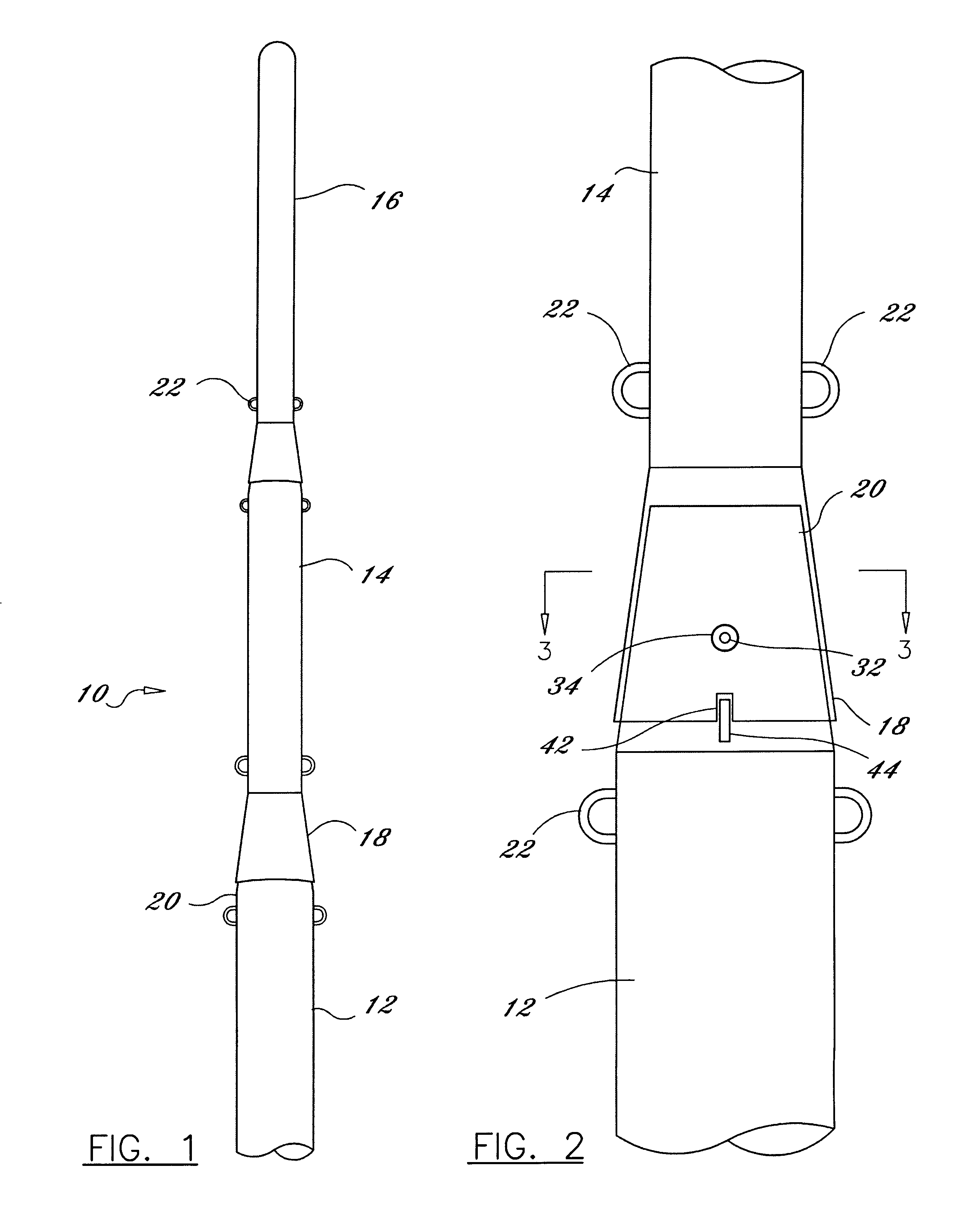
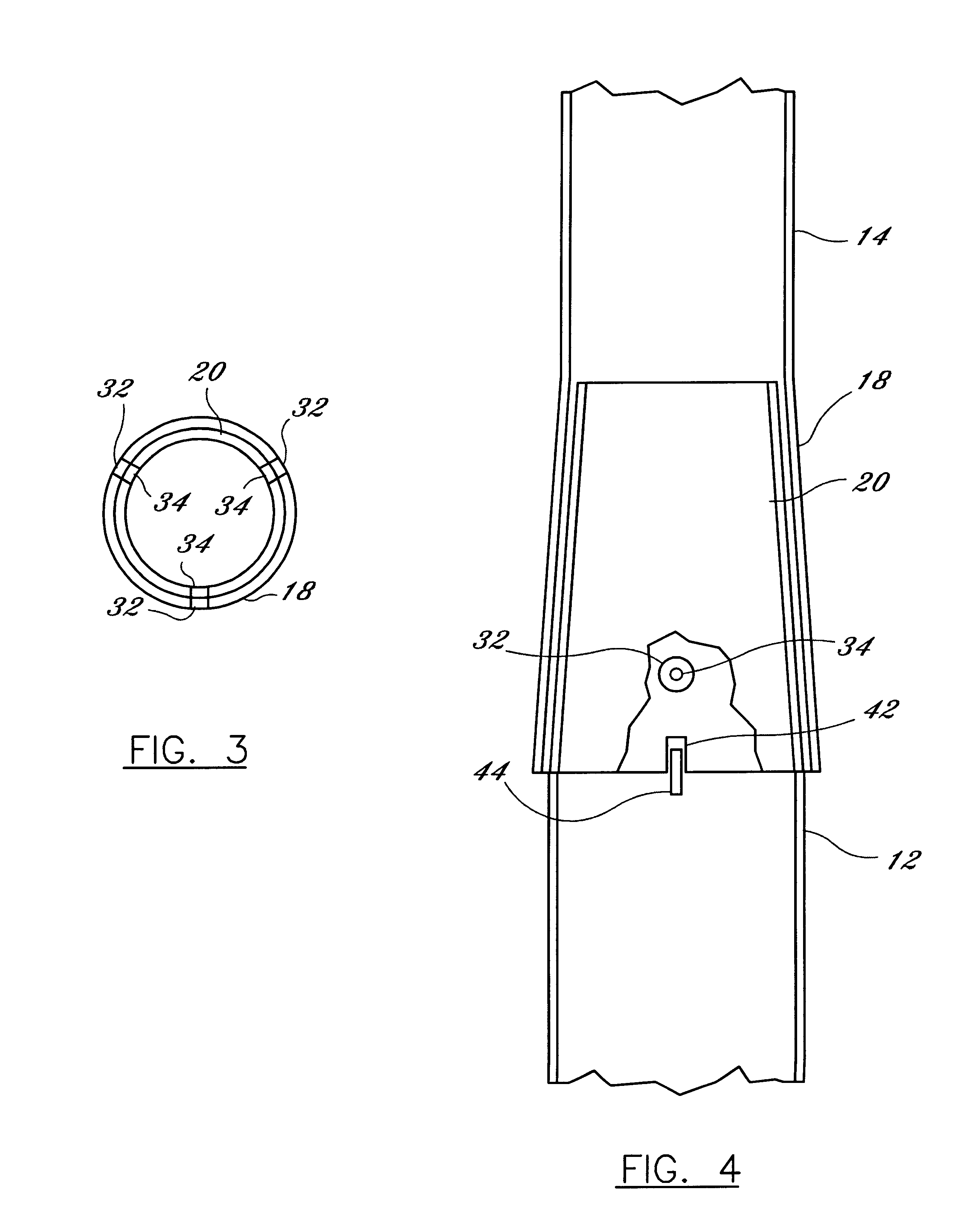
Referring to FIG. 1, according to the preferred embodiment, a pole 10 comprises three sections 12, 14, 16, which are not tapered uniformly. However, any number of sections are anticipated by the present invention. Each section 12, 14, 16 primarily consists of a straight section of pipe, which is not tapered at all. Each straight section of pipe, in this embodiment, has a narrower diameter than the one below it. At one or more ends of each section of pipe, there is a tapered portion 18, 20. At the bottom of each of the upper sections of the pole there is a female tapered portion, and at the top of each of the lower sections of the pole there is a male tapered portion.

These male and female tapered portions form a ferrule or slip joint. A slip joint is a friction fit wherein two sections of poles are slipped together, for example, with the female section being above the male section. Both sections have the same taper so that they will axially slide together a certain distance and then ...