

Endoscopic instrument which can be bent
- Summary
- Abstract
- Description
- Claims
- Application Information
AI Technical Summary
Benefits of technology
Problems solved by technology
Method used
Image

Examples
Embodiment Construction
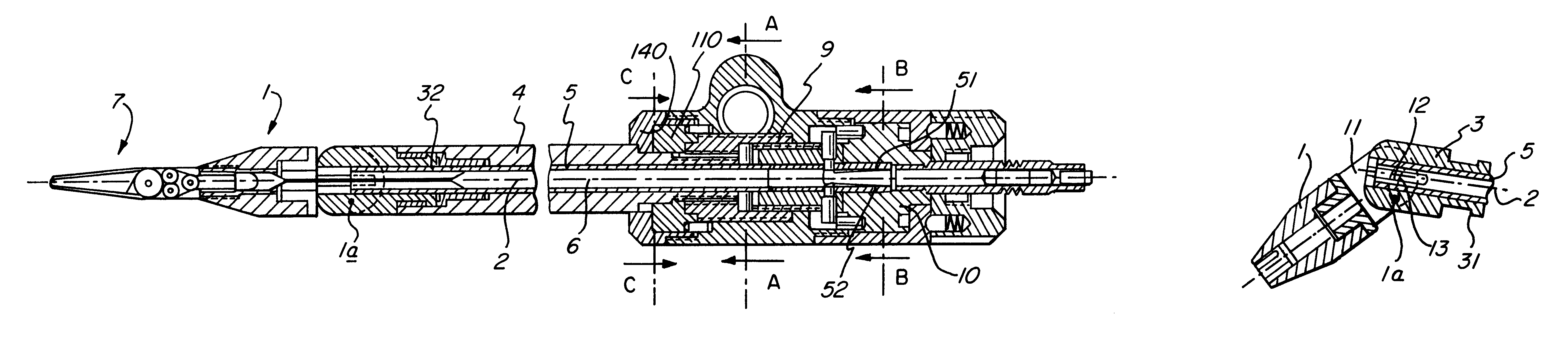
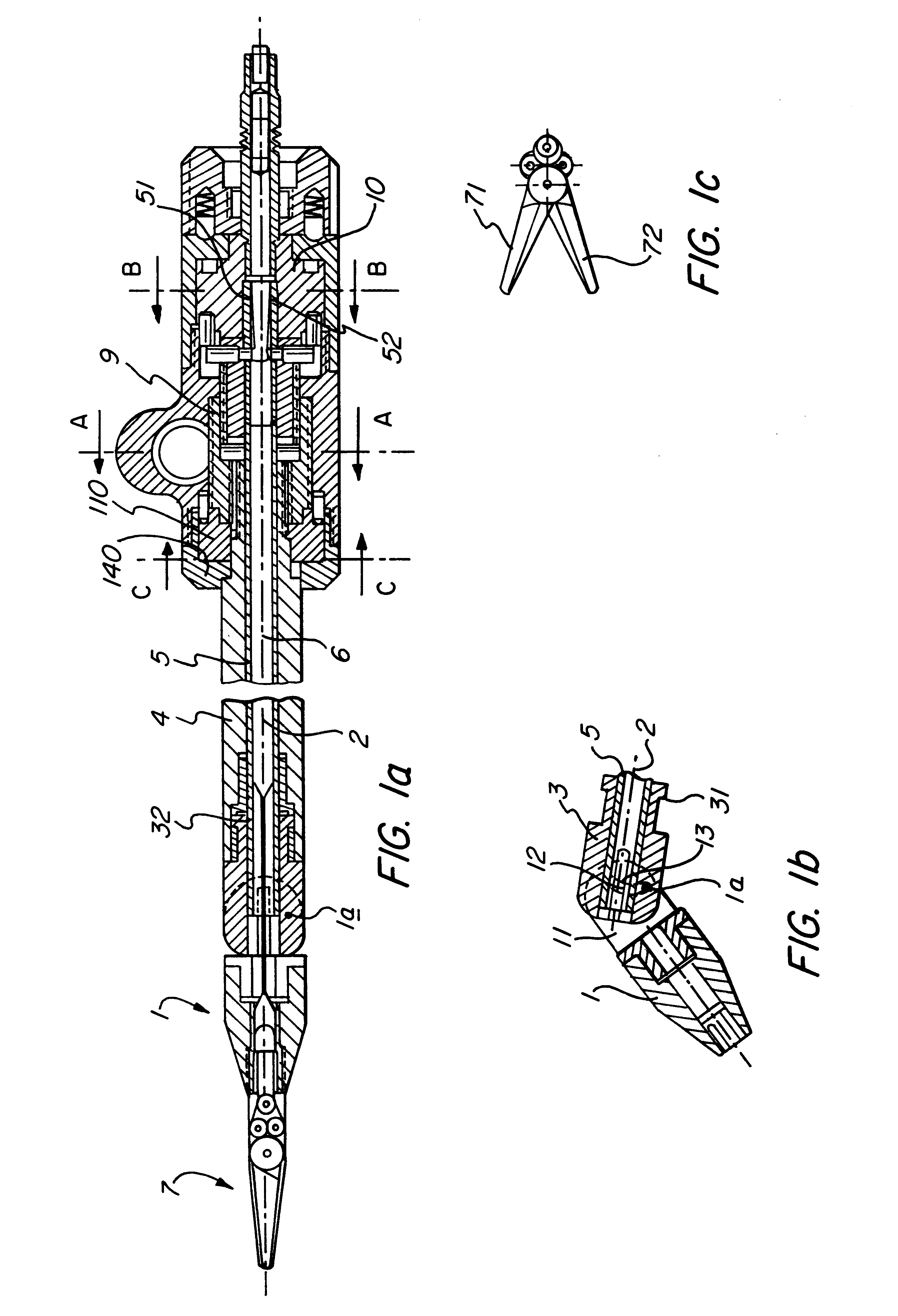
An endoscopic instrument illustrated in FIG. 1 includes coaxially positioned an external tube 4 and an internal hollow cylinder 5 which extend along a center axis 2. As will be explained in detail hereinbelow, opposite axial displacement of the tube and the cylinder causes the distal end 1 of the instrument to move axially and rotatably to bring an engaging element 7 in at least one angular position, as shown in FIG. 1b.
Particularly, the distal end 1 includes a pivoting element 11 formed with a curved groove 12 and a bayonet flange 31, which detachably engages a bayonet socket 32 of the external tube 4 for axial displacement therewith. Due to the bayonet connection, the bayonet flange 31 is axially aligned with the external tube and the cylinder 5 during their displacement.
In accordance with the invention, the bayonet flange 31 and the pivoting element 11 are rotatably interconnected by means of a pin 1a extending along a rotation axis which is spaced radially from the longitudinal ...
PUM
 Login to View More
 Abstract
Description
Claims
Application Information
 Login to View More