Check patentability & draft patents in minutes with Patsnap Eureka AI!

Method and system for exclusive two-level caching in a chip-multiprocessor

a chip-multiprocessor and memory system technology, applied in the field of microprocessor design, can solve the problems of large memory stall, lack of instruction-level parallelism, poor performance of commercial workloads in traditional high-end microprocessors, and nearly half of the cache capacity can be wasted with duplicate copies of data, so as to maximize the use of the cache memory capacity of the chip, minimize data replication and on-chip data traffic, and increase the effect of second level hit latency or occupancy

Inactive Publication Date: 2005-06-28
SK HYNIX INC
View PDF15 Cites 4 Cited by
  • Summary
  • Abstract
  • Description
  • Claims
  • Application Information

AI Technical Summary

Benefits of technology

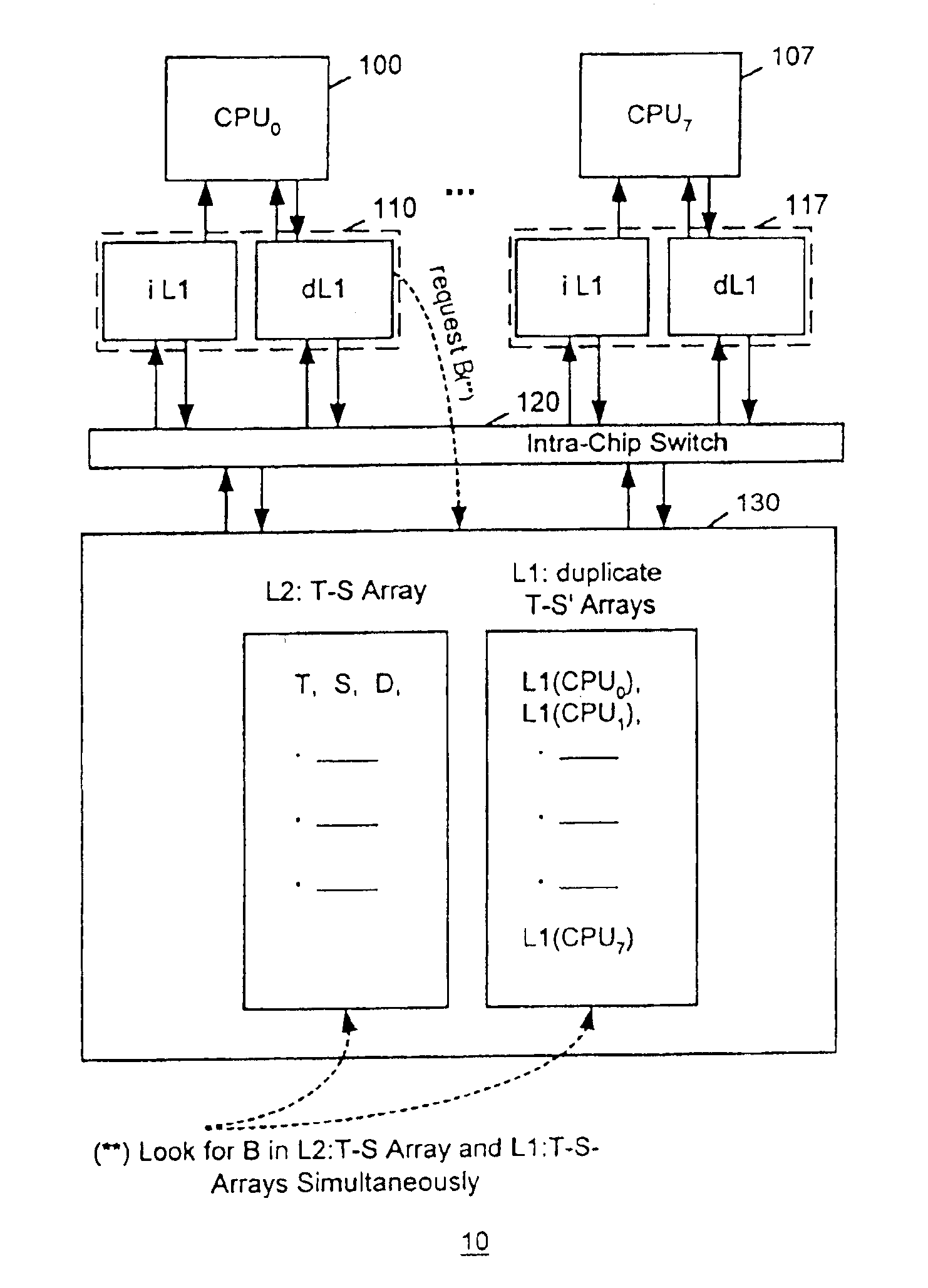
[0011]Hence, in accordance with the purpose of the invention, as embodied and broadly described herein, the invention relates to chip multiprocessors (CMP) design. In particular, the present invention provides a system and method that maximizes the use of on-chip cache memory capacity in CMP systems. The system and method are realized with a combination of features. One such feature is a relaxed subset property (inclusion) requirement. This property forms an exclusive cache hierarchy in order to minimize data replication and on-chip data traffic without incurring an increased second level hit latency or occupancy. Another aspect of the combination involves maintaining in the second-level cache a duplicate tag-state structure of all (per-CPU) first-level caches in order to allow a substantially simultaneous lookup for data in the first-level and second-level tag-state arrays.
[0012]An additional aspect involves extending the state information to include ownership indication in addition to the data validity / existence indication and data shared / exclusive indication. The ownership aspect lives in the exclusive two-level cache hierarchy and helps orchestrate write-backs to the second-level cache (i.e., L2 fills). Another aspect involves associating a single owner with each cache line in order to eliminate redundant write-backs of evicted data to the second-level cache. Namely, at any given time in the lifetime of a cache line in the CMP chip, only one of its copies can be the owner copy.

Problems solved by technology

Data-dependent computations, lack of instruction-level parallelism and large memory stalls contribute to the poor performance of commercial workloads in traditional high-end microprocessors.
When this ratio approaches 1.0, nearly half of the on-chip cache capacity can be wasted with duplicate copies of data.
But, even with exclusive two-level caching, there are performance issues to be addressed in CMP design.

Method used

the structure of the environmentally friendly knitted fabric provided by the present invention; figure 2 Flow chart of the yarn wrapping machine for environmentally friendly knitted fabrics and storage devices; image 3 Is the parameter map of the yarn covering machine
View more

Image

Smart Image Click on the blue labels to locate them in the text.
Viewing Examples
Smart Image
  • Method and system for exclusive two-level caching in a chip-multiprocessor
  • Method and system for exclusive two-level caching in a chip-multiprocessor
  • Method and system for exclusive two-level caching in a chip-multiprocessor

Examples

Experimental program
Comparison scheme
Effect test

Embodiment Construction

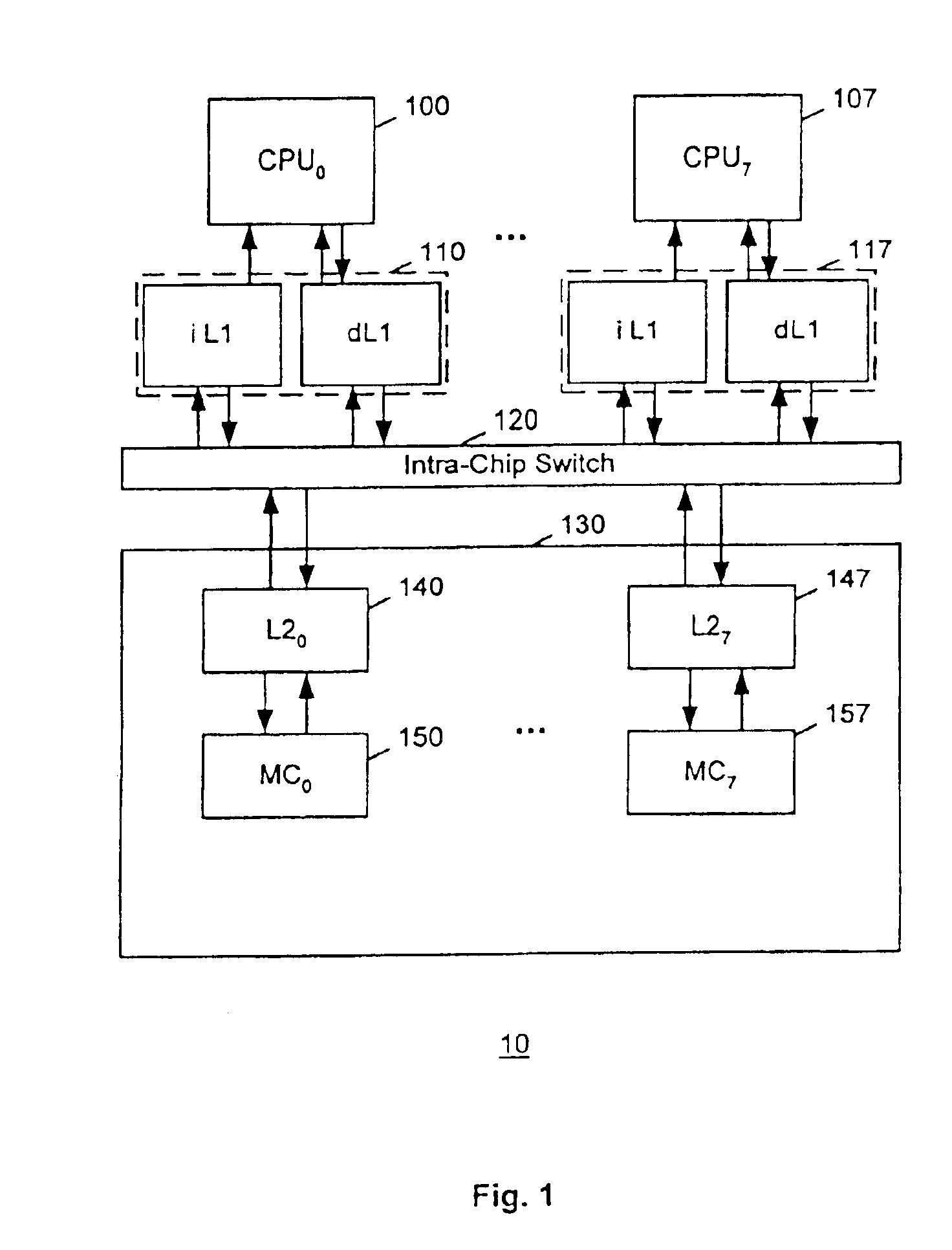
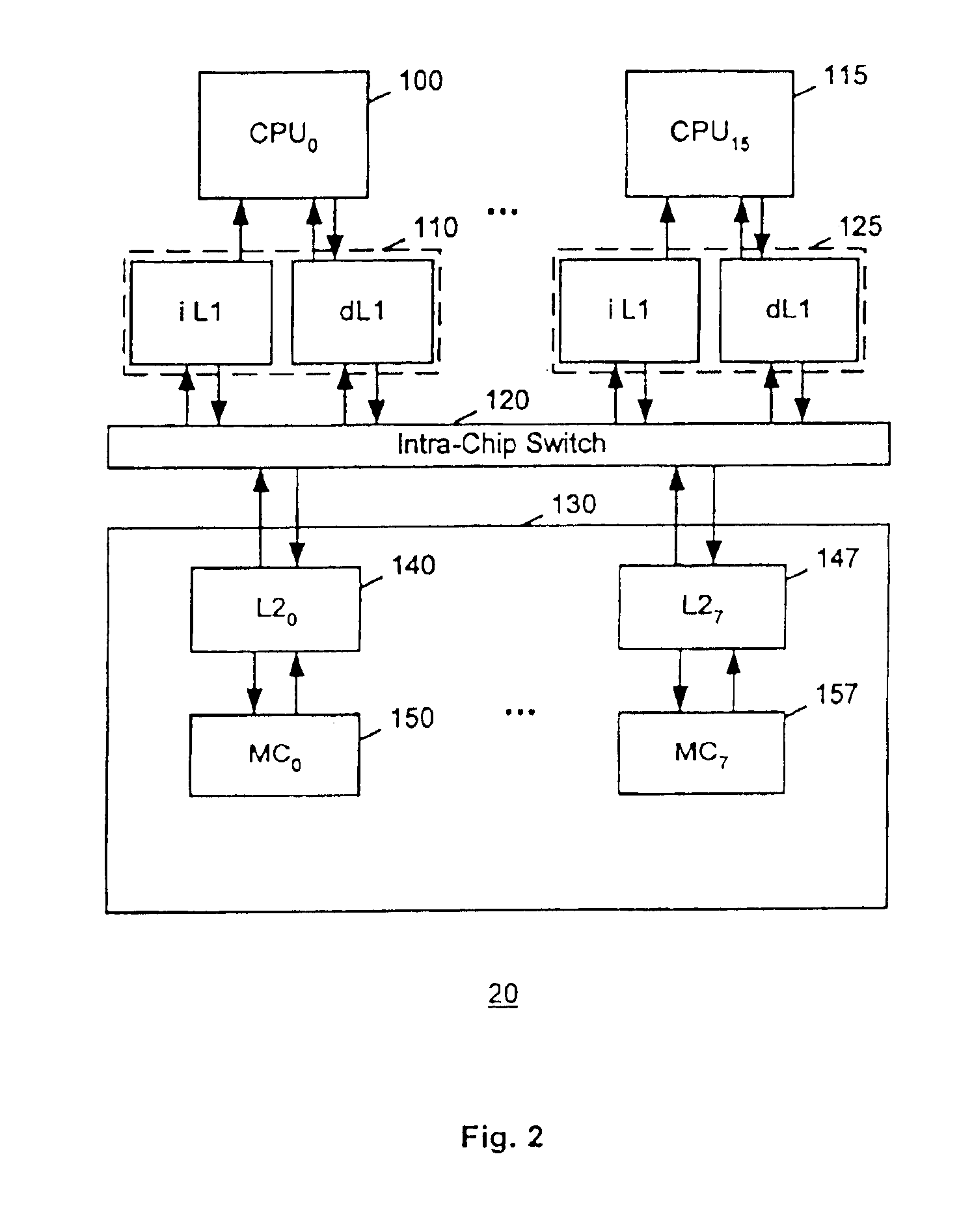
[0022]The present invention is directed to cache memory systems in microprocessors and more specifically, to a system and method for maximizing the effective use of cache memory systems within multiprocessing systems. As a functional and architectural strategy, the invention contemplates a chip multiprocessors (CMP) design that maximizes the effective use of on-chip cache memory capacity, and consequently improves overall memory system performance. In broad terms, this strategy is realized by: 1) relaxing the subset property (inclusion) requirement, thereby forming an exclusive cache hierarchy, in order to minimize data replication and on-chip data traffic without incurring increased second-level hit latency or occupancy; 2) maintaining in the second-level cache a duplicate tag-state structure of all first-level caches in order to allow a simultaneous lookup for data in the first-level and second-level tag-state arrays; 3) extending the state information to include an ownership indi...

the structure of the environmentally friendly knitted fabric provided by the present invention; figure 2 Flow chart of the yarn wrapping machine for environmentally friendly knitted fabrics and storage devices; image 3 Is the parameter map of the yarn covering machine
Login to View More

PUM

No PUM Login to View More

Abstract

To maximize the effective use of on-chip cache, a method and system for exclusive two-level caching in a chip-multiprocessor are provided. The exclusive two-level caching in accordance with the present invention involves method relaxing the inclusion requirement in a two-level cache system in order to form an exclusive cache hierarchy. Additionally, the exclusive two-level caching involves providing a first-level tag-state structure in a first-level cache of the two-level cache system. The first tag-state structure has state information. The exclusive two-level caching also involves maintaining in a second-level cache of the two-level cache system a duplicate of the first-level tag-state structure and extending the state information in the duplicate of the first tag-state structure, but not in the first-level tag-state structure itself, to include an owner indication. The exclusive two-level caching further involves providing in the second-level cache a second tag-state structure so that a simultaneous lookup at the duplicate of the first tag-state structure and the second tag-state structure is possible. Moreover, the exclusive two-level caching involves associating a single owner with a cache line at any given time of its lifetime in the chip-multiprocessor.

Description

REFERENCE TO RELATED APPLICATION[0001]This application is a divisional application of U.S. patent application Ser. No. 09 / 877,530, which was filed on Jun. 8, 2001 now U.S. Pat No. 6,725,334, by L. A. Barroso et al., entitled “Method and System For Exclusive Two-Level Caching in a Chip Multiprocessor.” This application is related to and incorporates herein by reference U.S. Pat. No. 6,668,308, which issued on Dec. 23, 2003, by L. A. Barroso et al., entitled “A Scalable Architecture Based on Single-Chip Multiprocessing.”REFERENCE TO PRIOR APPLICATION[0002]This application claims the benefit of and incorporates herein by reference U.S. Provisional Application No. 60 / 210,655 filed Jun. 9, 2000 and U.S. Provisional Application No. 60 / 210,675 filed Jun. 10, 2000.BACKGROUND OF THE INVENTION[0003]1. Field of the Invention[0004]This application relates to microprocessor design and, specifically, to cache memory systems in microprocessors.[0005]2. Background Art[0006]The performance of applic...

Claims

the structure of the environmentally friendly knitted fabric provided by the present invention; figure 2 Flow chart of the yarn wrapping machine for environmentally friendly knitted fabrics and storage devices; image 3 Is the parameter map of the yarn covering machine
Login to View More

Application Information

Patent Timeline
no application Login to View More
IPC IPC(8): G06F12/08
CPCG06F12/0811G06F12/0826G06F2212/621
Inventor BARROSO, LUIZ ANDREGHARACHORLOO, KOUROSHNOWATZYK, ANDREAS
Owner SK HYNIX INC
Features
  • R&D
  • Intellectual Property
  • Life Sciences
  • Materials
  • Tech Scout
Why Patsnap Eureka
  • Unparalleled Data Quality
  • Higher Quality Content
  • 60% Fewer Hallucinations
Social media
Patsnap Eureka Blog
Learn More