Image processing method and image processing apparatus
a technology of image processing which is applied in the field of image processing method and image processing apparatus, can solve the problems of inability to reproduce high-quality images even by applying, and the copying machine for outputting images of a variety of digital cameras is incapable of obtaining print images, so as to reduce the calculation time for obtaining characteristic values, reduce the defect of images, and increase the exposure of digital cameras.
- Summary
- Abstract
- Description
- Claims
- Application Information
AI Technical Summary
Benefits of technology
Problems solved by technology
Method used
Image



Examples
first embodiment
[0066]Note that the calculation of the weighted mean value M in the first embodiment is not limited to what has been described so far, and may be done such as setting the weight coefficients in color coordinates with axes b-r and r-g or in color coordinates with axes b-r and g-b, or setting the color coordinates based on saturation signals and hue signals into which the RGB image signals are classified. Further, the weight coefficient described above may be weight a coefficient proportional to a distance from the origin of the color coordinates or from a desired color temperature trajectory (see FIG. 2) set on the color coordinates. Moreover, taking lightness of the RGB image signal into consideration, the weight coefficient maybe set smaller as the lightness becomes higher.
[0067]In addition, the weight coefficient may be changed in correspondence with the subject or a scene. Take a sunset scene for example, photographers do not, it seems, want to modify the sunset portion in the pi...
third embodiment
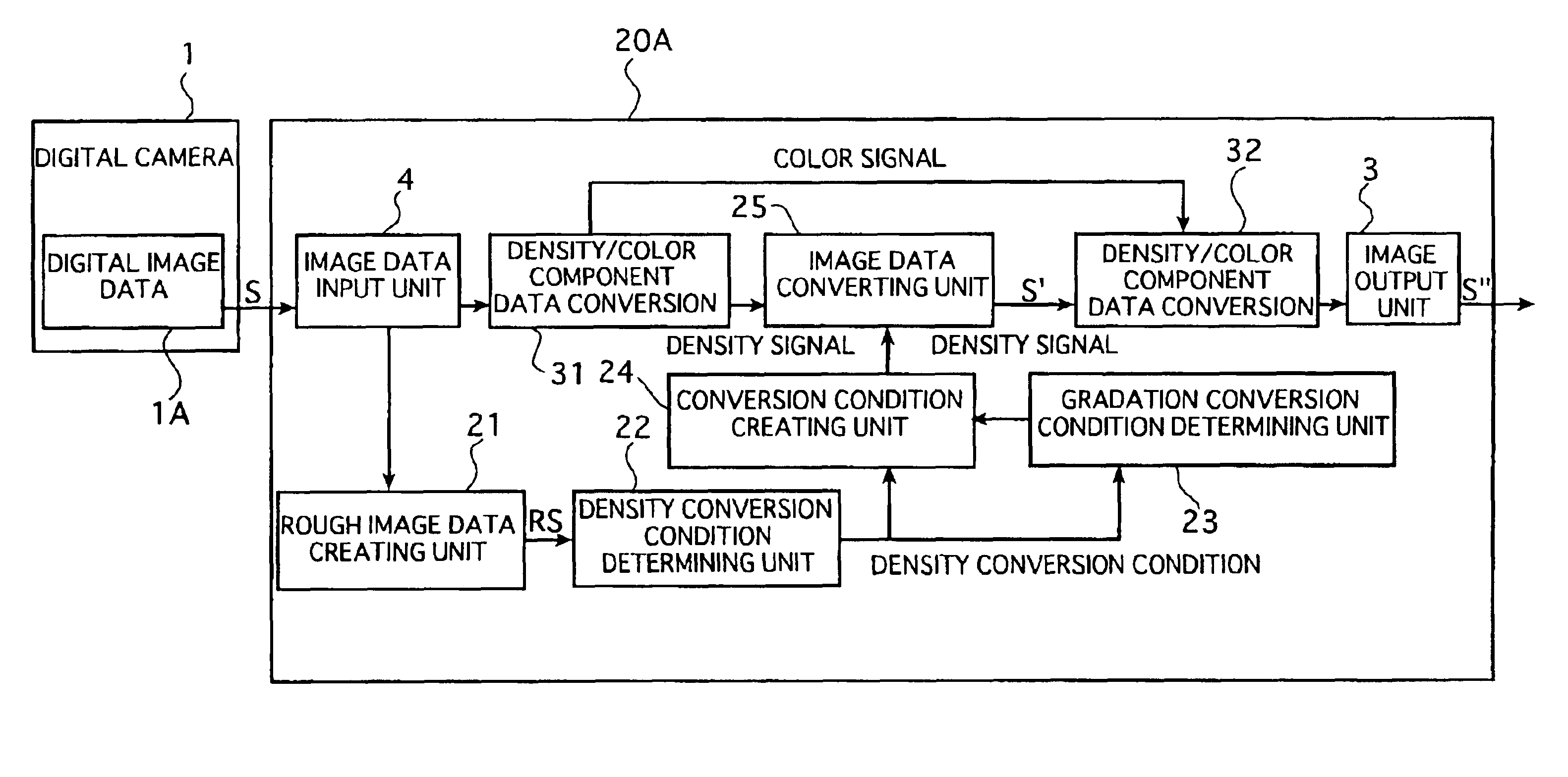
[0109]FIG. 10 is a block diagram illustrating the image processing apparatus in the present invention. Referring to FIG. 10, there are shown the digital camera 1, an image processing apparatus 20, and the input unit (means) 4 for reading the digital image data S from the recording medium 1A.
[0110]Further, a rough image data creating unit (means) 21 creates rough image data RS by thinning out the pixels of the digital image data S. A density conversion condition determining unit (means) 22 determines a condition for increasing or decreasing a density of a print image from the image expressed by the digital image data S. A gradation conversion condition determining unit (means) 23 controls gradations (particularly, a gradation of the highlight area) on the basis of the density conversion conditions (e.g., the modification value C used in common to the image data R, G and B, and the conversion conditions shown in FIG. 4 in the first embodiment) determined by the above density conversio...
fourth embodiment
[0137]That is, the image data is converted into the density component data and the color component data, and the density correction and the gradation correction based on this density correction, are executed upon the density component data. Thereafter, these two items of data are synthesized. With this contrivance, no color change of the print can be seen before and after the modification even by having modified the density and the gradation.
[0138]The method of converting the image data of the digital camera into the density component data and the color component data, may involve the use of a known method. Instead of the density component data, there may be used luminance component data (Y=0.30R+0.59G+0.11B) and data (L* and Y) converted into lightness in terms of a color science.
[0139]It should be noted that the density (luminance) component data and the lightness component data can be equally treated. Further, saturations and hues in terms of the color science such as R-G, B-G a...
PUM
 Login to View More
 Abstract
Description
Claims
Application Information
 Login to View More